
GameStop 10-K Analysis (2026): $9 Billion in Cash and a CEO Who Has to Spend It

By Chad Hartman
Published March 31, 2026 · Last updated June 14, 2026
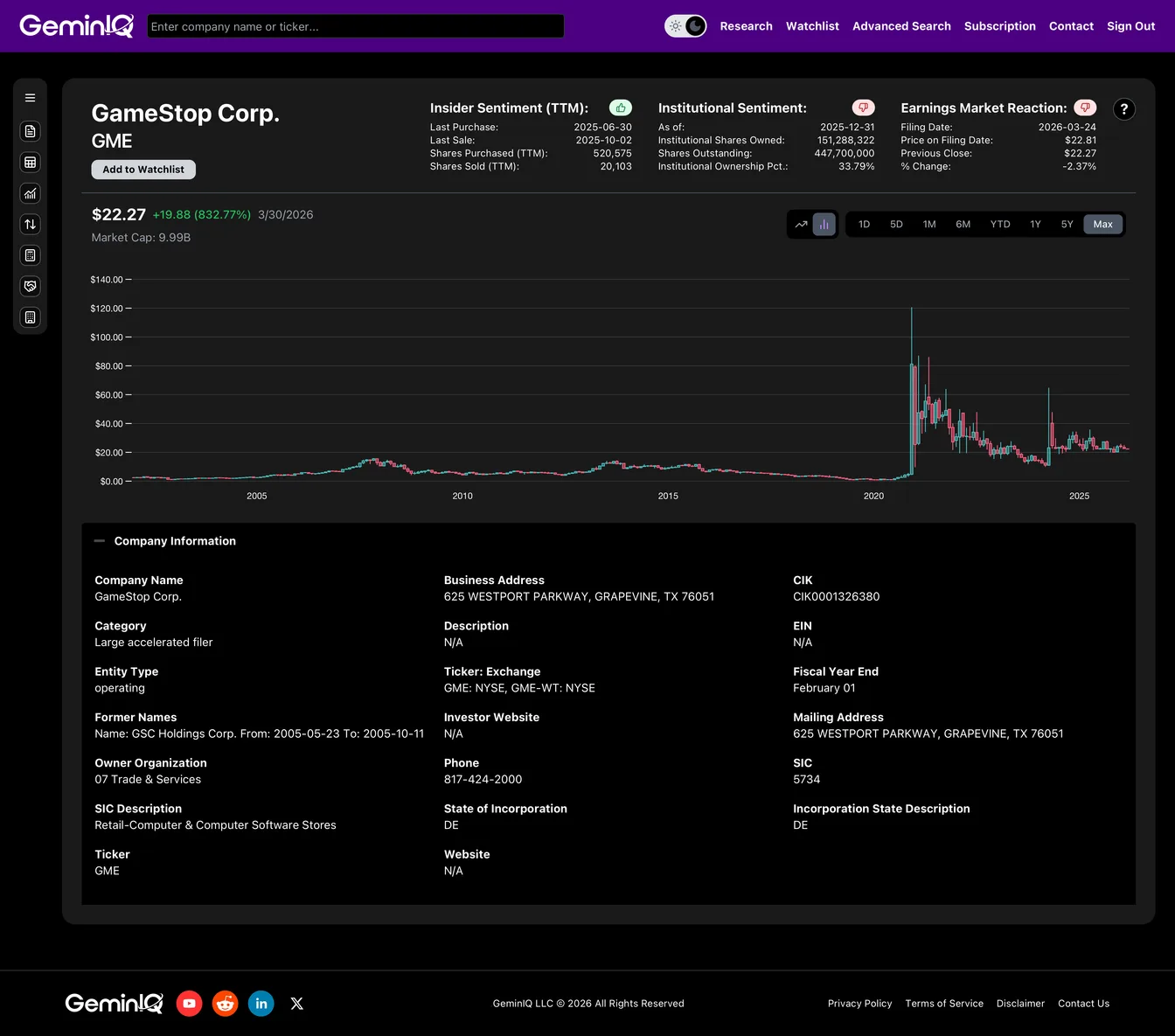
GameStop Corp. ($GME) just dropped its 2025 Annual Report (10-K filed March 24, 2026), alongside a flurry of proxy and compensation filings. Every time this company reports earnings, the financial media hyper-focuses on declining physical software sales and mock the company as a dying brick-and-mortar dinosaur kept on life support by internet memes and retail nostalgia.
But standard financial media doesn't read the footnotes. I used GeminIQ to audit the raw SEC data—cross-referencing their 10-K, Cash Flow Statements, Insider Form 4s, and Institutional Holdings. The real story is that GameStop is no longer a video game retailer. It is a heavily armed, institutional holding company actively hunting for a massive acquisition. Here is the fundamental, data-driven truth behind the ticker.
The $9 Billion War Chest (A Capital-Raising Masterclass)
Wall Street views GameStop's historical stock volatility as a bug; GameStop management viewed it as a feature. While the media was laughing at the stock's wild swings, management quietly used the retail trading frenzy as a live testing ground. They aggressively tested and perfected every mechanism of capital raising, executing At-The-Market (ATM) share offerings at massive premiums, utilizing convertibles, and mastering warrant structures.
The Data: Look at their Balance Sheet over the last five years. They completely wiped out their legacy, high-interest brick-and-mortar debt. By utilizing their perfected capital-raising mechanics, they have amassed an absolutely staggering war chest. Sitting on the books at the end of FY 2025 is $6.3 Billion in Cash and Cash Equivalents, alongside $2.7 Billion in Marketable Securities.
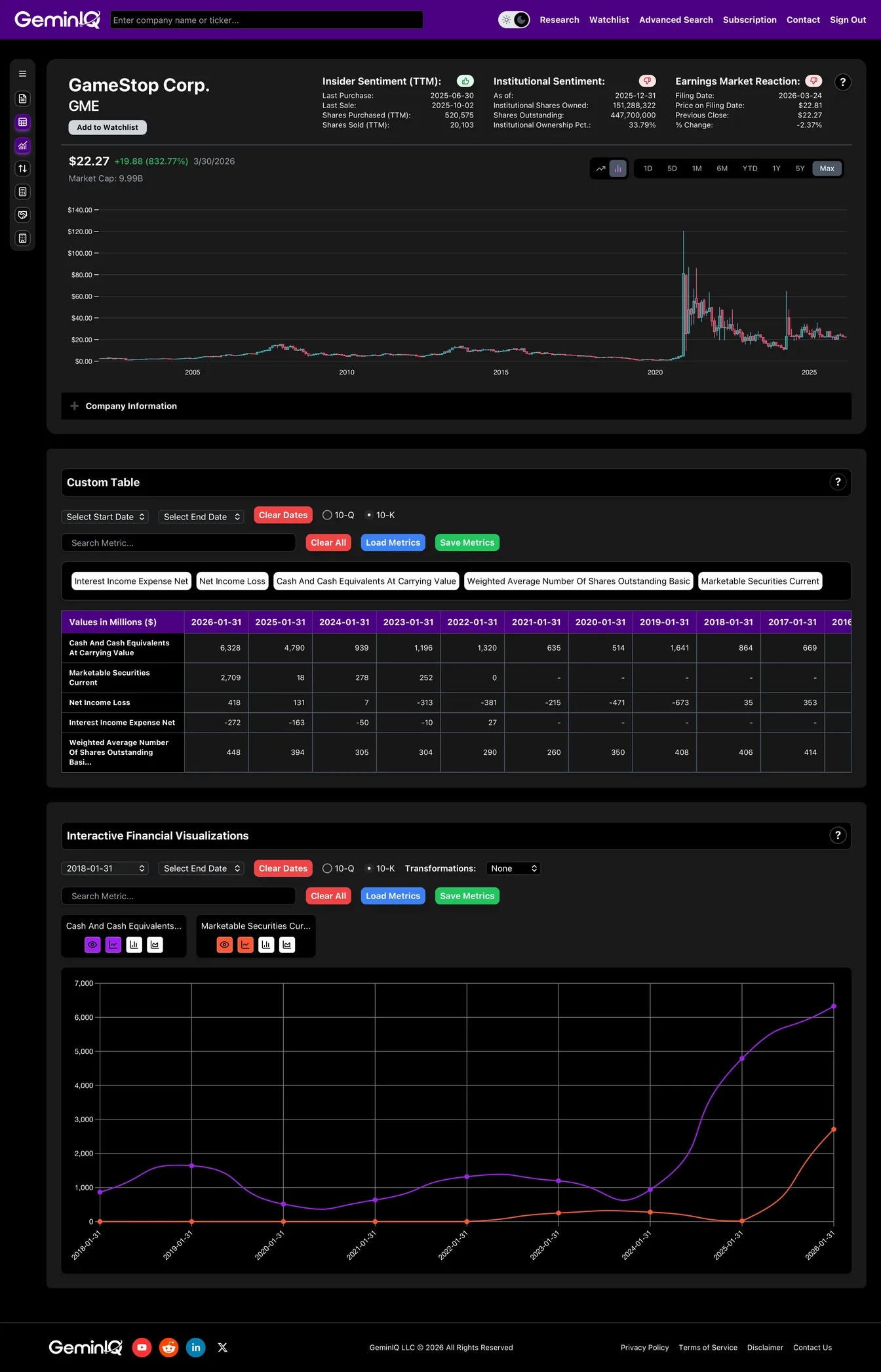
The GeminIQ Edge: Standard screeners blend everything into a negative "GAAP Net Income," completely obscuring this structural pivot. By pulling the raw balance sheet via GeminIQ, you can see the ultimate divergence. GameStop is effectively a $9 Billion SPAC (Special Purpose Acquisition Company). They are earning hundreds of millions in pure interest just sitting on Treasury bills while they prepare to deploy their capital. And because they've perfected the art of the offering, they have the proven mechanics to raise even more cash instantly if a mega-acquisition requires it.
The "Convenience" Pivot (Funding the Wait)
But what about the core business? In their recent 10-K, GameStop management openly acknowledges a harsh truth: modern gamers prefer digital downloads. They aren't in denial. However, the 10-K explicitly outlines their pivot to "convenience", and they don't mean digital games.

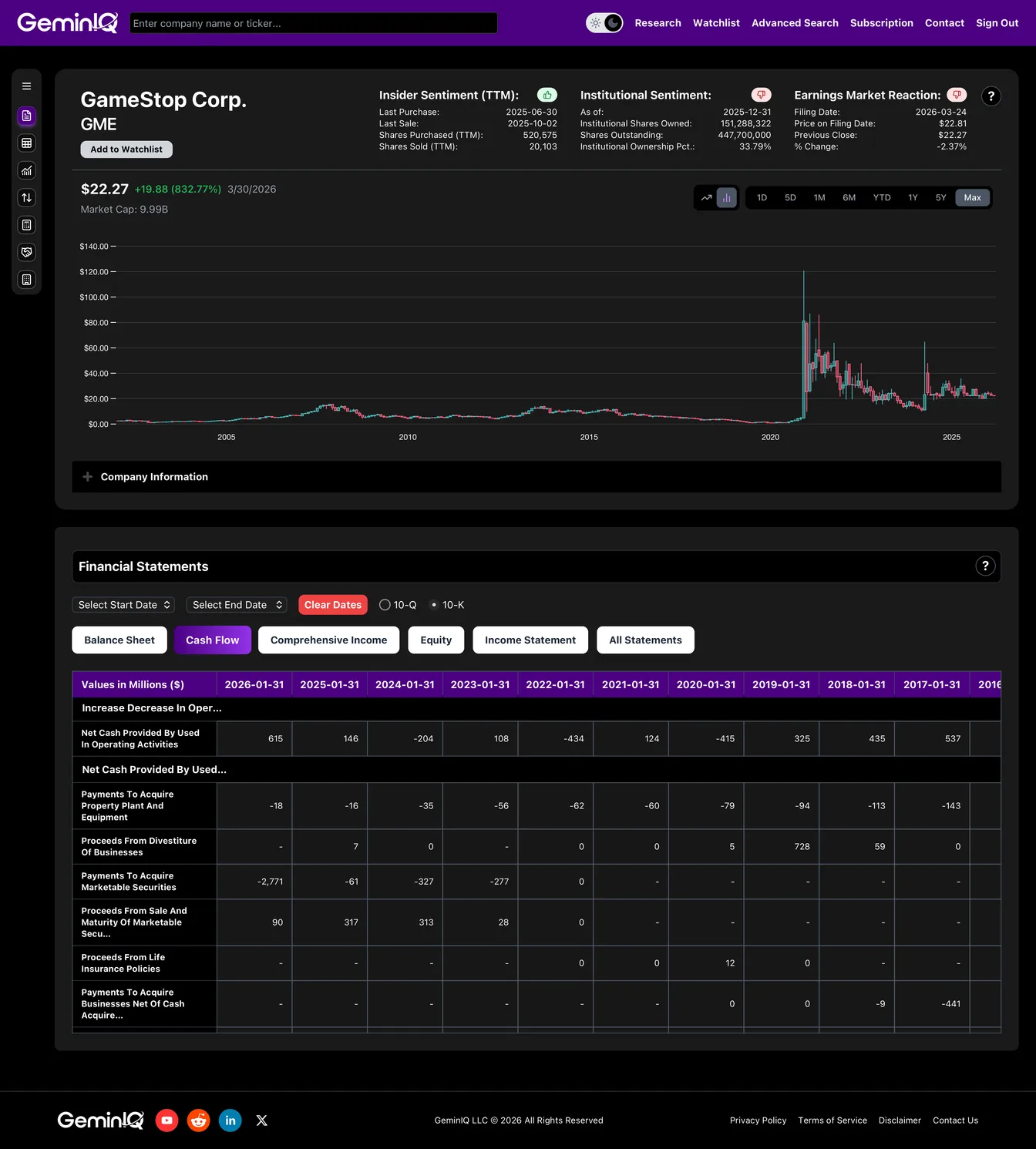
They have confirmed their thesis that customers want high-margin physical convenience in the form of collectibles, trading cards, and professional grading services (like their massive push into PSA card grading). This isn't meant to be the next Amazon; this physical footprint is meant to be their "textile mill." Just as Warren Buffett used the baseline cash flow of a dying textile mill to fund Berkshire Hathaway's early investments, GameStop is using high-margin trading cards to generate $614.8 Million in Operating Cash Flow to keep the lights on while the holding company hunts for the whale.
The "Berkshire 2.0" Catalyst (Cohen's Milestones)
Having $9 Billion in the bank is useless without a visionary capital allocator. This is where the narrative shifts from a retail trade to a serious, institutional value play.
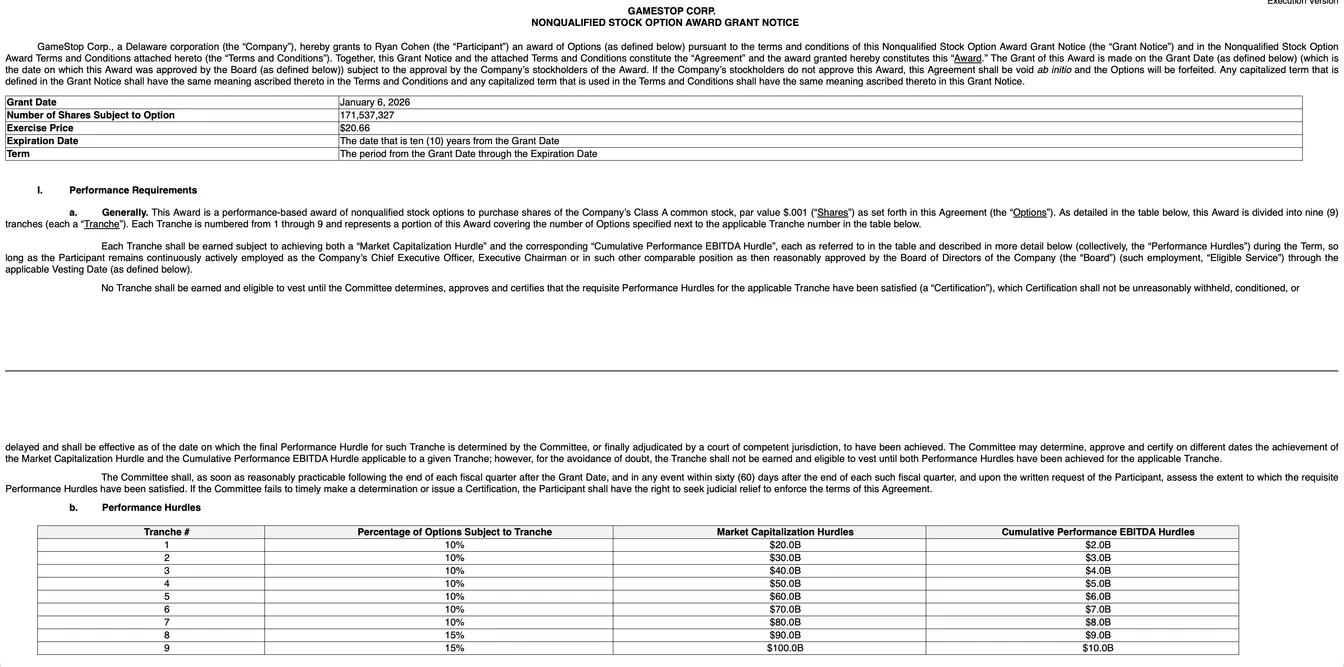
The Context: For years, CEO Ryan Cohen refused a standard salary, taking exactly $0 in compensation. Now, look at his newly filed compensation package. His proposed financial incentive structure is entirely tied to aggressive, performance-based milestones. He doesn't get a massive base salary just to manage a declining retail footprint. He only unlocks his equity payouts by executing highly accretive acquisitions and transforming the business model. He is structurally, legally, and financially forced to act as a capital allocator.
This pivot is so significant that "Big Short" legend Michael Burry, who famously held a massive early stake in GME, has publicly validated the strategy. Wall Street is increasingly comparing GameStop's current state to Warren Buffett's early days.
Decoding the Volatility (The Heat Map)
Standard value investors are horrified by GameStop's stock chart, viewing the constant double-digit price swings as dangerous mania. Retail traders panic during post-earnings drops.
But institutions and insiders know the truth: GameStop doesn't trade on its earnings anymore. Traditional valuation models like Price-to-Earnings (P/E) are useless for an entity that is functionally a SPAC. The volatility is not a risk; it is just the engine they use to raise capital.
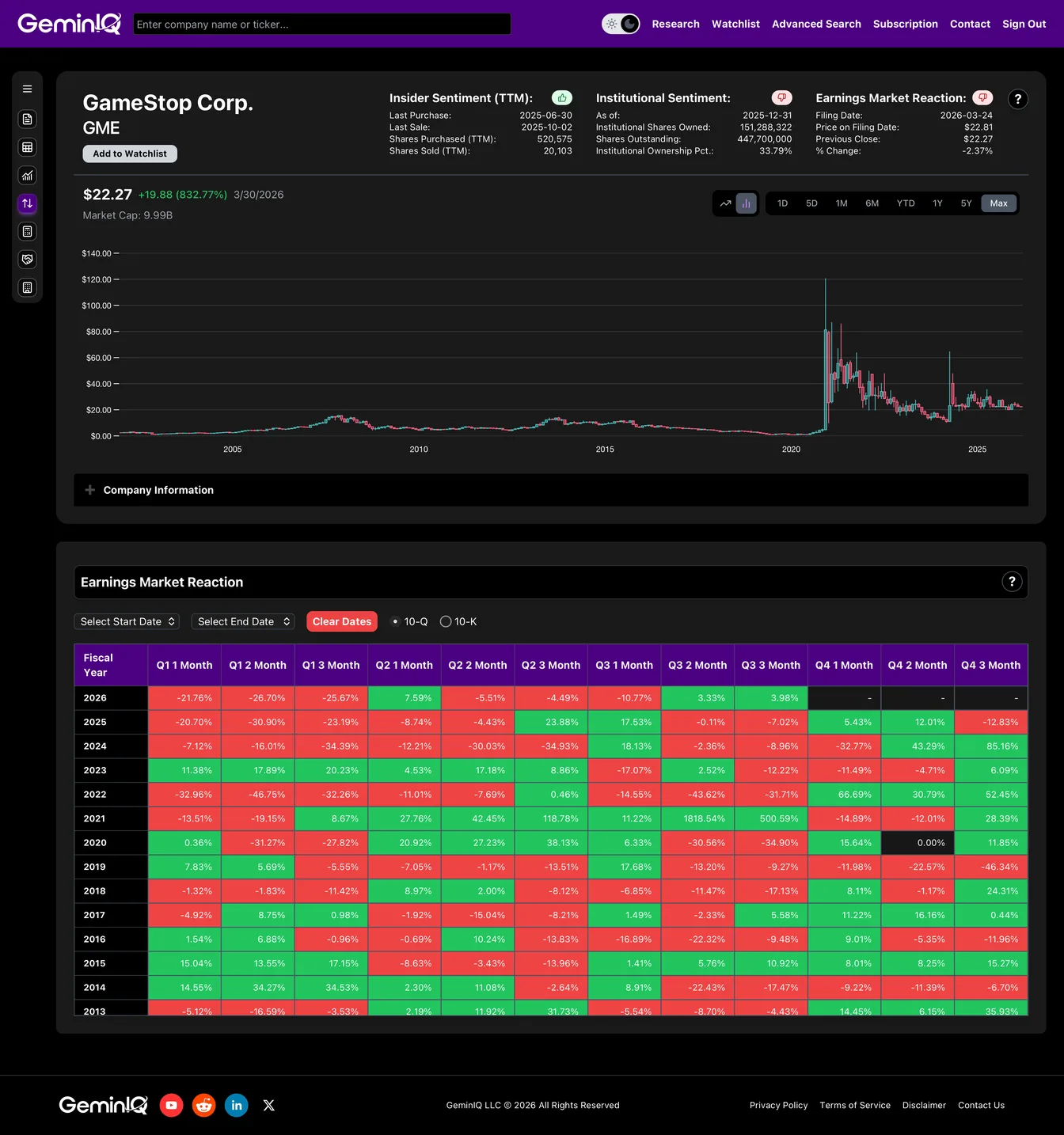
The Unprecedented Conviction (Smart Money Accumulation)
Talk is cheap, and Wall Street executives promise "turnarounds" every day. If you want to know what management really believes about this massive acquisition thesis, you have to look at their personal bank accounts.
Standard financial sites trigger random "insider selling" alerts on GameStop. But using GeminIQ to audit the raw SEC Form 4 filings reveals that selling is purely administrative—taxes and standard compensation coverage by non-core executives like the General Counsel.
The core architects of this turnaround, Ryan Cohen, Larry Cheng, Alain Attal, and Jim Grube, have made massive open-market purchases year after year. Cohen alone has purchased tens of millions of dollars in stock.
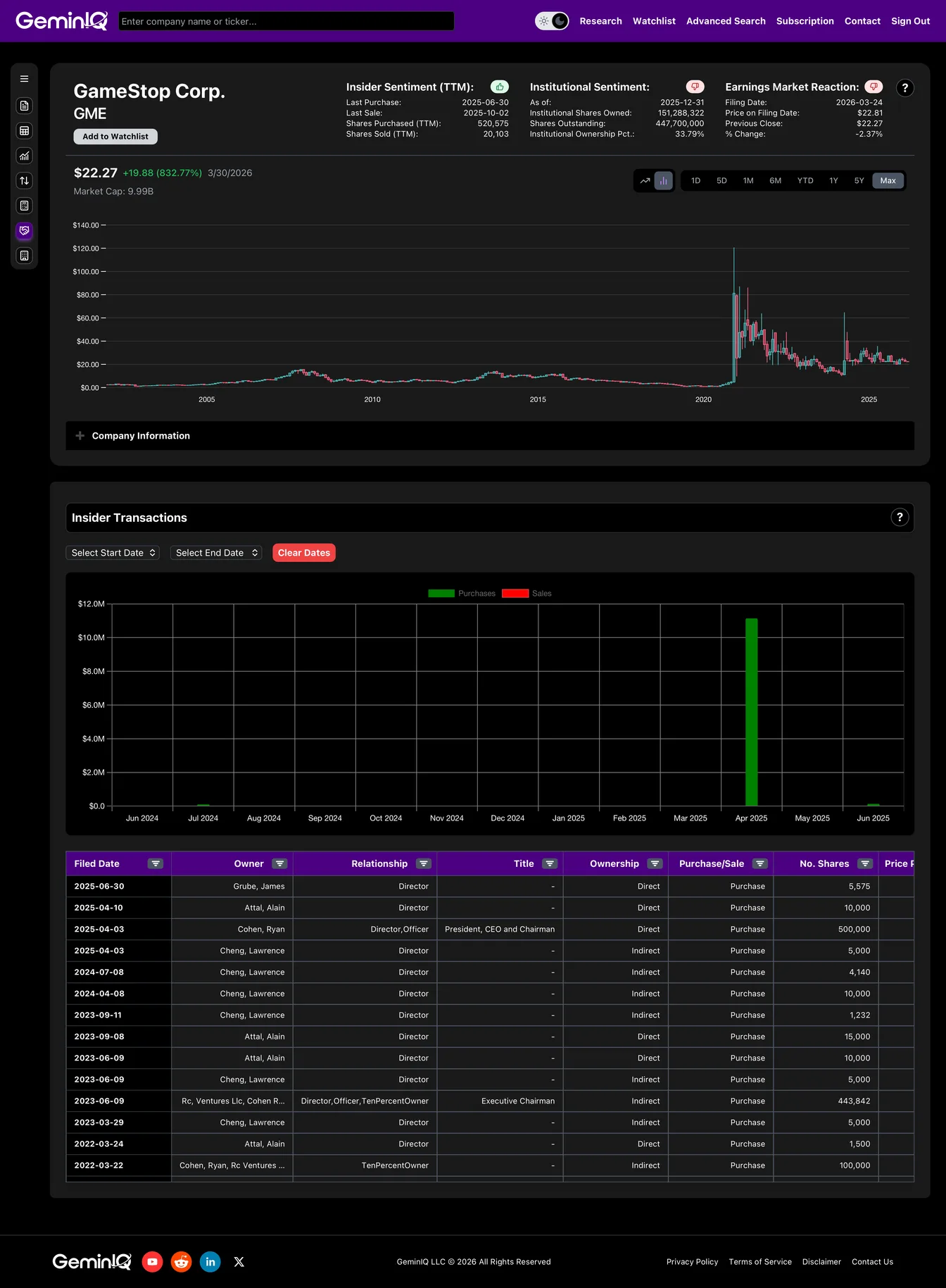
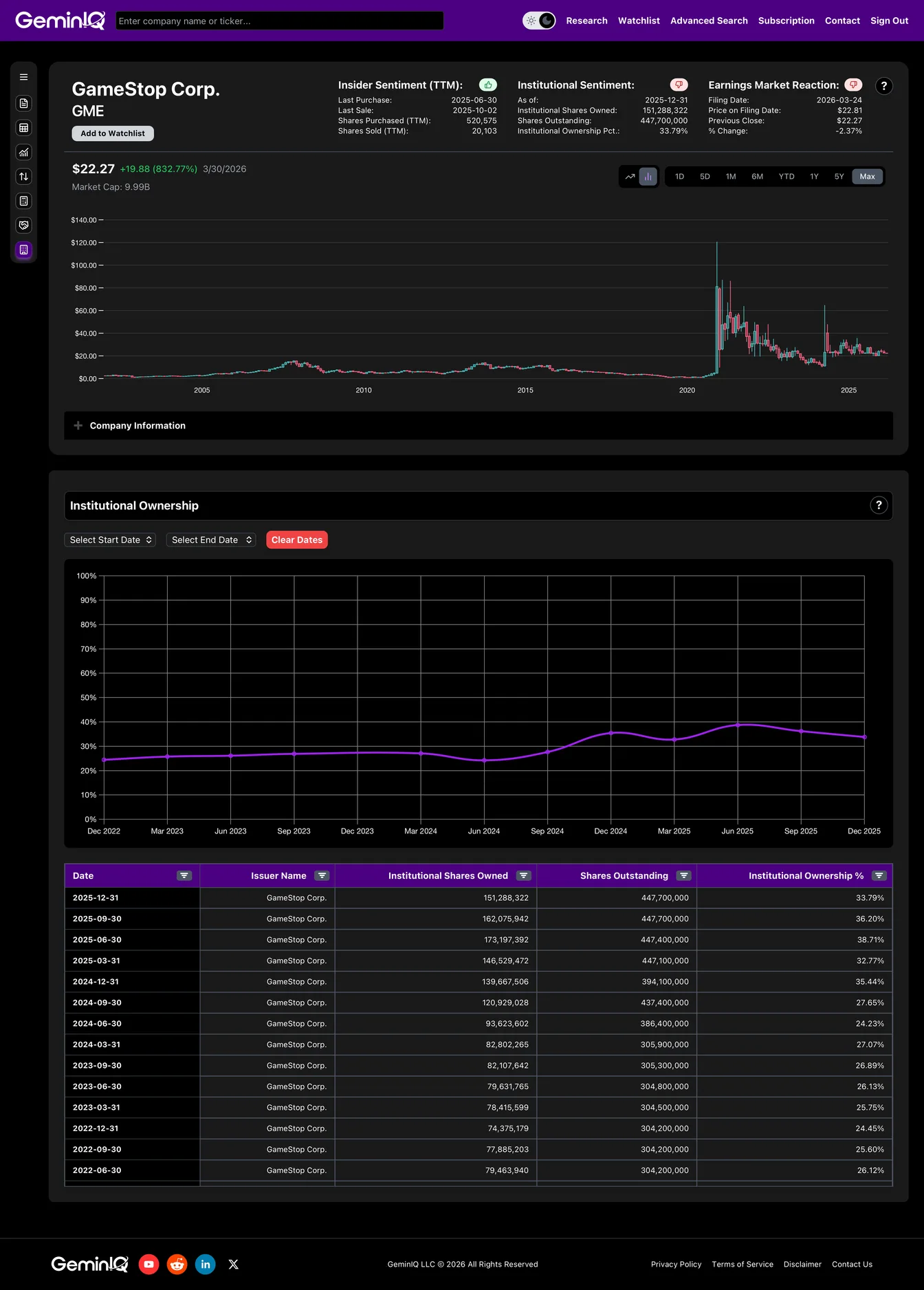
Furthermore, auditing the 13F Institutional Holdings data shows that smart money is quietly securing positions. While retail fights over daily price action, institutions are anchoring millions of shares, recognizing that a $9 Billion cash pile with no debt establishes a massive, unbreakable fundamental floor.
GameStop is no longer a video game store. It is Ryan Cohen's acquisition vehicle.
Research faster. Invest smarter.
Most financial websites rely on third-party aggregators that simplify or process data before you ever see it. We built GeminIQ because we believe you deserve a better fundamental analysis tool—one that goes beyond basic price charts and processed numbers. We extract our data directly from SEC 10-K and 10-Q filings to ensure that when you look at a balance sheet or a cash flow statement, you are seeing the numbers exactly how the company reported them. GeminIQ turns raw 10-K and 10-Q filings into traceable financial statements, calculated metrics, charts, screeners, and watchlists for US public company research. Our goal is to give you the tools to verify the narrative for yourself using clean, traceable data. Start researching now at GeminIQ.
Related Blogs
- See the five types of hidden filing signals the headlines always miss
- See how Apple's $24.7B buyback engine is mathematically shrinking your ownership stake
- See how NVIDIA's $120B cash machine is returning capital the same way
Disclaimer: The content in this blog is for educational and entertainment purposes only and does not constitute financial, legal, or tax advice. Investing involves risk, including the loss of principal. The views expressed are my own and not intended as financial advice or a guarantee of future performance.