
How to Read a 10-K: A Value Investor's Guide (2026)
2026-04-29
The 10-K is the annual report that every U.S.-listed company files with the Securities and Exchange Commission. It's not the glossy shareholder letter your broker sends you. It's the real thing — audited financial statements, detailed risk disclosures, management's own analysis of the business, and the raw data that drives every valuation model worth building.
Warren Buffett reads hundreds of them a year. If you're serious about value investing, you should be reading them too.
In this guide, we'll walk through how to read a 10-K section by section, using Apple's fiscal year 2025 filing (filed October 31, 2025) as our working example. We'll also show you how GeminIQ automatically extracts, structures, and visualizes the data inside these filings — so you spend less time copying numbers into spreadsheets and more time analyzing them.
Or explore Apple's data now — no account needed →
Follow along, open Apple's 10-K here →
What Is a 10-K Filing?
A 10-K is a comprehensive annual report filed by every company registered with the SEC. Unlike the 10-Q (quarterly) or 8-K (current events), the 10-K gives you the full picture: three years of audited financial statements, detailed segment breakdowns, risk factors, management's discussion of results, and notes that explain the accounting behind every number.
The key word is audited. The financial statements in a 10-K are reviewed and signed off by an independent accounting firm — in Apple's case, Ernst & Young. This is the highest standard of reliability you'll get from any corporate financial data source.
Every 10-K follows the same structure mandated by the SEC, which means once you know how to read one, you can read any of them. Here's the roadmap:
- Part I — Business description, risk factors, properties
- Part II — Financial data: MD&A, financial statements, and notes
- Part III — Governance, compensation (usually in the proxy statement)
- Part IV — Exhibits and signatures
For value investors, the real meat is in Part I (Item 1 and Item 1A) and Part II (Items 7 and 8). That's where we'll focus.
Step 1: Understand the Business (Item 1)
Before you touch a single number, read Item 1. This is where the company tells you — in plain English — what it does, how it makes money, and how it's structured.
In Apple's FY2025 10-K, Item 1 reveals a few things that matter for valuation. Apple reports revenue across five geographic segments: Americas, Europe, Greater China, Japan, and Rest of Asia Pacific. It breaks product revenue into four hardware categories (iPhone, Mac, iPad, Wearables/Home/Accessories) plus Services.
This is important because Services revenue — which hit $109.2 billion in FY2025, up 14% year-over-year — carries a 75.4% gross margin compared to just 36.8% for Products. As Services becomes a larger share of the mix, it structurally improves the overall margin profile. A value investor who only looks at the top-line revenue number misses this entirely.
Item 1 also tells you that 60% of Apple's sales flow through indirect channels (carriers and resellers), and that a "significant majority" of manufacturing is outsourced to partners in China, India, Japan, South Korea, Taiwan, and Vietnam. That's a supply chain concentration risk that directly intersects with the tariff discussion in FY2025.
GeminIQ Tip: On GeminIQ, every line item from Apple's 10-K is extracted automatically and tagged with its XBRL identifier — including the segment and product breakdowns. You don't need to manually pull these numbers from the PDF. They're structured, searchable, and ready to visualize the moment the filing hits EDGAR.
Step 2: Read the Risk Factors (Item 1A)
Most investors skip Item 1A because it reads like a legal disclaimer. That's a mistake.
The risk factors section tells you what management themselves believe could materially hurt the business. Read it not for the boilerplate (every company warns about "macroeconomic conditions"), but for the specific, new, or evolving risks that weren't in last year's filing.
In Apple's FY2025 10-K, the tariff disclosure is the standout. The filing describes new U.S. tariffs imposed beginning in the second quarter of 2025 on imports from China, India, Japan, South Korea, Taiwan, Vietnam, and the EU — essentially every country in Apple's manufacturing supply chain. The filing notes that the "ultimate impact remains uncertain" and that the U.S. Department of Commerce has initiated an investigation into semiconductor imports, including "downstream products that contain semiconductors" — which describes every Apple product.
This is the kind of risk that directly impacts gross margins. Apple's Products gross margin percentage actually decreased in FY2025 despite higher revenue, "primarily due to a different mix of products and tariff costs." You'd find that detail in Item 7 (MD&A), but the risk factor in Item 1A gives you the forward-looking framework for understanding it.
The other risk worth flagging: Apple's licensing relationship with Google. The filing discloses that on September 2, 2025, a U.S. District Court ordered remedies after finding Google violated antitrust laws — and notes that if certain proposed remedies are implemented, they "could materially adversely affect the Company's ability to earn revenue from such licensing arrangements." Google's search licensing fees are widely estimated to represent a significant portion of Apple's Services revenue.
Step 3: Follow the Money in the MD&A (Item 7)
Item 7 — Management's Discussion and Analysis — is where the CEO and CFO explain, in their own words, what happened during the year and why. This section bridges the gap between the narrative in Item 1 and the raw numbers in Item 8.
For Apple's FY2025, the MD&A shows:
- Total net sales grew 6% to $416.2 billion, driven by iPhone (up 4%), Mac (up 12%), and Services (up 14%)
- Greater China was the only segment that declined, falling 4% to $64.4 billion — primarily due to lower iPhone sales
- Total gross margin expanded to 46.9% from 46.2%, driven by the Services mix shift, even as Products margins compressed from tariff costs
- R&D spending rose 10% to $34.6 billion, representing 8% of revenue — a sign of continued heavy investment
- The company repurchased $89.3 billion of its own stock and paid $15.4 billion in dividends
The MD&A also reveals that Apple's effective tax rate dropped from 24.1% in FY2024 to 15.6% in FY2025. Why? Because FY2024 included a one-time $10.2 billion charge from the European Commission's State Aid Decision. Stripping that out, the underlying tax rate is more stable — and understanding this adjustment is essential for building a forward earnings estimate.
GeminIQ Tip: GeminIQ's Calculated Metrics automatically compute over 50 financial KPIs from the raw filing data — including ROIC, free cash flow per share, and growth rates — so you don't have to build your own spreadsheet. For Apple FY2025, GeminIQ shows an ROIC of 85.4% (reflecting Apple's massive capital efficiency relative to its small invested capital base), an ROE of 171.4%, and free cash flow of $98.8 billion.
Or explore Apple's data now — no account needed →
Step 4: Analyze the Financial Statements (Item 8)
This is the core of the 10-K. Item 8 contains three audited financial statements — and each tells you something different about the business.
The Income Statement: How the Company Makes Money
Start at the top with revenue and work your way down to net income. For Apple FY2025:
| Line Item | FY2025 | FY2024 | Change |
|---|---|---|---|
| Total Net Sales | $416.2B | $391.0B | +6% |
| Cost of Sales | $221.0B | $210.4B | +5% |
| Gross Margin | $195.2B | $180.7B | +8% |
| Operating Income | $133.1B | $123.2B | +8% |
| Net Income | $112.0B | $93.7B | +19.5% |
| Diluted EPS | $7.46 | $6.08 | +22.7% |
The 22.7% EPS growth is faster than the 19.5% net income growth — because Apple repurchased 402 million shares during the year, reducing the share count. This is the buyback effect, and it's a core part of Apple's capital return strategy.
The Balance Sheet: What the Company Owns and Owes
The balance sheet is a snapshot of financial health. Key items for Apple as of September 27, 2025:
- Cash and marketable securities: $132.4 billion
- Total debt: $99.3 billion ($91.3B term debt + $8.0B commercial paper)
- Total assets: $359.2 billion
- Total shareholders' equity: $73.7 billion (up from $57.0B — the accumulated deficit is shrinking)
- Current ratio: 0.89 (current liabilities exceed current assets — typical for Apple's asset-light model)
A current ratio below 1.0 would concern you with most companies. For Apple, it's structural — the company generates $111.5 billion in annual operating cash flow and carries $132.4 billion in liquid assets. The low current ratio reflects Apple's efficient working capital management, not financial distress.
The Cash Flow Statement: Where the Cash Actually Goes
The cash flow statement is the value investor's favorite — it shows you actual cash movement, stripped of accounting adjustments.
- Operating cash flow: $111.5 billion
- Capital expenditures: $12.7 billion (up 35% — Apple is investing in manufacturing and data center infrastructure)
- Free cash flow: $98.8 billion
- Stock repurchases: $90.7 billion
- Dividends: $15.4 billion
Apple returned $106.1 billion to shareholders in FY2025 through buybacks and dividends — more than its free cash flow of $98.8 billion. The difference was funded from existing cash and marketable securities. This level of capital return is only sustainable for a business generating Apple's level of cash flow.
GeminIQ Tip: On GeminIQ, all three financial statements are presented exactly as the company filed them — preserving every line item, every segment, and every XBRL tag. You can build Custom Tables that pull specific metrics across multiple years and save them as reusable templates. Build your Apple income statement comparison once, then apply it to any company in seconds.
Step 5: Don't Skip the Notes
The Notes to Consolidated Financial Statements (starting on page 34 of Apple's 10-K) are where the real analytical depth lives. This is where you find:
- Revenue recognition policies — Apple defers revenue on bundled services (iCloud, Siri, Maps) and recognizes it over time. As of September 2025, Apple had $13.7 billion in deferred revenue, with 66% expected to be recognized within a year.
- Segment detail — Note 13 breaks operating income by geographic segment. Americas generated $72.5B in operating income, Europe $47.7B, Greater China $26.9B. The corporate segment shows $(42.6B) — that's where R&D and G&A sit.
- Tax complexity — Note 7 reveals $23.2 billion in gross unrecognized tax benefits. The European State Aid Decision created a $10.2 billion charge in FY2024 that reversed in FY2025's effective rate — if you didn't read the notes, you'd mismodel the tax rate going forward.
- Debt maturity schedule — Note 9 shows $12.4 billion in term debt maturing in 2026, $10.1B in 2027, $9.3B in 2028. This is your forward-looking view of refinancing risk and interest expense.
These details don't appear in any screener or dashboard that normalizes the data. They're only in the filing itself — or on a platform like GeminIQ that preserves the as-filed structure.
Step 6: Go Beyond the 10-K
The 10-K tells you what the company reported. But as a value investor, you also want to know what the market did with that information — and what insiders are doing with their own shares.
Insider Transactions
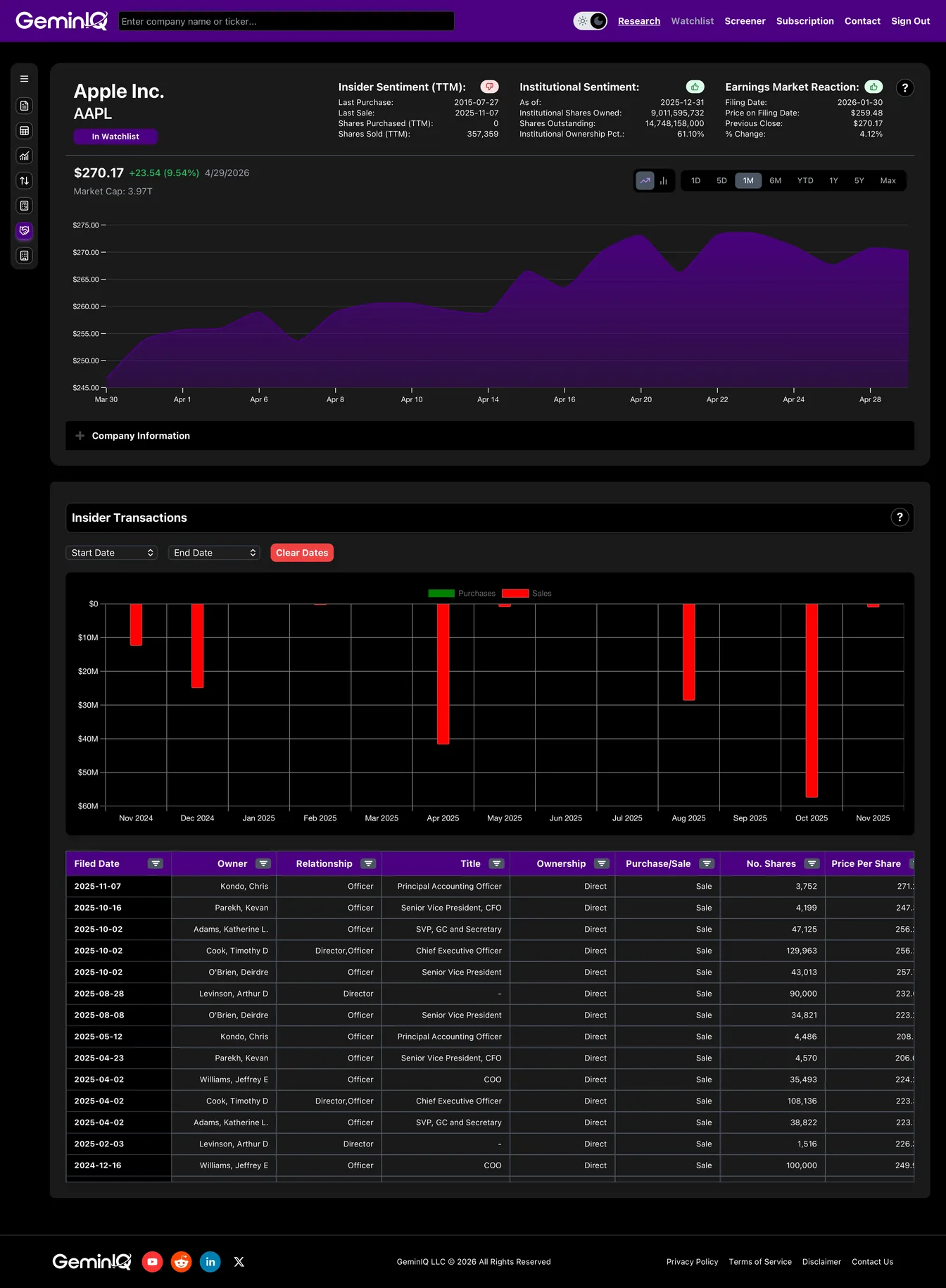
GeminIQ's Insider Transaction Tracking shows that Apple's executives have been consistent net sellers of stock through equity compensation vesting. In October 2025 alone, CEO Tim Cook sold 129,963 shares at $256.22, SVP Deirdre O'Brien sold 43,013 shares at $257.72, and CFO Kevan Parekh sold 4,199 shares at $247.37.
For Apple, this selling pattern is routine — executives receive RSUs that vest and are partially sold to cover tax obligations. What a value investor looks for is unusual buying, which would signal that insiders see the stock as undervalued relative to their private knowledge. GeminIQ's visual sentiment timeline helps you distinguish between routine compensation sales and conviction-driven transactions at a glance.
 Explore Apple's data now — no account needed →
Institutional Ownership
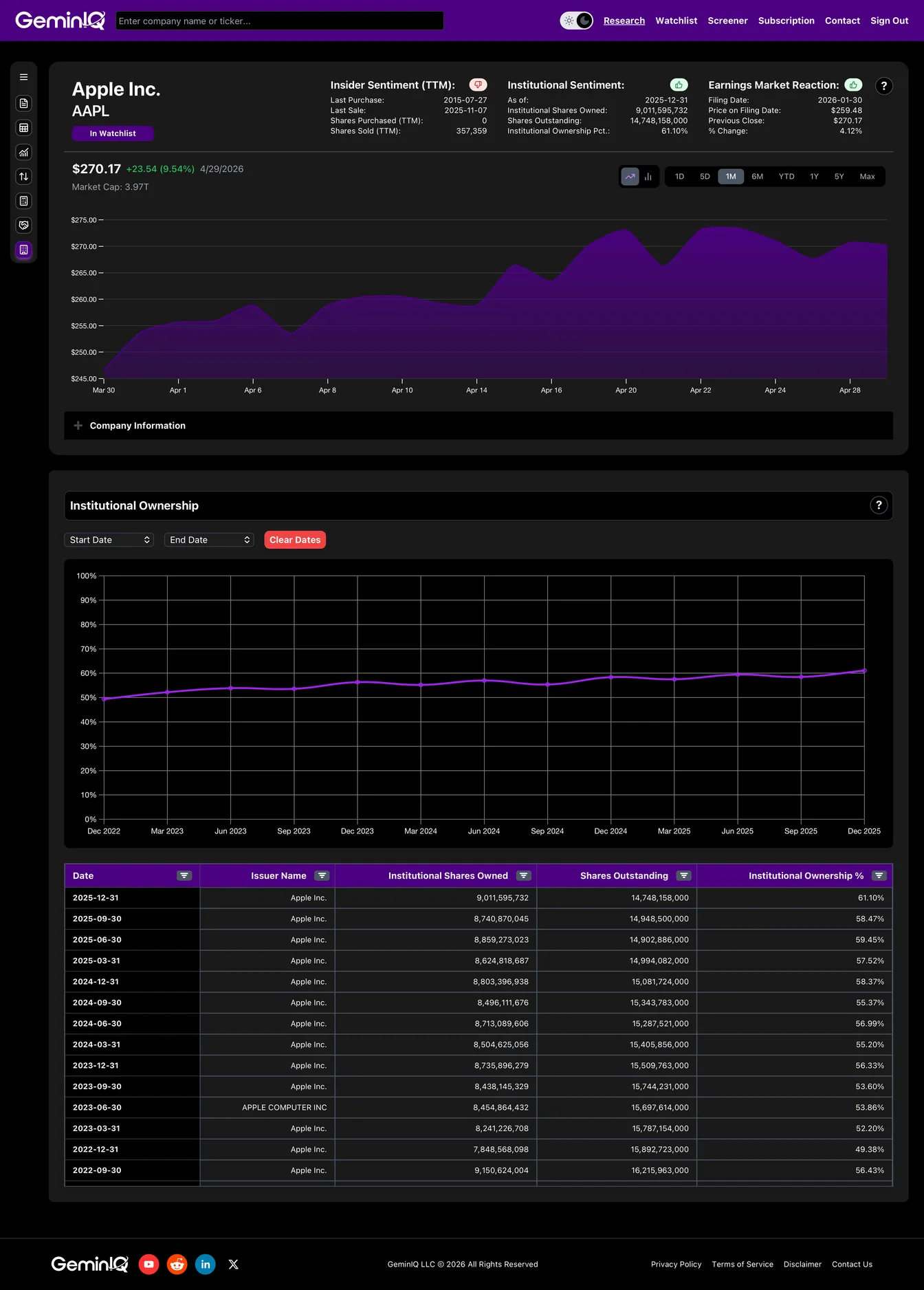
GeminIQ's Institutional Ownership data shows that institutional investors held approximately 57.5% of Apple's outstanding shares as of March 2025, up from 55.2% a year earlier. Rising institutional ownership alongside rising share prices suggests professional capital is accumulating, not distributing — a constructive signal for value investors evaluating market sentiment.
 Explore Apple's data now — no account needed →
Earnings Market Reaction
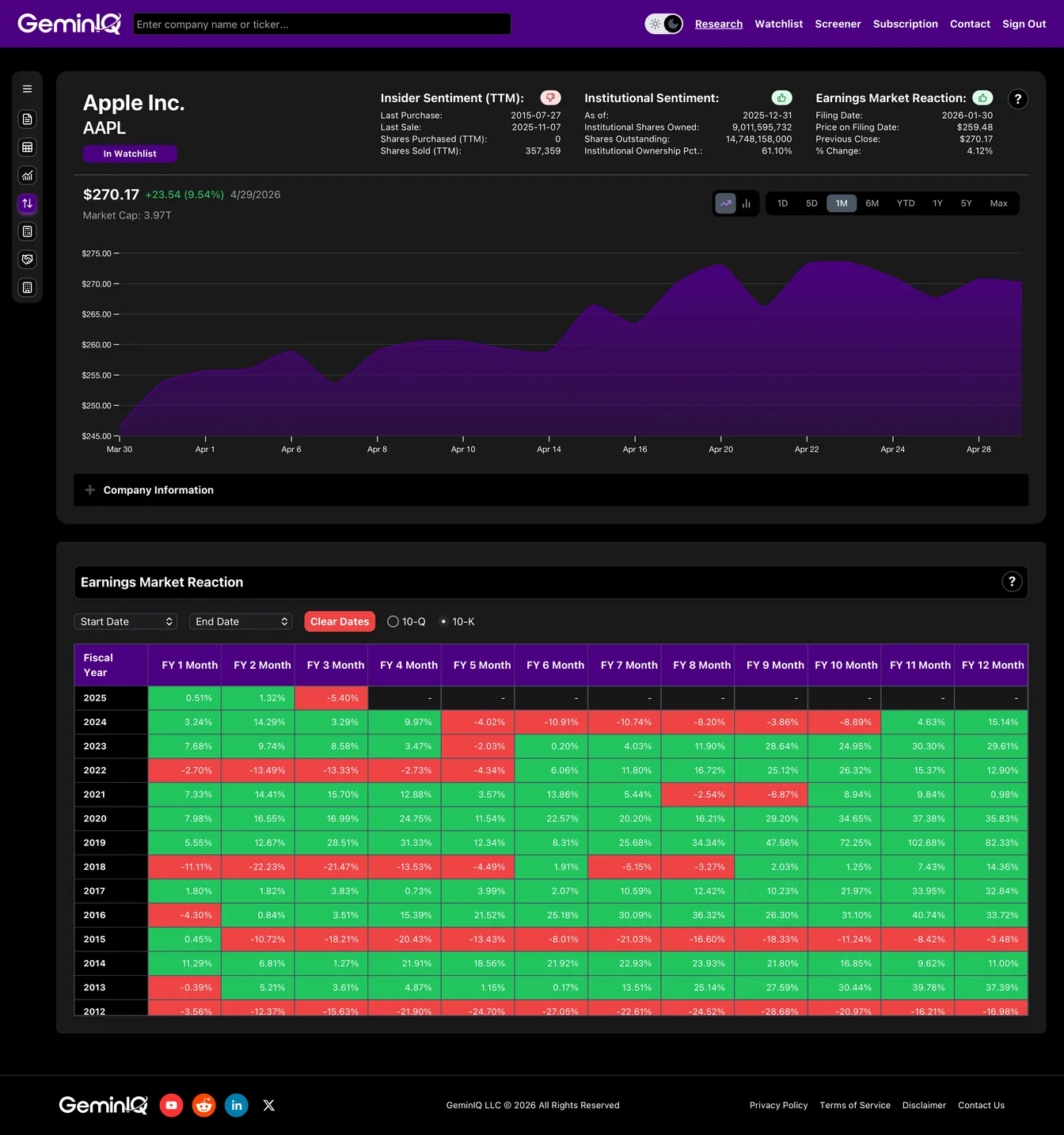
GeminIQ's proprietary Earnings Market Reaction Heatmap tracks how Apple's stock performed 1, 2, 3, 6, and 12 months after each filing. For the FY2024 10-K (filed November 1, 2024), Apple gained 3.2% in the first month, 3.3% after three months, dropped 10.9% after six months (coinciding with the tariff announcements), and recovered to gain 15.1% after twelve months.
This behavioral data helps you understand how the market historically reacts to Apple's reported results — and whether post-filing pullbacks have historically been buying opportunities or signals of fundamental deterioration. No other platform tracks this filing-to-price relationship.
 Explore Apple's data now — no account needed →
Finding Your Next 10-K to Read
Once you're comfortable reading Apple's 10-K, the natural next step is finding other companies worth the same level of analysis. GeminIQ's Stock Screener lets you filter across 100+ financial metrics — all derived from XBRL-tagged SEC data — with up to 10 stackable conditions. Screen for companies with ROIC above 15%, gross margins above 40%, and revenue growth above 8% to find businesses with Apple-like quality characteristics, then dive into their 10-Ks armed with the same analytical framework.
Every number on GeminIQ traces directly to its XBRL tag in the source SEC filing. You can verify any metric in under 30 seconds. No normalization, no aggregation, no black boxes — just the data the company reported, structured for analysis.
Start Reading 10-Ks the Smarter Way
The 10-K is the most important document in a value investor's toolkit. But manually extracting data from 100+ page PDFs, building spreadsheet models from scratch, and cross-referencing insider activity across multiple sources takes hours per company.
GeminIQ automates the data extraction, calculates the metrics, visualizes the trends, and tracks the behavioral signals — all built on direct SEC EDGAR data with XBRL traceability for every number. So you can spend your time doing what actually generates returns: analyzing businesses and making decisions.
Most financial websites rely on third-party aggregators that simplify or process data before you ever see it. We built GeminIQ because we believe you deserve a better fundamental analysis tool—one that goes beyond basic price charts and processed numbers. We extract our data directly from SEC 10-K and 10-Q filings to ensure that when you look at a balance sheet or a cash flow statement, you are seeing the numbers exactly how the company reported them. Our goal is to give you the tools to verify the narrative for yourself using clean, traceable data. Start researching now at GeminIQ.
Disclaimer: The content in this blog is for educational and entertainment purposes only and does not constitute financial, legal, or tax advice. Investing involves risk, including the loss of principal. The views expressed are my own and not intended as financial advice or a guarantee of future performance.