Apple (AAPL) Q4 FY2026 Earnings: Revenue Up 12%

By Chad Hartman
Published · Last updated
Apple (AAPL) reported fiscal Q4 2026 revenue of $114.48 billion, up 11.7% year over year, and diluted EPS of $2.10, up 13.5%, for the quarter ended September 26, 2026. The November 2 earnings release credits tariff refunds with about 1 point of the 47.9% gross margin and $0.05 of EPS. Without them, gross margin was roughly 46.9%, below the 47.2% of a year earlier, and operating cash flow fell 5.5% in a quarter when net income rose 11.8%. The 10-K, filed November 3, closed a fiscal year of $478.83 billion in revenue, up 15%.
| Field | Value |
|---|---|
| Company | Apple ($AAPL) |
| Quarter | Q4 FY2026, period ended September 30, 2026 |
| Earnings release | November 2, 2026 (Form 8-K) |
| 10-K filed | November 3, 2026 |
| Revenue | $114.48 Billion (+11.7% YoY) |
| Diluted EPS | $2.10 (+13.5% YoY) |
| Operating margin | 31.1% (-0.5 pts YoY) |
| Operating cash flow (TTM) | $145.10 Billion |
| Full-year revenue | $478.83 Billion (+15.1% YoY) |
| Gross margin excluding tariff refunds (derived from 8-K) | ~46.9% |
Apple Q4 FY2026 Revenue, EPS and Operating Margin
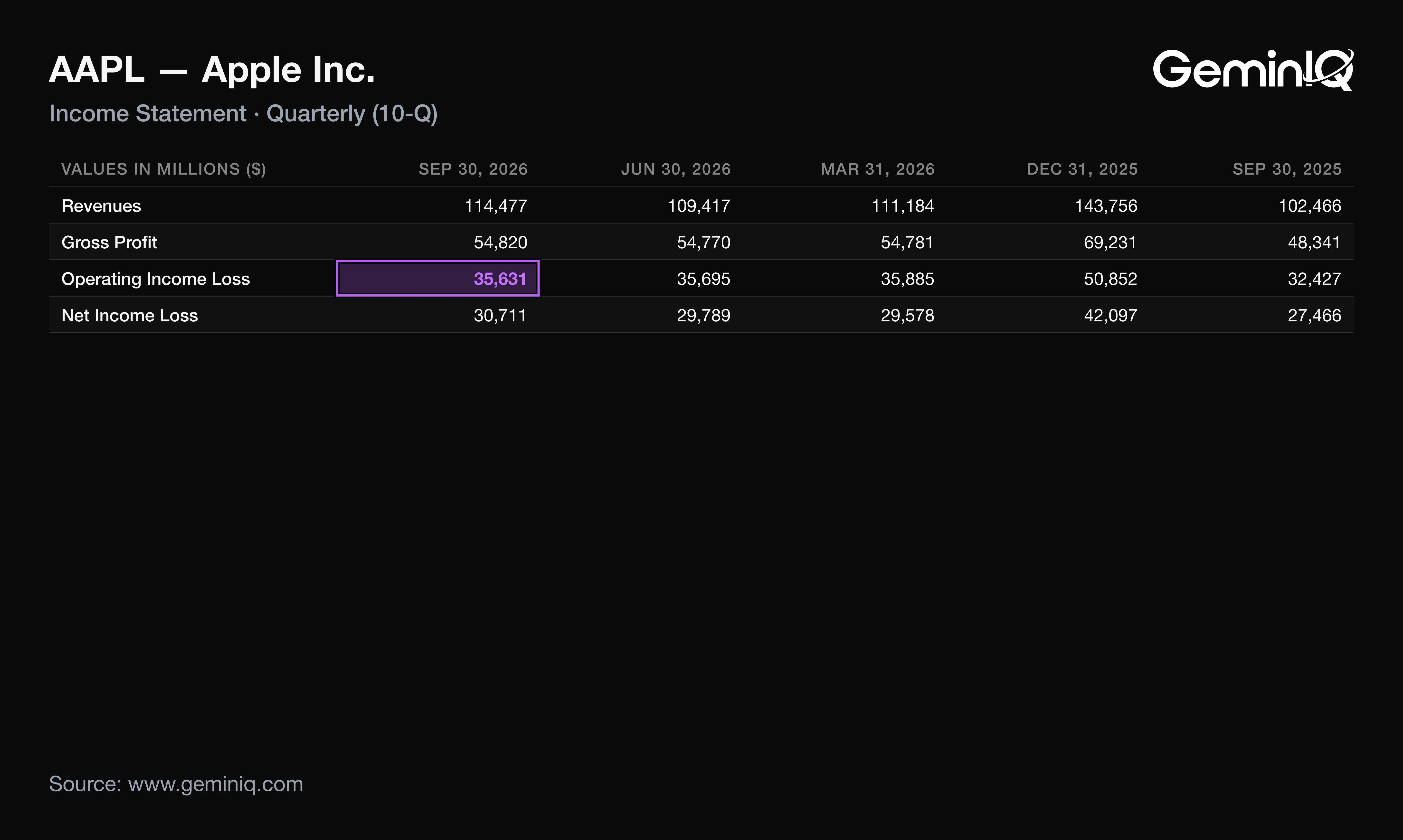
Apple's Q4 FY2026 revenue was $114.48 billion, up 11.7% from $102.47 billion a year earlier and the fifth-highest of the last 16 quarters. Operating income grew more slowly than revenue and gross profit, and EPS grew faster than both.
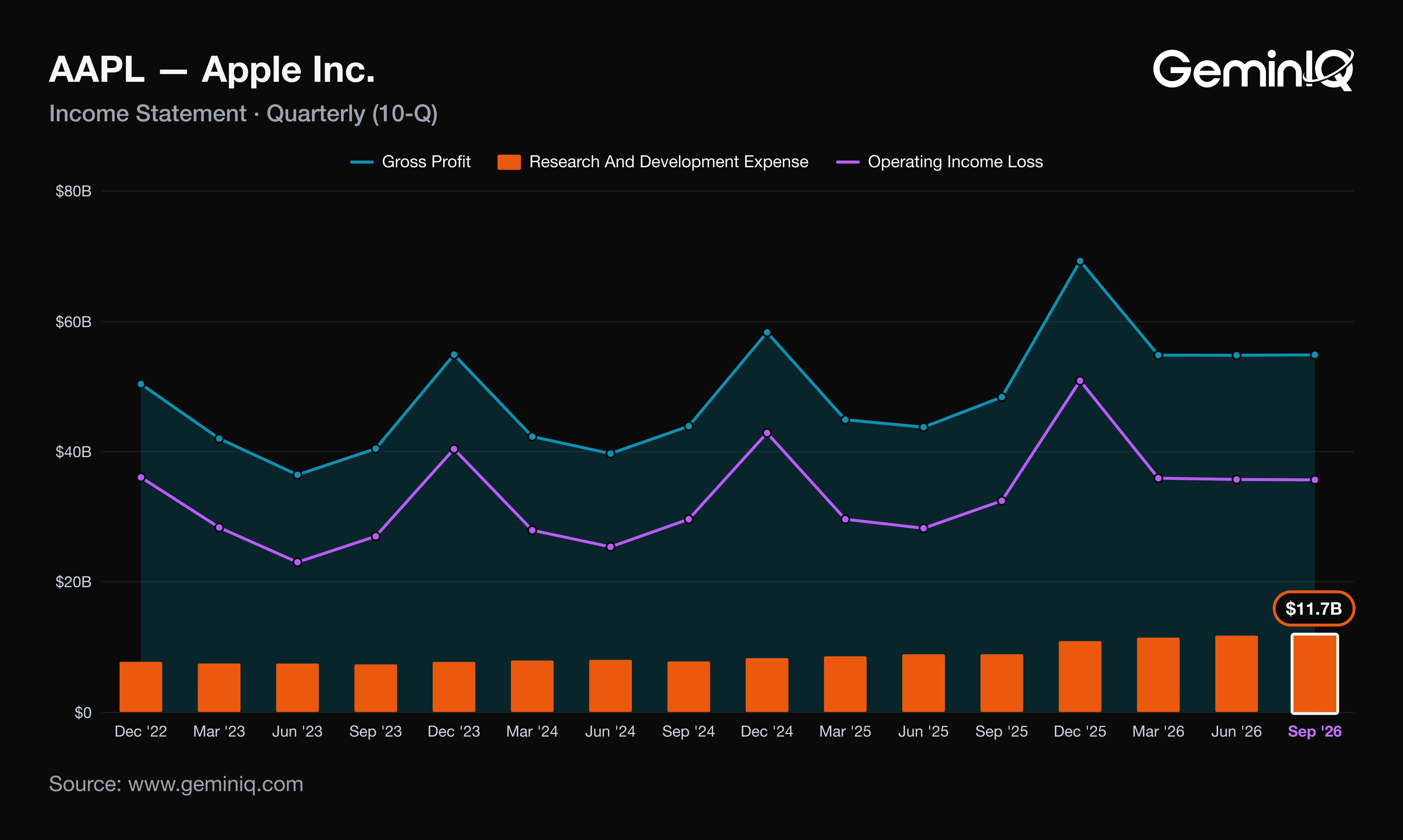
Gross profit rose 13.4% to $54.82 billion, so the operating line should have widened too. The Data: operating income was $35.63 billion, up 9.9%, which left operating margin at 31.1%, 0.5 points below a year earlier and the eighth-highest of the last 16 quarters. Research and development was $11.73 billion against $8.87 billion a year earlier, up 32% (8-K), and total operating expenses rose 20.6% to $19.19 billion.
Why: gross profit added $6.48 billion and operating expenses took back $3.28 billion of it. The 10-K attributes the full-year R&D increase to "infrastructure-related costs, including investments in artificial intelligence, and headcount-related expenses." Below the operating line, a 15.0% tax rate against 16.3% a year earlier and a diluted share count 1.6% lower pushed EPS ahead of net income, which rose 11.8% to $30.71 billion, the fourth-highest of the last 16 quarters. Had the tax rate held at 16.3%, diluted EPS would have been about $2.07 instead of $2.10. EPS growth outran operating income growth by 3.6 points, and none of that gap came from operations.
What Apple's Q4 FY2026 10-K Shows Beyond the Press Release
Apple's 10-K says it has recognized tariff refunds "as a reduction of products cost of sales," and the release puts their size at about 1 point of the quarter's 47.9% gross margin. A reader who saw "September quarter records" would expect the margin to have widened on its merits. Instead the 0.7-point gain over the year-ago 47.2% is smaller than the refund.
The Data: removing the approximately 1 point leaves a gross margin of about 46.9%, 0.3 points below Q4 FY2025 and 3.2 points below the 50.1% of Q3. The same adjustment takes diluted EPS to about $2.05 against $1.85, up 10.8% instead of 13.5%. For the full year, the 10-K ties the rise in Products gross margin to 39.3% from 36.8% to "product mix and tariff refunds, partially offset by higher costs, including memory."
Why: the refunds follow the Supreme Court's February 20, 2026 ruling striking down certain IEEPA tariffs. Apple applied for refunds and books them when received, so they arrive on the government's schedule, not on a sales cycle. The same 10-K says supply constraints and rising costs for memory and storage are expected "to intensify," and that gross margins will be "subject to volatility and downward pressure." The 1-point figure is the company's own approximation. The refund has no counterpart on the cost side: the memory pressure the 10-K describes comes with no refund attached.
Apple Q4 FY2026 Cash Flow, Inventory and Buybacks
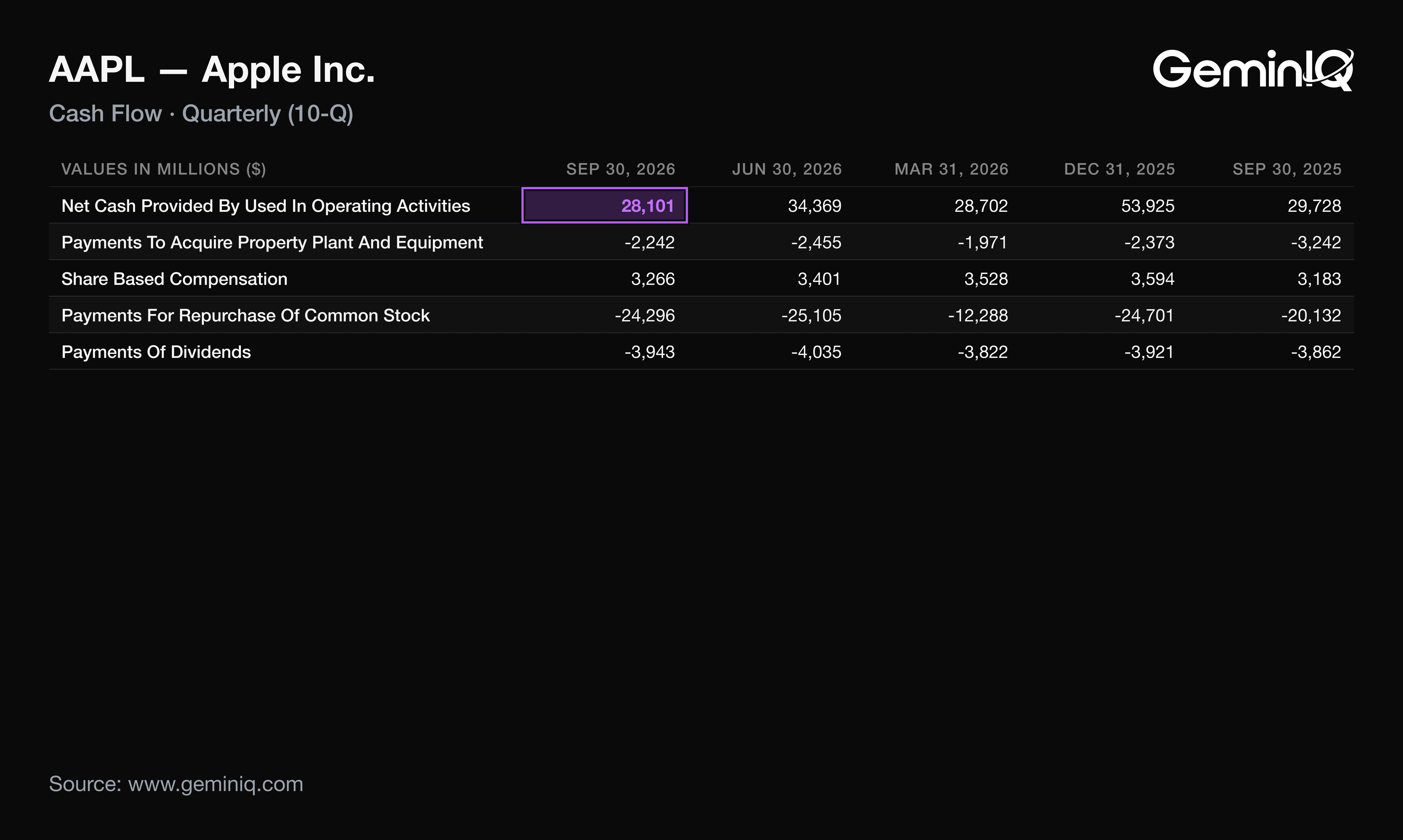
Apple's Q4 FY2026 operating cash flow was $28.10 billion, down 5.5% from $29.73 billion a year earlier and the seventh-lowest of the last 16 quarters, while net income rose 11.8%. Cash conversion fell to 91% of net income from 108%.
Cash usually follows earnings in a quarter like this. The Data: capital expenditure fell 30.8% to $2.24 billion, so spending did not cause the shortfall. Inventories were $14.54 billion at fiscal year-end against $5.72 billion a year earlier, up 154%, and vendor non-trade receivables rose to $39.90 billion from $33.18 billion (8-K balance sheet). Accounts payable rose $12.39 billion to $82.25 billion.
Why: suppliers financed the $8.82 billion inventory increase, which is why GeminIQ's pre-calculated Free Cash Flow still reached $136.06 billion over the last 12 months, up 37.8%. The 10-K does not explain the build. It does list $89.7 billion of manufacturing purchase obligations, $82.7 billion of them due within 12 months. Capital returns kept pace with the cash: the 10-K reports $85.8 billion of repurchases (297 million shares) and $15.7 billion of dividends for the year, about three-quarters of trailing free cash flow. Only 55.7 million shares were issued net of withholding, so shares outstanding fell 1.6% to 14.53 billion. The CFO said in the release that the quarter's $28 billion of operating cash flow funded $28 billion of shareholder returns. If the inventory sells through before the payables fall due, the cash comes back.
How AAPL Stock Has Moved After Past Earnings Reports
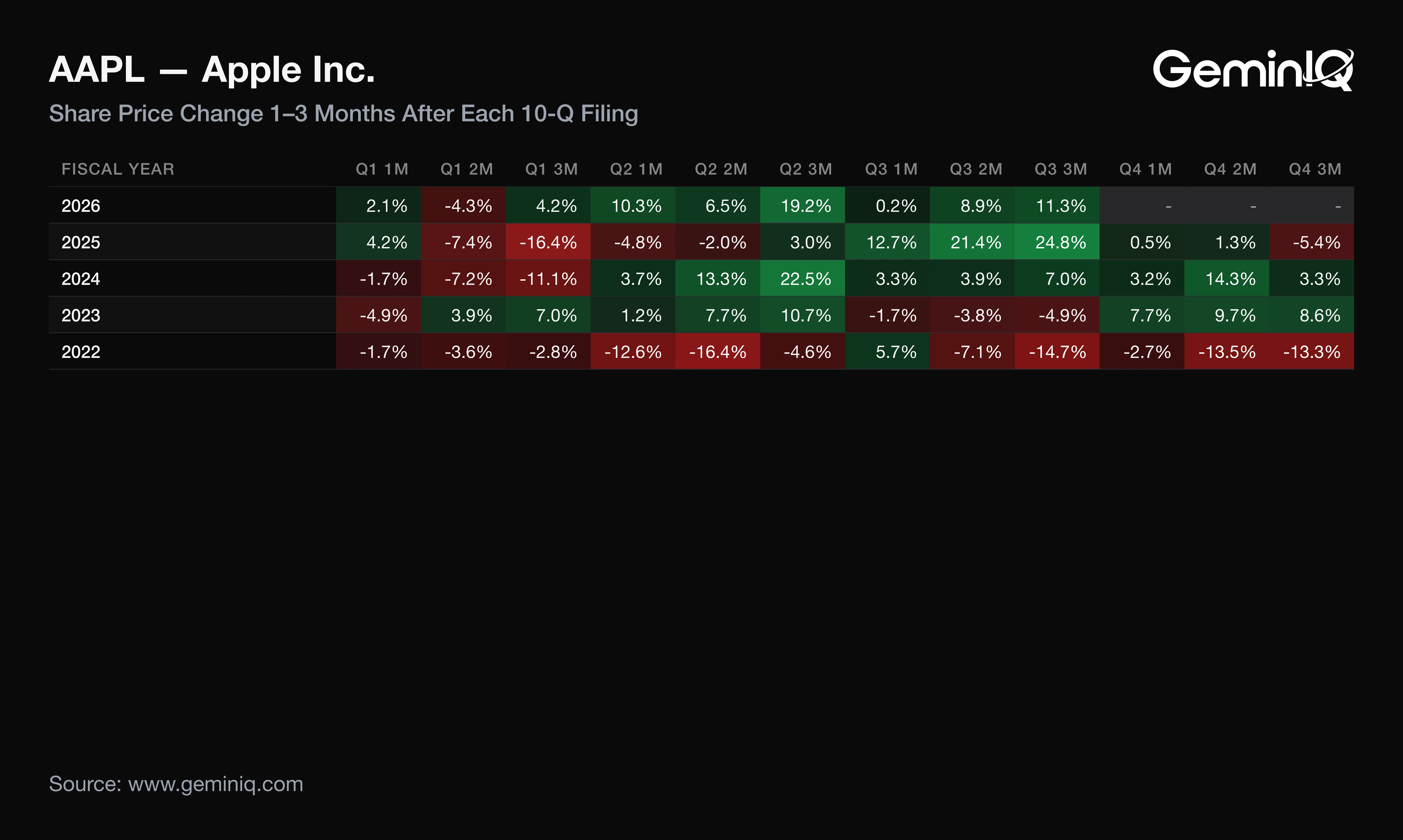
Apple's stock was up one month after 10 of its last 12 quarterly filings, with a median one-month return of +3.3% and a range of -4.8% (FY2025 Q2) to +12.7% (FY2025 Q3). The three-month median was +5.6%, positive after 9 of 12, with a low of -16.4% after the FY2025 Q1 filing.
The Data: the fourth-quarter filings, which land at the iPhone launch, were followed by one-month returns of +7.7%, +3.2% and +0.5% for FY2023 through FY2025, and three-month returns of +8.6%, +3.3% and -5.4%. Each was weaker than the one before. These figures describe how Apple's stock moved after its past filings; they are a historical association, not a forecast. The returns for this filing have not elapsed, and the GeminIQ Earnings Reaction Heat Map shows them as blank.
Why: three Q4 observations cannot separate a seasonal pattern from noise, so the median across all 12 filings is the sturdier yardstick and the Q4 sequence is a note on direction only.
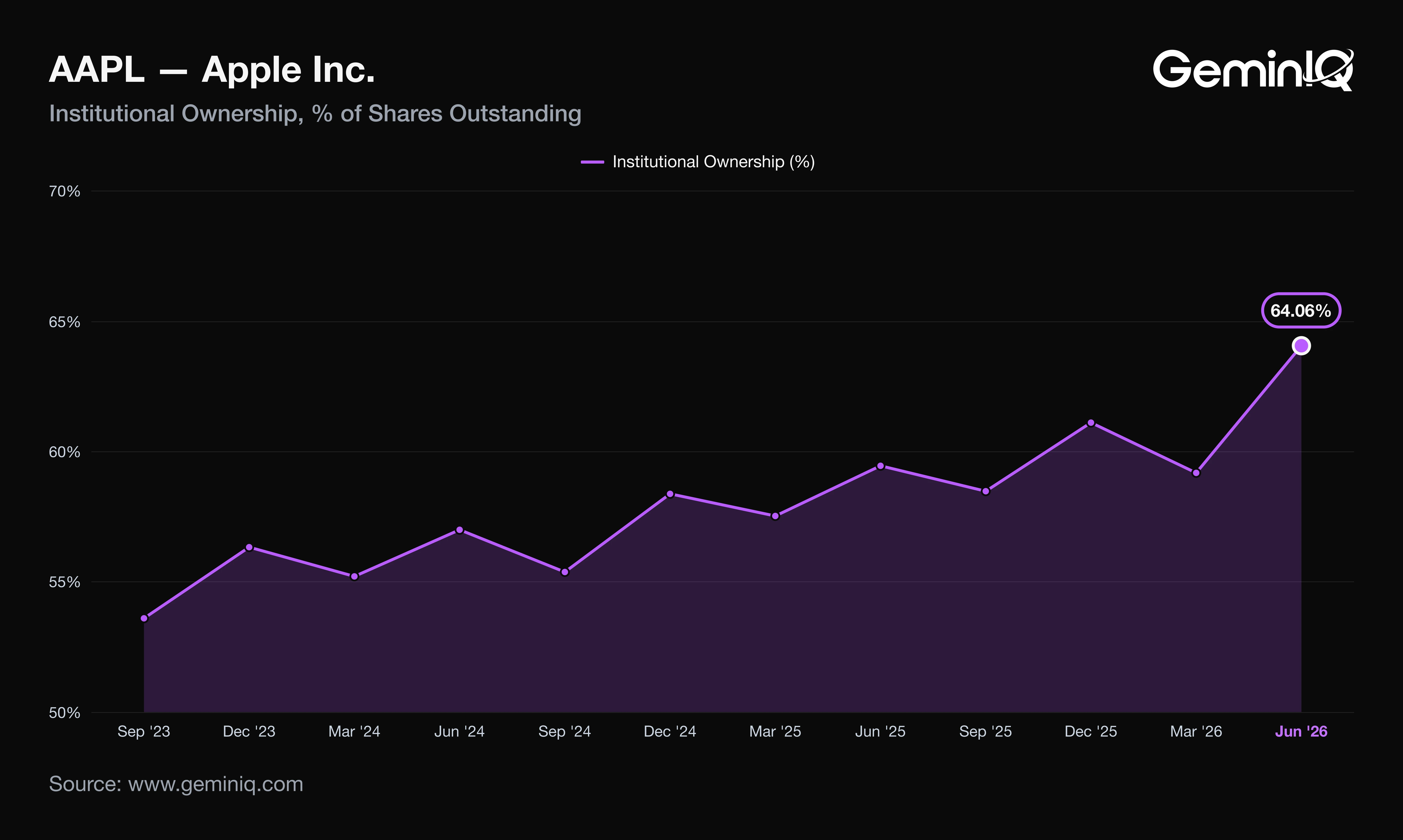
Institutions held 64.06% of Apple at the June 30, 2026 13F quarter end, up from 59.45% a year earlier and the highest of the last 16 quarters. The September 30 13F had not been filed when the data was pulled. Insiders filed 19 sales totaling $173.8 million between September 22, 2025 and September 22, 2026, against 18 sales totaling $248.1 million in the prior 12 months. Arthur Levinson accounted for 50% of the latest total. There have been no insider purchases since July 2015.
Any margin gain smaller than a disclosed one-time benefit is an underlying decline, whatever the headline says.
Frequently Asked Questions
When does Apple report earnings?
Apple reported its fiscal Q4 2026 results on November 2, 2026 and filed its 10-K on November 3, 2026. A year earlier, Apple filed its first-quarter FY2026 results on January 30, 2026. That is a filing pattern from the record, not a forecast of the next date.
Does Apple pay a dividend?
Yes. Apple's board declared $0.27 per share on November 2, 2026, payable November 16, 2026 to shareholders of record on November 12 (8-K). The 10-K says the quarterly rate rose from $0.26 in May 2026. Dividends paid were $3.94 billion in Q4 and $15.72 billion over the last 12 months, up 1.9%.
Is Apple doing well financially?
Apple's trailing 12-month net profit margin was 27.60%, up from 26.92% a year earlier, on fiscal 2026 net income of $132.18 billion (8-K). GeminIQ's pre-calculated Return on Invested Capital (ROIC) was 84.58%, and Net Debt to EBITDA was 0.26x. The Current Ratio was 1.02x, up from 0.89x.
What was Apple's free cash flow in Q4 FY2026?
Apple's Q4 FY2026 free cash flow, operating cash flow less capital expenditure, was $25.86 billion, down 2.4% from $26.49 billion a year earlier. It was also below the $31.91 billion of Q3 and the eighth-lowest of the last 16 quarters.
Wall Street's data. Main Street's price.
Institutional terminals charge thousands a year for as-filed accuracy. GeminIQ gives you the same thing for a fraction of the cost: financials built directly from raw SEC EDGAR filings, not third-party APIs, with full XBRL traceability back to the original 10-K or 10-Q. No normalized guesswork, just calculated metrics, charts, screeners, and watchlists built on numbers exactly as the company reported them. Start researching now at GeminIQ.com.
All financial figures cited in this article reference Apple Inc.'s fiscal 2026 10-K (filed November 3, 2026, period ending September 30, 2026), with guidance and management commentary drawn from the company's Form 8-K earnings release (filed November 2, 2026). All SEC filings are publicly available at SEC EDGAR and SEC EDGAR.
Disclaimer: The content in this blog is for educational and entertainment purposes only and does not constitute financial, legal, or tax advice. Investing involves risk, including the loss of principal. The views expressed are my own and not intended as financial advice or a guarantee of future performance.