AutoZone (AZO) Q4 FY2026 Earnings: EPS Up 15%, Refunds Added 9 Pts

By Chad Hartman
Published · Last updated
AutoZone (AZO) reported fourth-quarter FY2026 revenue of $6.59 billion, up 5.6%, and diluted EPS of $56.05, up 15.1%, for the 16 weeks ended August 29, 2026, in its September 22 earnings release and the 10-K filed October 26. EPS grew nearly three times as fast as revenue, yet operating expenses took a larger share of sales, so the entire gain sits in gross margin, where a $96.0 million tariff refund did the lifting. Without that refund, diluted EPS would have been about $51.5, up roughly 6%.
| Field | Value |
|---|---|
| Company | AutoZone ($AZO) |
| Quarter | Q4 FY2026, period ended August 29, 2026 |
| Earnings release | September 22, 2026 (Form 8-K) |
| 10-K filed | October 26, 2026 |
| Revenue | $6.59 Billion (+5.6% YoY) |
| Diluted EPS | $56.05 (+15.1% YoY) |
| Operating margin | 20.0% (+0.8 pts YoY) |
| Operating cash flow (TTM) | $3.25 Billion |
| Full-year revenue | $20.34 Billion (+7.4% YoY) |
| Tariff refund in Q4 gross margin | 145 bps ($96.0M, per 8-K/10-K) |
AutoZone Q4 FY2026 Revenue, EPS and Margins
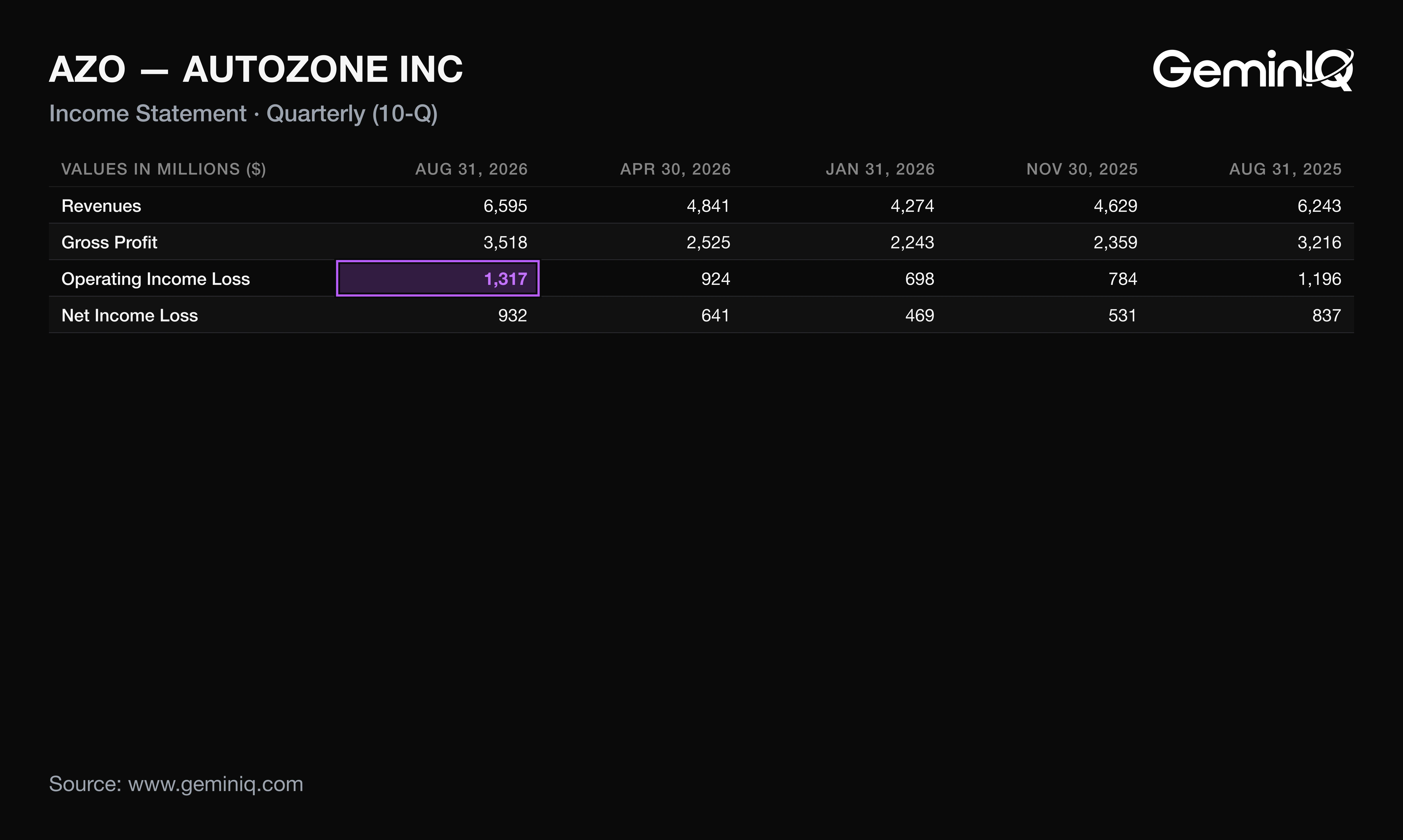
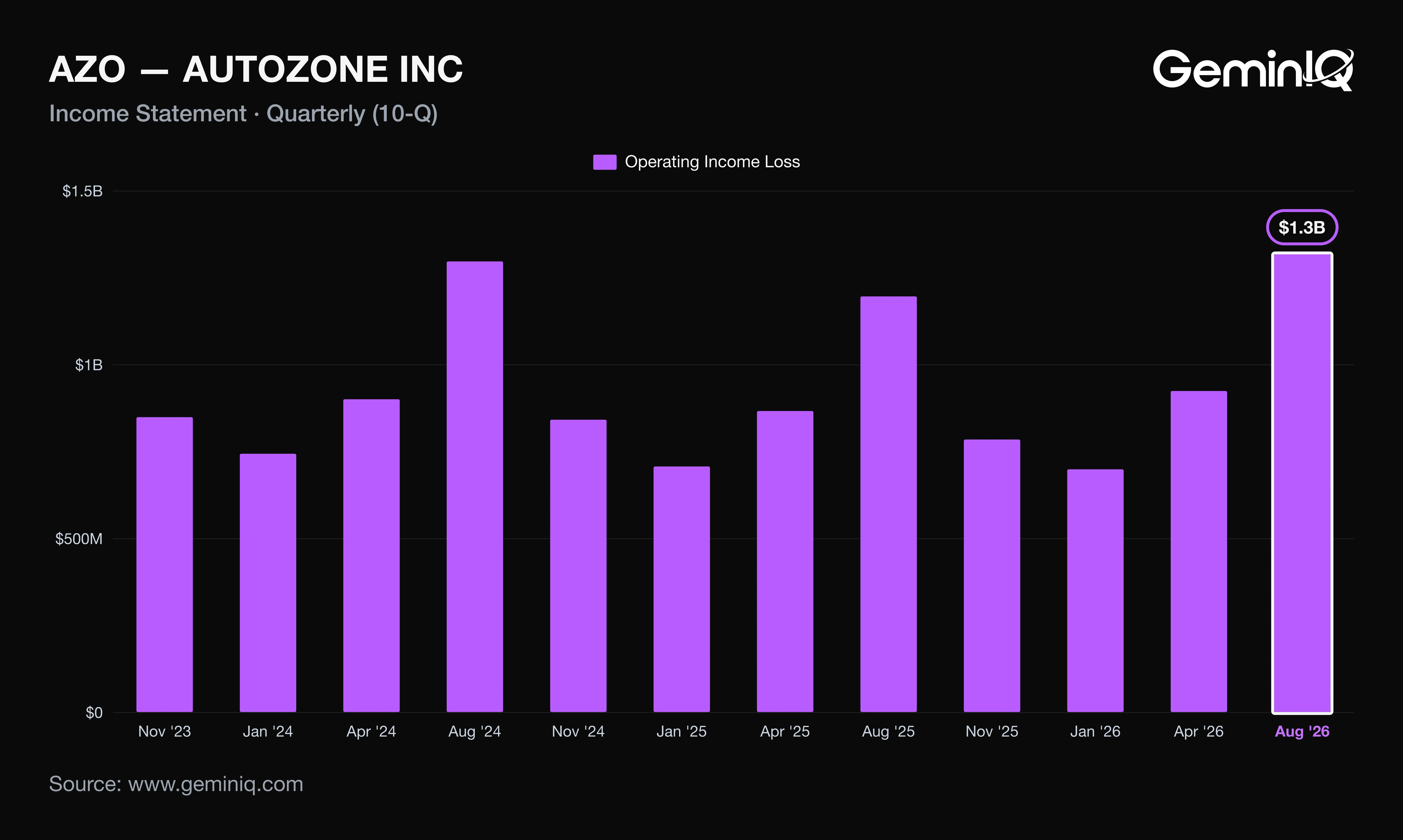
AutoZone's Q4 FY2026 revenue was $6.59 billion, up 5.6% from a year earlier, and operating income was $1.32 billion, up 10.1%. Same-store sales rose 1.5% in constant currency (domestic 1.6%), according to the 8-K, so most of the growth came from the 175 stores opened in the quarter. A reader would expect operating profit growing at nearly twice the pace of sales to signal operating leverage. Instead operating expenses rose to 33.4% of sales from 32.4%, and the gain arrived above that line.
The Data: Gross margin was 53.3%, up 1.8 points and the fourth-highest of the last 16 quarters. Operating margin was 20.0%, up 0.8 points, only the sixth-highest of those 16. Net income rose 11.3% to $931.6 million; diluted EPS rose 15.1% from $48.71, and year-end shares outstanding fell 3.0% to 16.17 million (8-K).
Why: Fewer shares explain about 3.8 points of the gap between EPS growth and net income growth. The refund explains most of the rest. At the 20.9% full-year tax rate, $96.0 million of lower cost of sales adds roughly $4.57 per share, so EPS excluding it would have been about $51.5, up 5.7%. These are derived figures, not reported ones. The quarter's growth rate was set by a refund the 10-K describes as substantially all of what the company filed for.
What AutoZone's 10-K Shows Beyond the Press Release
AutoZone's FY2026 10-K reports $127.6 million of IEEPA tariff refunds received, of which $96.0 million reduced cost of sales and $31.6 million reduced inventory. The release sized the realized part in basis points; the filing adds the part still on the shelves.
The Data: The release credits the gross margin increase to a 145-basis-point tariff-refund effect and a 105-basis-point net non-cash LIFO effect, "partially offset by higher commercial mix." Those two items total 250 basis points against a reported gain of 182, leaving about negative 68 basis points for everything else (derived). For the full year, gross margin fell 29 basis points to 52.3% even with a 48-basis-point refund benefit, and the LIFO charge was $192.0 million against $64.0 million a year earlier.
Why: The Supreme Court invalidated the tariffs on February 20, 2026, and AutoZone filed for refunds on April 20. The company records refunds on receipt, as a reduction to cost of sales for goods already sold. The $31.6 million assigned to inventory moves into cost of sales only as that product sells, so part of the benefit lands in FY2027. Management attributes the operating expense deleverage to growth initiatives; the numbers fit, since 374 net new stores opened in the year. Next year's gross margin comparison starts against a quarter that carried 145 basis points of one-time refunds.
AutoZone Q4 FY2026 Free Cash Flow, Buybacks and Debt
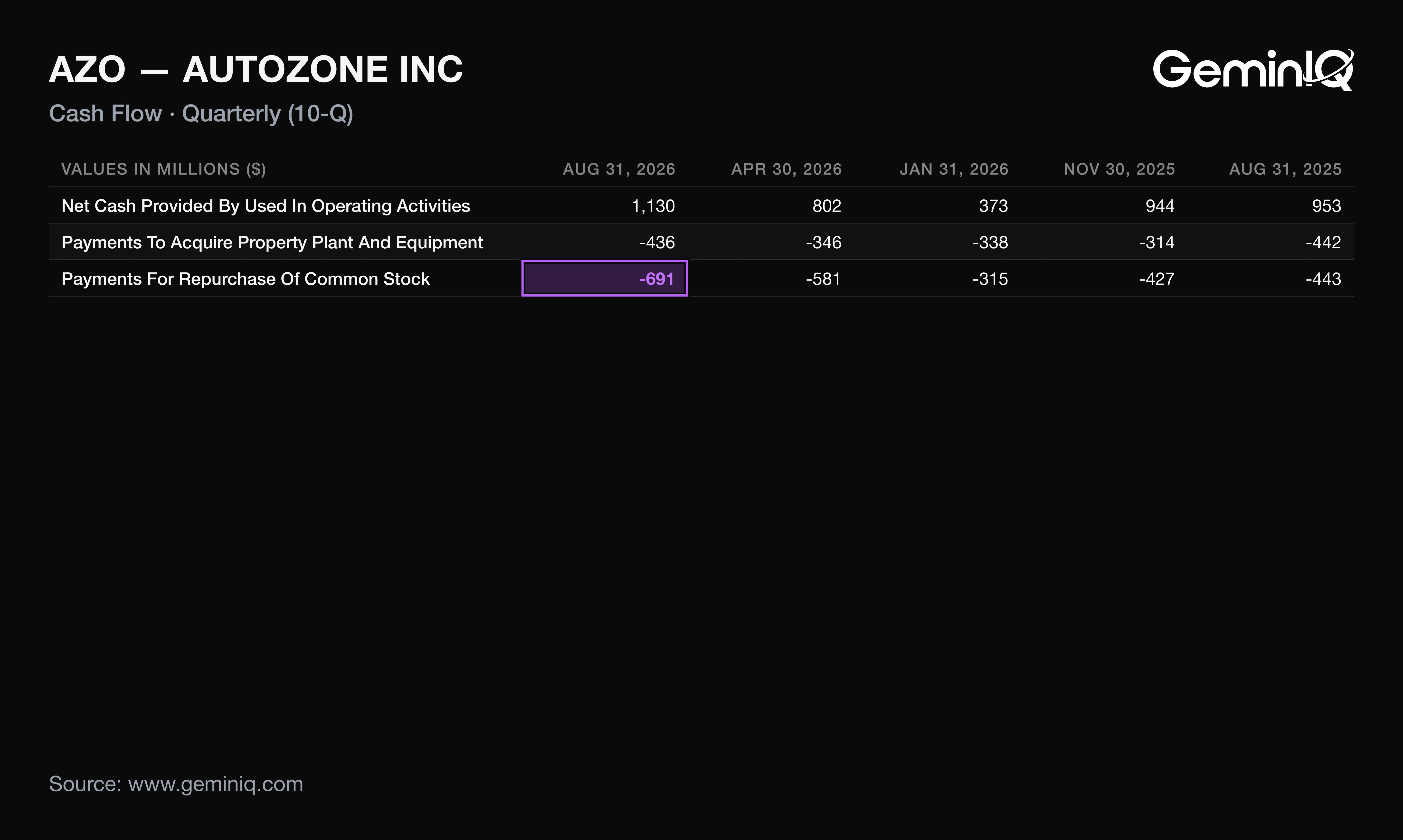
AutoZone's Q4 FY2026 free cash flow was $693.4 million, up 35.7%, as operating cash flow rose 18.6% to $1.13 billion and capital expenditure slipped 1.3% to $436.1 million. One strong quarter overstates the year: GeminIQ's pre-calculated Free Cash Flow for the trailing twelve months was $1.82 billion, up only 1.4%.
The Data: The company repurchased $691 million of stock in the quarter, matching Q4 free cash flow almost dollar for dollar. For the year it spent $2.0 billion on 579 thousand shares at an average $3,496, more than the trailing free cash flow. Debt rose to $9.08 billion from $8.80 billion on $276.4 million of net commercial paper borrowing. GeminIQ's Net Debt to EBITDA was 1.99x against 2.02x a year earlier. Inventory grew 10.1% against sales growth of 5.6%, and the accounts payable to inventory ratio slipped to 111.1% from 114.2%.
Why: AutoZone targets adjusted debt to EBITDAR of 2.5 and says debt rises as EBITDAR rises, so earnings growth itself funds part of the buyback. The cost shows in returns: GeminIQ's Return on Invested Capital (ROIC) fell to 49.27% from 59.57%, and the company's adjusted ROIC fell to 35.8% from 41.3%. Its invested capital grew 19% to $9.33 billion while adjusted after-tax return grew 2.9% (derived from the 10-K reconciliation). The company attributes the inventory build to 175 new stores including 16 Mega Hubs, which is a benign explanation consistent with 374 new stores in the year. Returns fall when the capital base compounds faster than the profit earned on it, whatever the buyback does to EPS.
How AZO Stock Has Moved After Past Earnings Reports
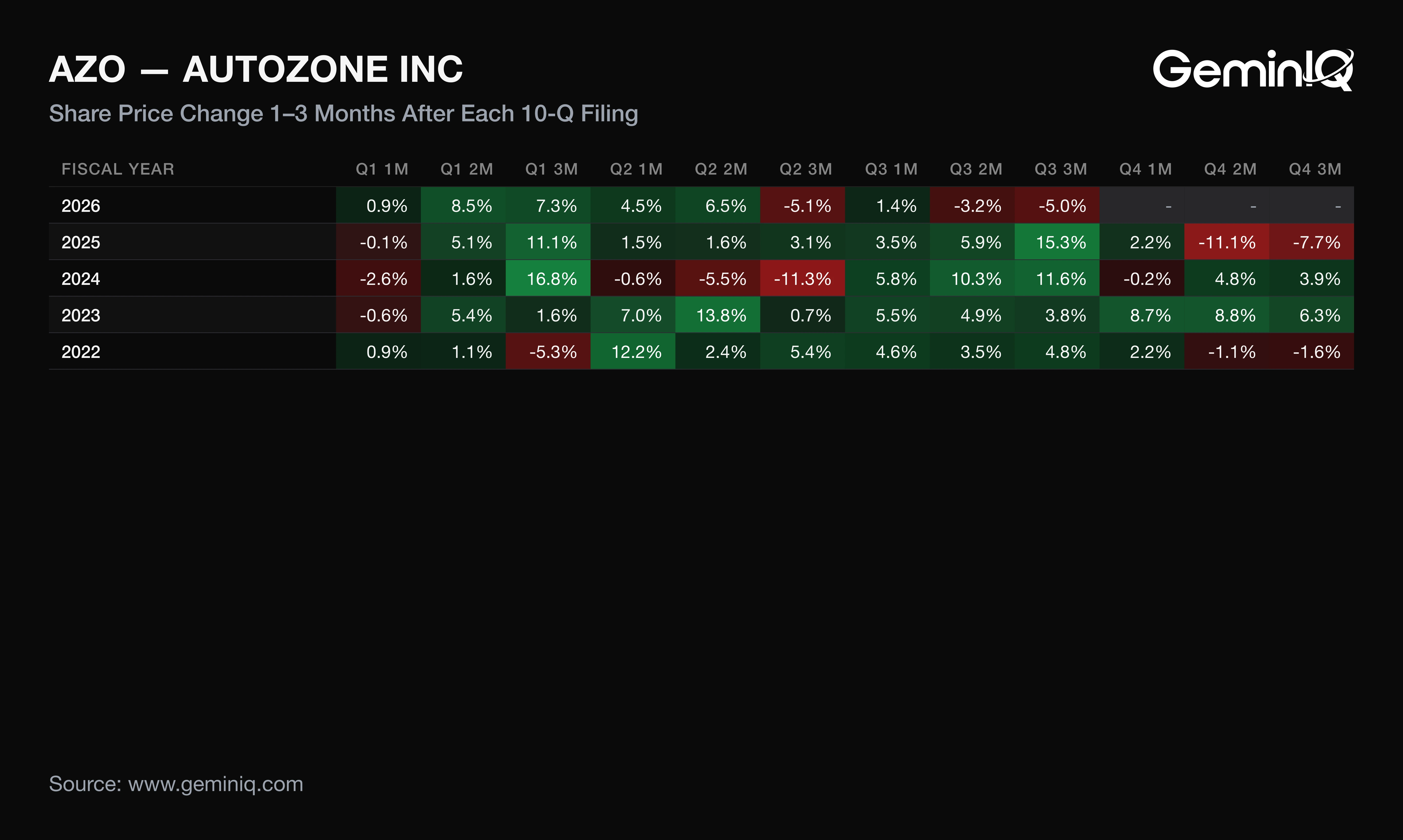
After AutoZone's last 12 filings with a completed one-month window, the median one-month return was +1.4%, and the stock was higher after 8 of the 12. The three-month median was +5.1%, also positive after 8 of 12.
The Data: One-month returns ranged from -2.6% to +8.7%, and three-month returns from -11.3% to +16.8%. After the last three fourth-quarter filings, one-month and three-month returns were +8.7% and +6.3% (FY2023), -0.2% and +3.9% (FY2024), and +2.2% and -7.7% (FY2025). This filing's window has not elapsed. These figures describe how AutoZone's stock moved after its past filings; they are a historical association, not a forecast.
Why: The history shows a mild positive skew and wide spread, so any single reaction says little about the next. For ownership, 13F data put institutions at 91.80% at June 30, 2026, up from 86.83% a year earlier and the highest of the last 16 quarters. Form 4 filings through August 7, 2026 show 9 sales totaling $62.1 million and 4 purchases of $1.7 million over 12 months, versus 16 sales of $228.0 million and no purchases in the prior 12 months. Richard Craig Smith accounted for 53% of the recent sales. Both datasets predate the release and lag it.
See also GeminIQ's study of post-earnings price reactions. Any quarter whose margin gain is smaller than its disclosed one-time items has an underlying trend pointing the other way.
Frequently Asked Questions
When does AutoZone report earnings?
AutoZone released Q4 FY2026 results on September 22, 2026 and filed its 10-K on October 26, 2026. Last year it filed its next quarter, FY2026 Q1, on December 19, 2025. That is a filing-record pattern, not a forecast of the date.
Does AutoZone pay a dividend?
AutoZone paid no dividends in Q4 FY2026 or in the trailing twelve months. It returns cash through buybacks instead: $2.0 billion in FY2026, plus another $310.6 million from August 30 through October 19, 2026, leaving $1.3 billion of authorization.
Is AutoZone doing well financially?
AutoZone's FY2026 net income was $2.57 billion, up 3.0%, on sales of $20.3 billion. GeminIQ's trailing net profit margin was 12.65% against 13.19% a year earlier, and Net Debt to EBITDA was 1.99x.
What was AutoZone's free cash flow in Q4 FY2026?
AutoZone's Q4 FY2026 free cash flow, operating cash flow less capital expenditure, was $693.4 million, the third-highest of the last 16 quarters. Fiscal-year capital investment was $1.4 billion, and the 10-K says FY2027 investment should rise slightly.
Wall Street's data. Main Street's price.
Institutional terminals charge thousands a year for as-filed accuracy. GeminIQ gives you the same thing for a fraction of the cost: financials built directly from raw SEC EDGAR filings, not third-party APIs, with full XBRL traceability back to the original 10-K or 10-Q. No normalized guesswork, just calculated metrics, charts, screeners, and watchlists built on numbers exactly as the company reported them. Start researching now at GeminIQ.com.
All financial figures cited in this article reference AUTOZONE, INC.'s fiscal 2026 10-K (filed October 26, 2026, period ending August 31, 2026), with guidance and management commentary drawn from the company's Form 8-K earnings release (filed September 22, 2026). All SEC filings are publicly available at SEC EDGAR and SEC EDGAR.
Disclaimer: The content in this blog is for educational and entertainment purposes only and does not constitute financial, legal, or tax advice. Investing involves risk, including the loss of principal. The views expressed are my own and not intended as financial advice or a guarantee of future performance.