Bally's (BALY) Q3 2026 Earnings: Revenue Up 22%, Cash Flow -$279M

By Chad Hartman
Published · Last updated
Bally's (NYSE: BALY) reported Q3 FY2026 revenue of $807.6 million, up 21.7%, and a diluted loss of $1.47 per share, narrower than the $1.70 loss a year earlier, for the quarter ended September 30, 2026. Operating income fell to a $69.9 million loss from $1.0 million of income, and operating cash flow was -$278.7 million. The company released results and filed its 10-Q on November 16, 2026; the 10-Q adds that Bally's does not project it would satisfy a liquidity requirement on its revolving credit facility.
| Field | Value |
|---|---|
| Company | Bally's ($BALY) |
| Quarter | Q3 FY2026, period ended September 30, 2026 |
| Earnings release | November 16, 2026 (Form 8-K) |
| 10-Q filed | November 16, 2026 |
| Revenue | $807.56 Million (+21.7% YoY) |
| Diluted EPS | -$1.47 (loss narrowed from -$1.70, +13.5% YoY) |
| Operating margin | -8.7% (-8.8 pts YoY) |
| Operating cash flow (TTM) | -$399.6 Million (nine months ended September 30, 2026, per the 10-Q; trailing-twelve-month figure not reliable) |
| Operating cash flow (Q3 2026) | -$278.7 Million |
Bally's Q3 2026 Revenue, Operating Loss and EPS
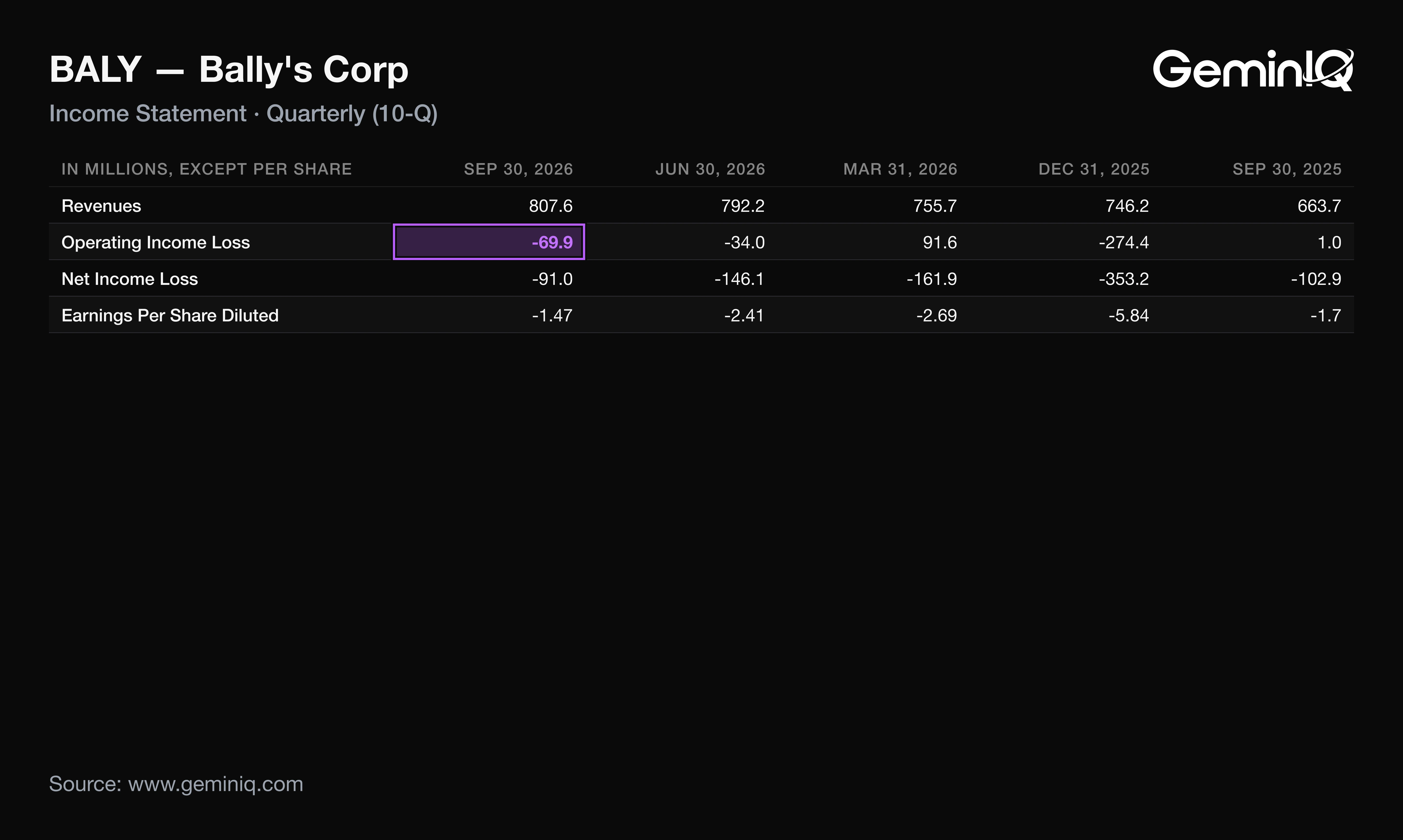
Bally's Q3 2026 revenue was $807.6 million, up 21.7% from $663.7 million and the highest of the last 16 quarters. Acquisitions produced the growth, and the operating line moved the other way.
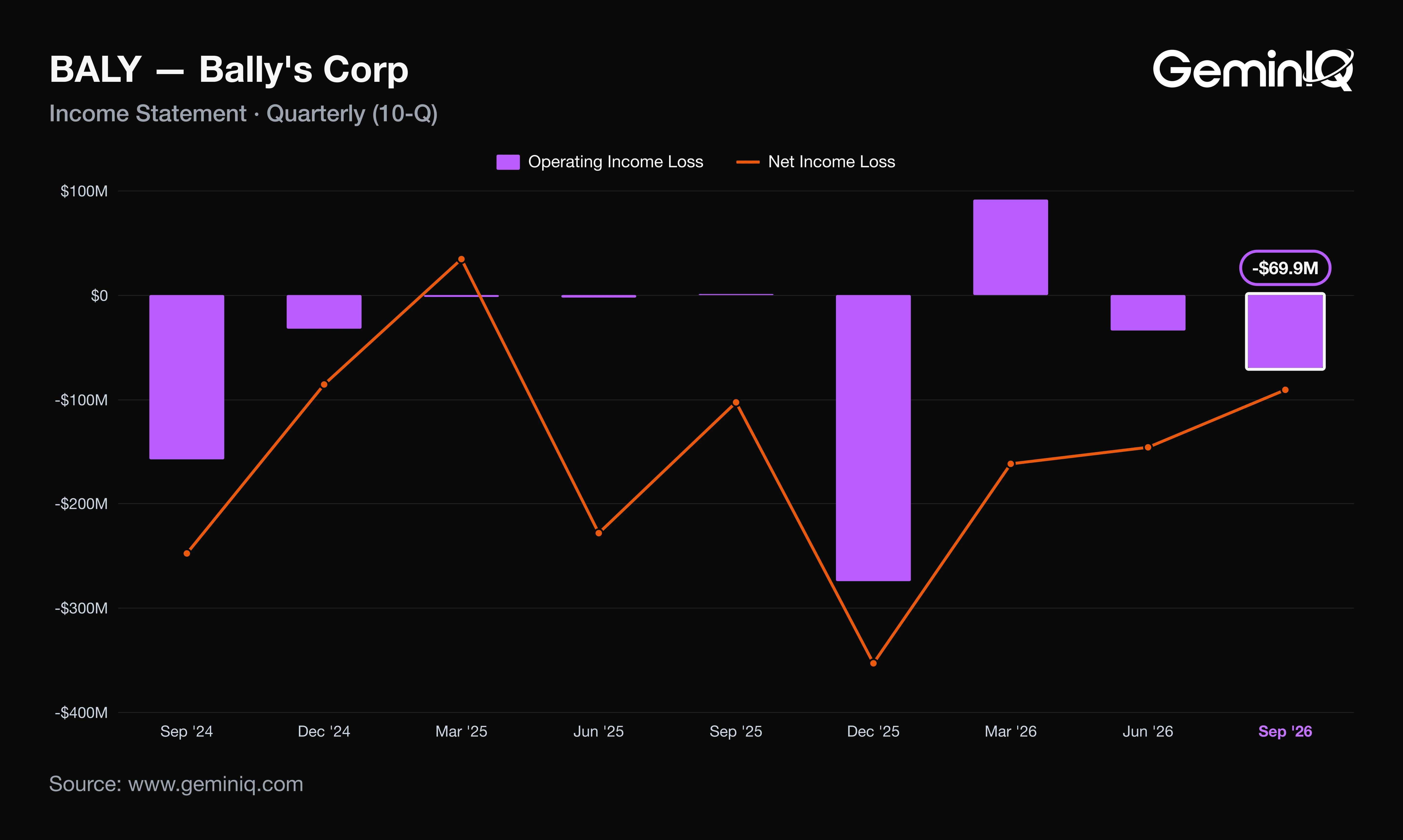
The Data: The Bally's Intralot entities, consolidated since October 8, 2025, contributed $98.7 million of revenue, so revenue excluding them rose about 7%. Operating income was -$69.9 million, the sixth-lowest of the last 16 quarters, and operating margin was -8.7% against 0.1% a year earlier. The 10-Q puts Intralot's operating losses at $59.8 million. Depreciation and amortization rose $55.0 million, to 16.5% of revenue from 11.8%.
Why: The narrower EPS loss did not come from operations. Total net loss widened to $117.0 million from $106.2 million. The loss attributable to Bally's shrank to $91.0 million from $102.9 million because noncontrolling holders absorbed roughly $26.0 million of it, against $3.3 million a year earlier, and because other expense, net fell to $40.9 million from $148.5 million. EPS improved because of where the losses landed. Diluted shares rose 2.0% to 61.85 million, the highest of the last 16 quarters.
What Bally's 10-Q Shows Beyond the Q3 2026 Press Release
Bally's 10-Q states that the company does not currently project it would satisfy its revolving credit facility's liquidity maintenance requirement, and the release's narrative never mentions it.
A reader who saw the CEO's statement that "execution is improving results across every segment" would expect a routine debt note. Instead the 10-Q reports that lenders conditionally waived the net leverage covenant in May and October 2026, that the waiver depends on liquidity tests, and that Bally's "may not be in compliance" during the twelve months after the statements were issued.
The Data: Bally's reclassified $379.1 million of the $498.3 million revolver to current liabilities. Interest expense net of interest income was $126.3 million, above the 10-Q's Adjusted EBITDA of $116.2 million, which itself fell from $130.6 million. GeminIQ's pre-calculated Net Debt to EBITDA was 29.43x on a trailing basis against 15.55x a year earlier, and the Current Ratio was 0.72x. Segment Adjusted EBITDAR also contradicts "every segment": Casinos & Resorts was flat at $107.8 million and Bally's Intralot B2C fell to $77.0 million from $86.4 million.
Why: The $400 million Bronx term loan that closed October 1 is, per the 10-Q, primarily designated for that project, so it does not cure the revolver test. The company says it is pursuing asset monetization, an equity sale and more debt, with no assurance any other than the term loan will close. The waiver, not earnings, now decides whether the revolver stays long-term.
Bally's Q3 2026 Operating Cash Flow, Capex and Free Cash Flow
Bally's Q3 2026 operating cash flow was -$278.7 million, against -$120.9 million in Q2, while capital expenditure rose to $95.6 million from $35.1 million.
The Data: Operating cash flow less capital expenditure was -$374.3 million, against -$156.0 million in Q2. Revenue rose 1.9% sequentially. Nine-month operating cash use was $399.6 million, so Q3 carried about 70% of it on about 34% of nine-month revenue. Cash and restricted cash fell to $598.8 million from $906.7 million at the start of the year.
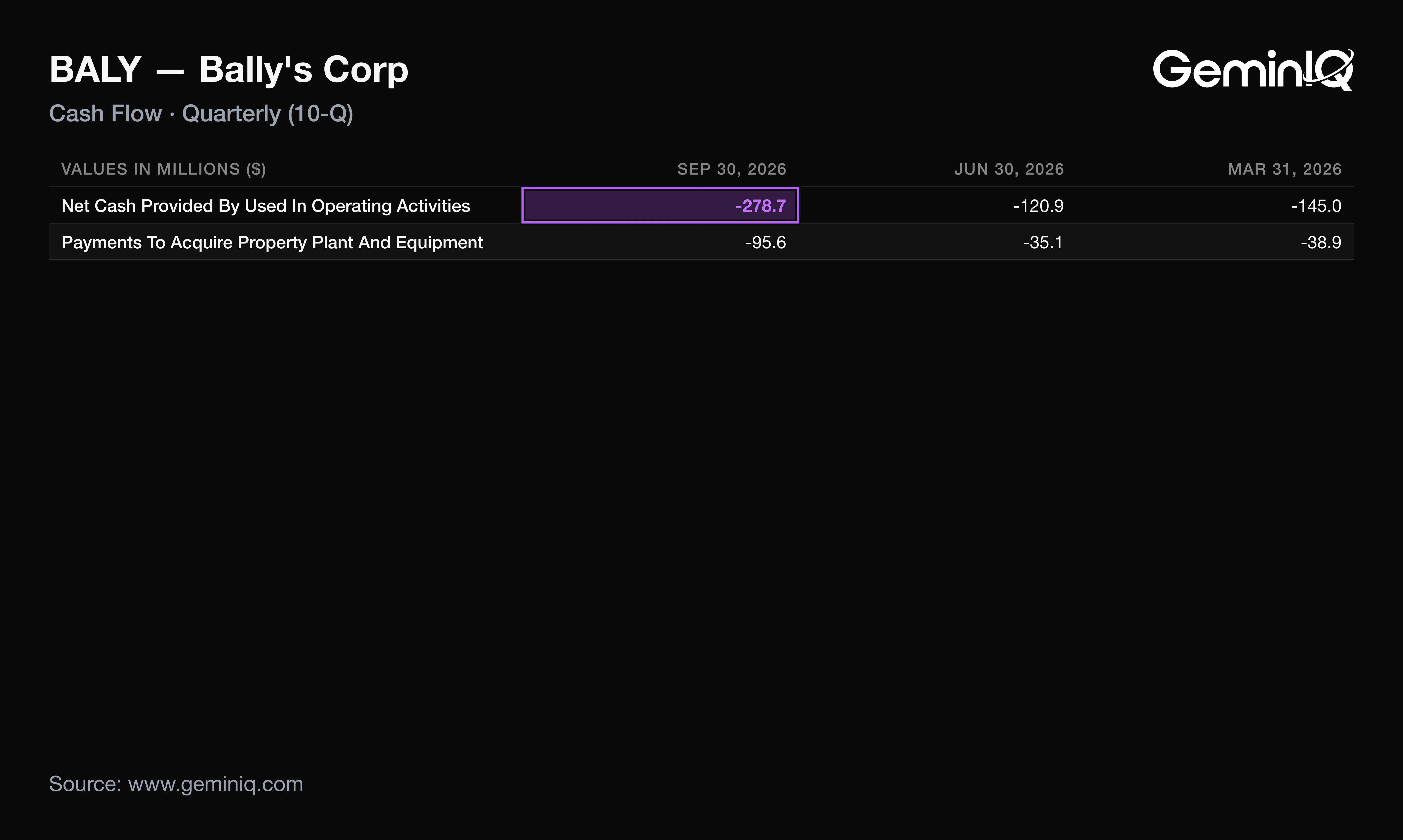
Why: Management attributes the nine-month cash use to $98.9 million of up-front license fees, a $90.7 million larger net loss and working capital. License fees buy supply rights and sit in Other assets, so part of the burn is investment, not operating loss. That explains the nine months but not why Q3 alone was more than double Q2, and the excerpted notes do not split it by quarter. Had Q3 matched Q2's burn, the nine-month figure would be about $158 million smaller.
How BALY Stock Has Moved After Past Earnings Reports
Bally's one-month return after its last seven 10-Q filings with completed windows had a median of -7.1% and was positive after one of the seven.
The Data: The one-month range ran from -34.7% (FY2026 Q2, filed August 14, 2026) to +26.7% (FY2026 Q1). Three-month returns had a median of -3.4%, positive after three of seven, from -46.1% to +83.0%. The one earlier Q3 filing, FY2025, was followed by -0.2% and -11.3%. This filing's window has not elapsed. Institutions held 62.89% at June 30, 2026, down 1.55 points from a year earlier; the September 13F is not yet filed.
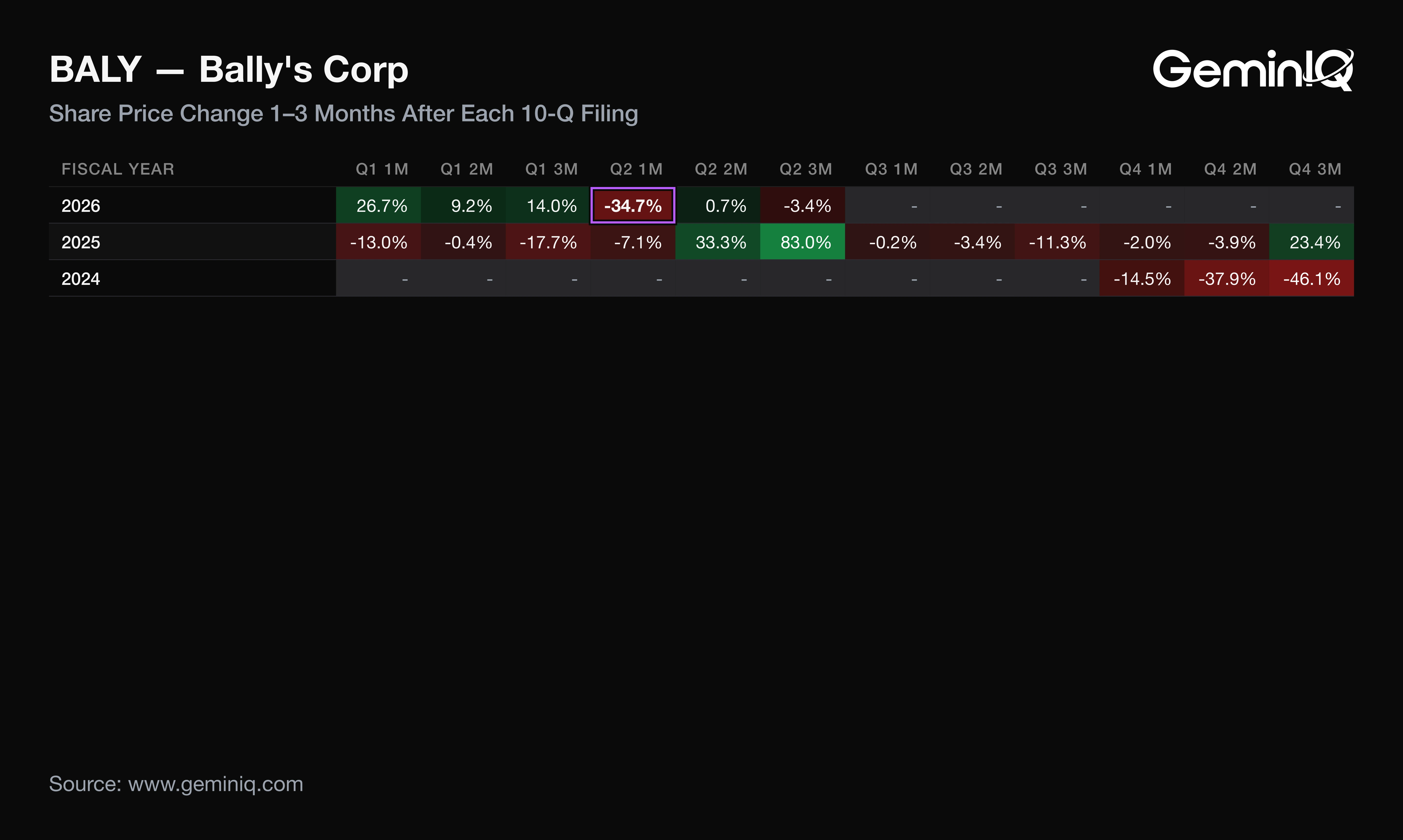
Why: These figures describe how Bally's stock moved after its past filings; they are a historical association, not a forecast. The Earnings Reaction Heat Map shows the history is skewed negative and wide, so one filing's return says little about the next.
For any issuer whose interest bill exceeds its adjusted EBITDA, the waiver language in the debt note moves the reading of a quarter more than the growth rate does.
Frequently Asked Questions
Is Bally's doing well financially?
Bally's reported a trailing net profit margin of -24.25% as of Q3 2026, against -16.85% a year earlier. Its trailing operating margin was -9.24% and trailing return on invested capital was -5.63%. Revenue is growing, but the company is not profitable on a GAAP basis.
When does Bally's report earnings?
Bally's reported Q3 2026 results and filed its 10-Q on November 16, 2026, against November 12 for Q3 2025. Last year it filed its fourth-quarter results on March 23, 2026. That is a filing-record pattern, not a forecast of the next date.
Does Bally's pay a dividend?
No. Bally's paid no cash dividends in the periods presented and says it does not intend to pay any in the foreseeable future. It repurchased no shares in 2026; $95.5 million remained available under its $700 million capital return program at September 30, 2026.
What was Bally's revenue in Q3 2026?
Bally's Q3 2026 revenue was $807.6 million, up 21.7%, and nine-month revenue was $2,355.5 million. Casinos & Resorts contributed $408.6 million and Bally's Intralot B2C $257.5 million.
Wall Street's data. Main Street's price.
Institutional terminals charge thousands a year for as-filed accuracy. GeminIQ gives you the same thing for a fraction of the cost: financials built directly from raw SEC EDGAR filings, not third-party APIs, with full XBRL traceability back to the original 10-K or 10-Q. No normalized guesswork, just calculated metrics, charts, screeners, and watchlists built on numbers exactly as the company reported them. Start researching now at GeminIQ.com.
All financial figures cited in this article reference Bally’s Corporation's Q3 2026 10-Q (filed November 16, 2026, period ending September 30, 2026), with guidance and management commentary drawn from the company's Form 8-K earnings release (filed November 16, 2026). All SEC filings are publicly available at SEC EDGAR and SEC EDGAR.
Disclaimer: The content in this blog is for educational and entertainment purposes only and does not constitute financial, legal, or tax advice. Investing involves risk, including the loss of principal. The views expressed are my own and not intended as financial advice or a guarantee of future performance.