
DoorDash (DASH) Q3 2026 Earnings: EPS Up 93%, Year-Ago Loss Did 39%

By Chad Hartman
Published · Last updated
DoorDash (DASH) reported Q3 FY2026 revenue of $4.62 billion, up 34.0% year over year, and diluted EPS of $1.06, up 92.7%, for the quarter ended September 30, 2026; it released results on October 29, 2026 and filed its 10-Q on October 30. EPS grew nearly three times as fast as revenue, yet $86 million of the $222 million rise in net income came from a year-ago loss on a Deliveroo-related forward contract that did not recur. Operating cash flow rose 14.1%, so cash did not follow the earnings jump.
| Field | Value |
|---|---|
| Company | DoorDash ($DASH) |
| Quarter | Q3 FY2026, period ended September 30, 2026 |
| Earnings release | October 29, 2026 (Form 8-K) |
| 10-Q filed | October 30, 2026 |
| Revenue | $4.62 Billion (+34.0% YoY) |
| Diluted EPS | $1.06 (+92.7% YoY) |
| Operating margin | 9.6% (+2.1 pts YoY) |
| Operating cash flow (TTM) | $2.95 Billion |
| Other income (expense), net | $5M (vs. -$81M year-ago) |
DoorDash Q3 2026 Revenue, EPS and Margins
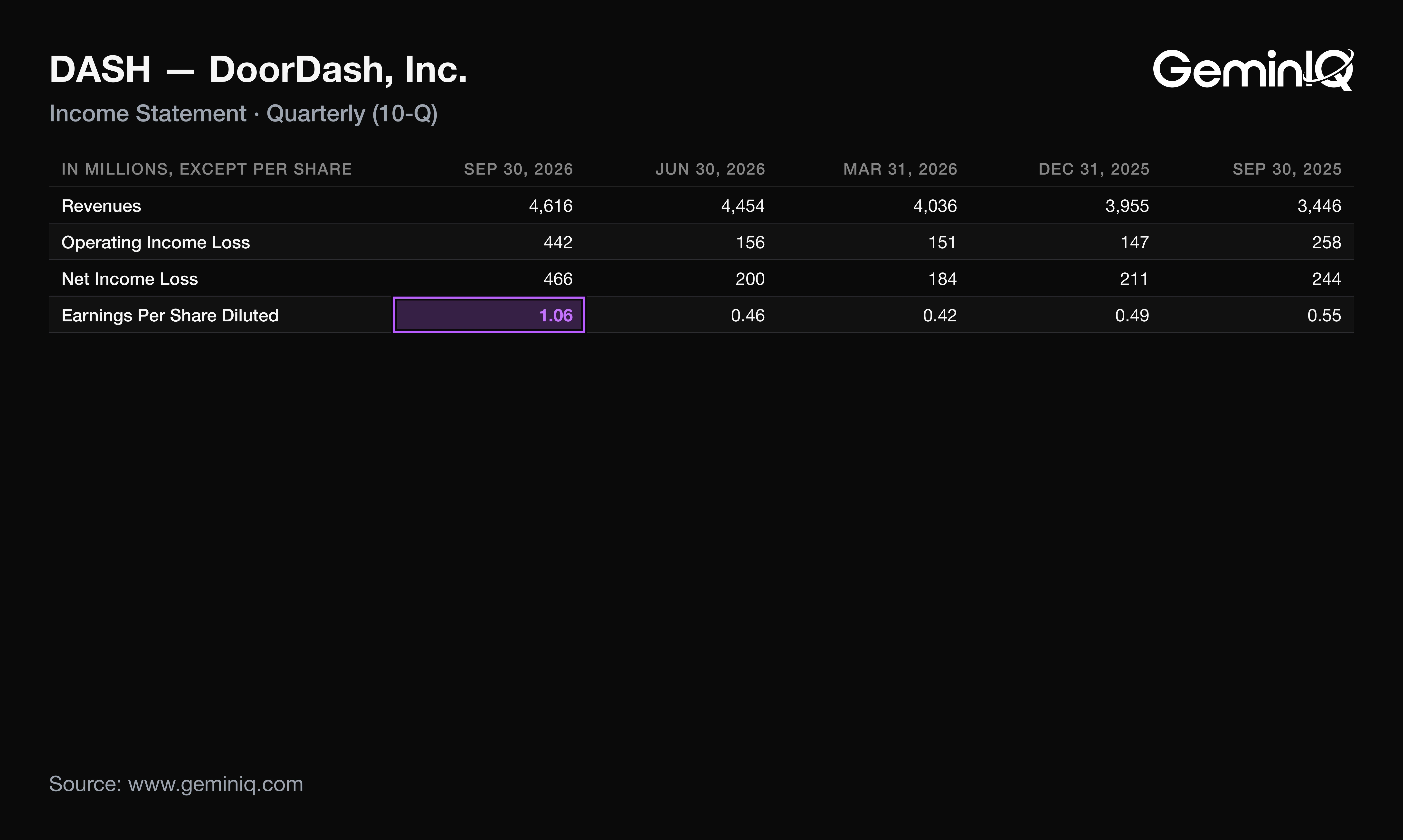
DoorDash's Q3 2026 revenue was $4.62 billion, up 34.0% from $3.45 billion a year earlier, and diluted EPS was $1.06, up 92.7% from $0.55. Operating leverage supplied most of that EPS jump, not all of it.
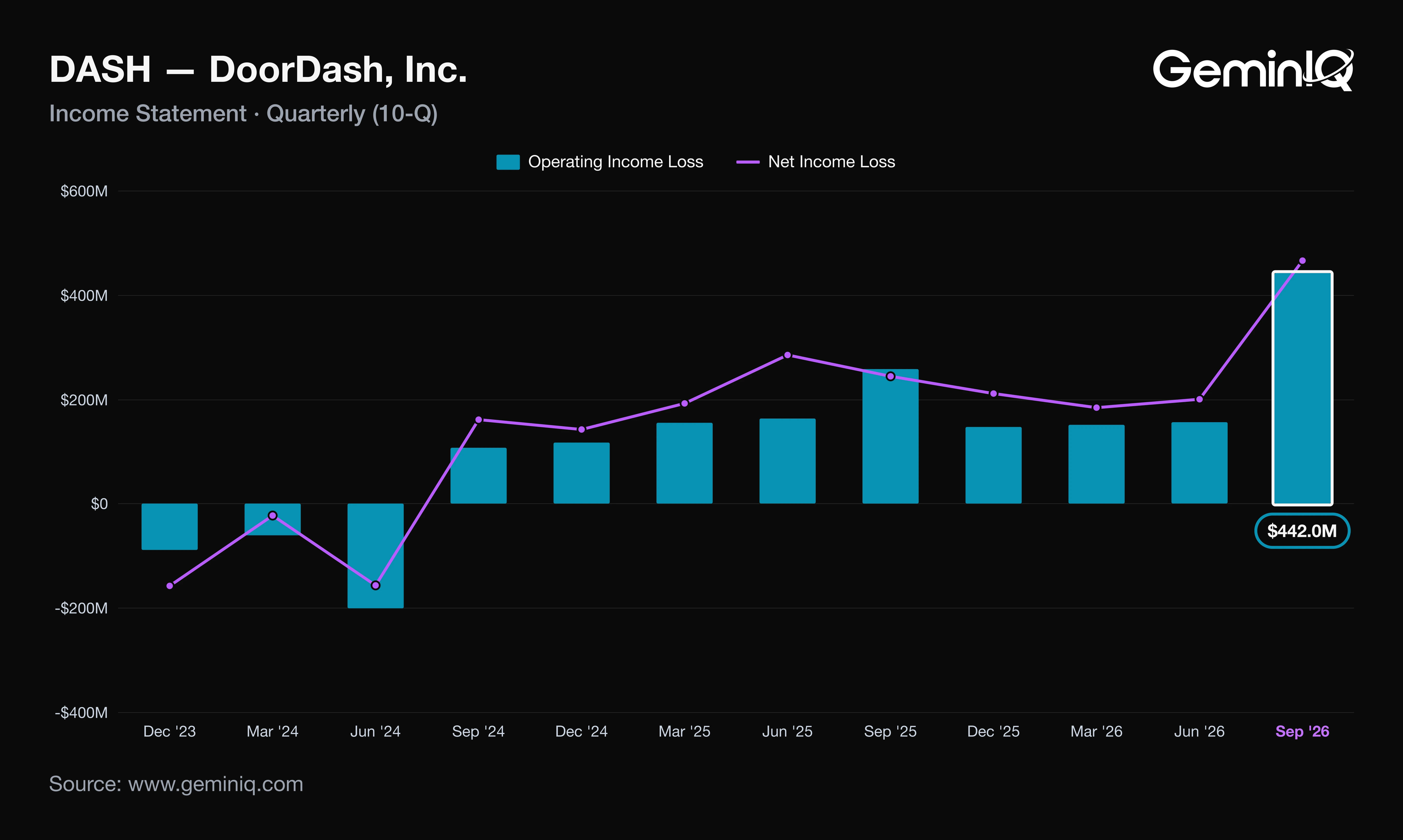
The Data: Operating income was $442 million, up 71.3% and the highest of the last 16 quarters, lifting operating margin to 9.6% from 7.5% a year earlier and 3.5% in Q2. Net income of $466 million exceeded operating income because other income was a $5 million gain against an $81 million expense in Q3 2025. Of the $222 million rise in net income, operating income contributed $184 million and the other-income swing $86 million; lower net interest income took back $34 million and higher taxes $14 million.
Why: The 10-Q attributes the year-ago expense to the fair-value change on a deal-contingent forward contract tied to the Deliveroo acquisition, which settled at closing in October 2025. With other income removed from both quarters, net income rose from $325 million to $461 million, up 42% rather than 91% (derived). Diluted shares fell 0.3% to 440.31 million, which is the whole 1.7-point gap between EPS growth and net income growth. About 39% of the net income gain was a base effect.
What DoorDash's 10-Q Shows Beyond the Q3 2026 Press Release
The release led with revenue up 34% and a record net income of $466 million, and the 10-Q adds that depreciation and amortization rose 85% to $312 million while operating margin still climbed. Operating margin rose despite that drag because general and administrative costs collapsed.
The Data: Depreciation and amortization reached 6.8% of revenue against 4.9% a year earlier. Cost of revenue excluding depreciation fell to 47.0% of revenue from 49.0%. General and administrative expense fell to $426 million from $538 million in Q2, or 9.2% of revenue against 11.6% a year earlier.
Why: The company excludes "certain legal, tax, and regulatory settlements, reserves, and expenses" from Adjusted EBITDA, and the reconciliation shows those items at $16 million in Q3 against $159 million for the nine months, which implies $143 million in the first half (derived). Q2's 3.5% operating margin carried that load; Q3's 9.6% did not. The company attributes the line to worker-classification and tax matters it does not expect to recur, a claim the first-half total tests rather than confirms.
DoorDash Q3 2026 Operating Cash Flow, Instacart Financing and Balance Sheet
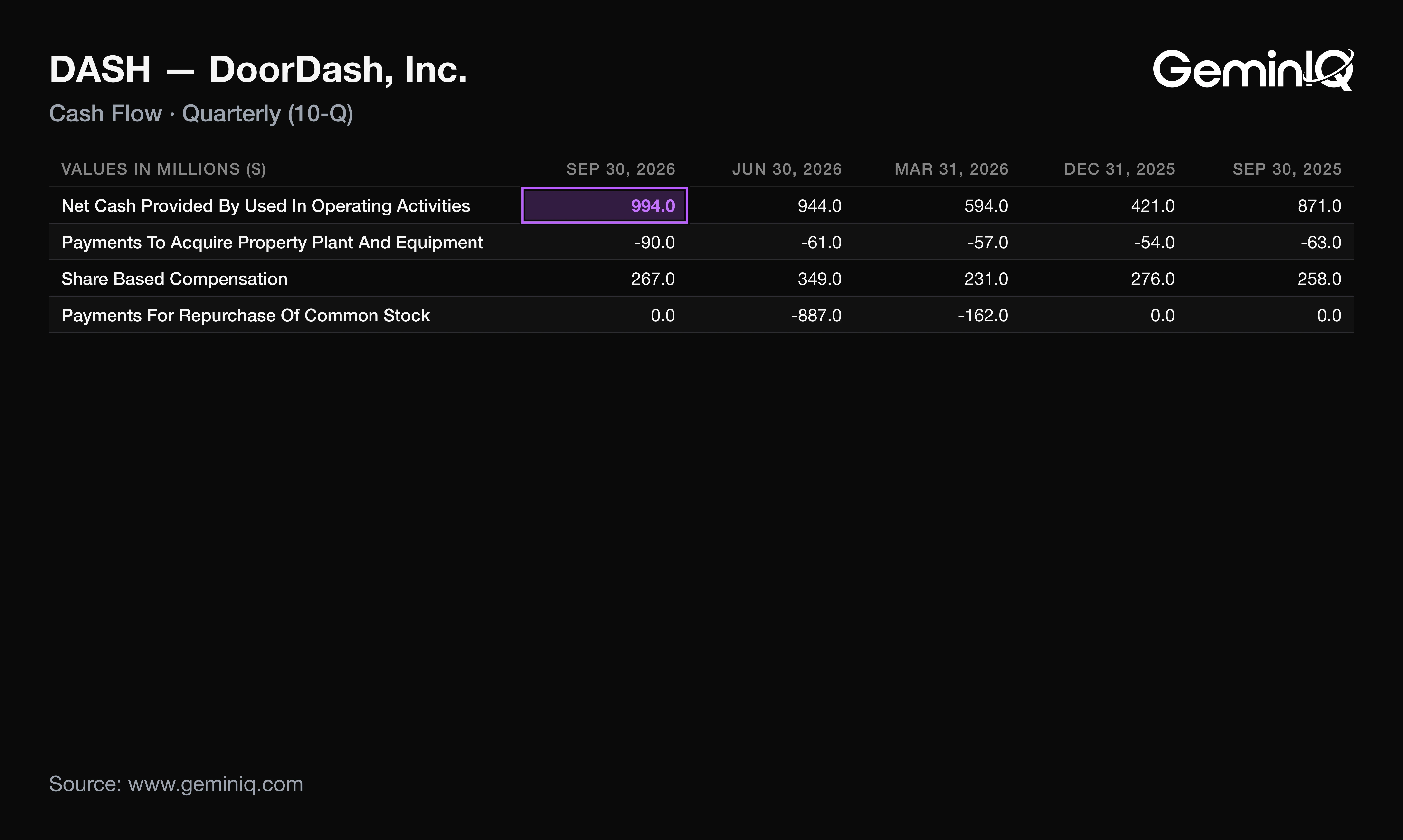
DoorDash's Q3 2026 operating cash flow was $994 million, up 14.1% from $871 million and the highest of the last 16 quarters. Net income grew 91% over the same window.
The Data: Operating cash flow equaled 2.1 times net income, down from 3.6 times a year earlier. The company's own Free Cash Flow, defined as operating cash flow less purchases of property and equipment and capitalized software, was $787 million, up 9% from $723 million. GeminIQ's pre-calculated Net Debt to EBITDA was -1.36x against -3.56x a year earlier.
Why: Part of net income's jump was non-operating, so cash flow had less to follow. The balance sheet is also about to change: the 8-K announces an agreement to acquire Instacart for roughly $17 billion of equity value, payable in at least 75% cash, which is at least about $12.75 billion (derived). DoorDash says it will fund the cash portion from cash on hand and debt, backed by a 364-day bridge facility, with closing expected at the end of 2027 or in the first half of 2028. A net-cash balance sheet of the kind the -1.36x reading describes is the starting point, not the ending one.
DoorDash's Q4 2026 Guidance After Q3
In its October 29, 2026 8-K, DoorDash guided Q4 2026 Marketplace GOV of $35.4 billion to $36.4 billion and Adjusted EBITDA of $900 million to $1,100 million. Both ranges point to slower growth than the quarter just reported.
The Data: The prior 8-K guided Q3 GOV of $33.0 billion to $34.0 billion and Adjusted EBITDA of $950 million to $1,100 million; the company reported $33.9 billion and $1,060 million, inside both ranges and near the top of the GOV range. The Q4 GOV midpoint of $35.9 billion is 5.8% above Q3, while the Adjusted EBITDA midpoint of $1,000 million is below it, an implied 2.8% of GOV against 3.1% in Q3 (derived). Against Q4 2025 GOV of $29.7 billion, the guided range implies growth of 19% to 23%, against 36% in Q3.
Why: The prior 8-K said the Q4 decline in Adjusted EBITDA as a share of GOV would come from seasonal Dasher costs, an annual insurance increase and technology platform investment. The company also said it will stop reporting results excluding Deliveroo from Q4, because the acquisition will have reached its anniversary.
How DASH Stock Has Moved After Past Earnings Reports
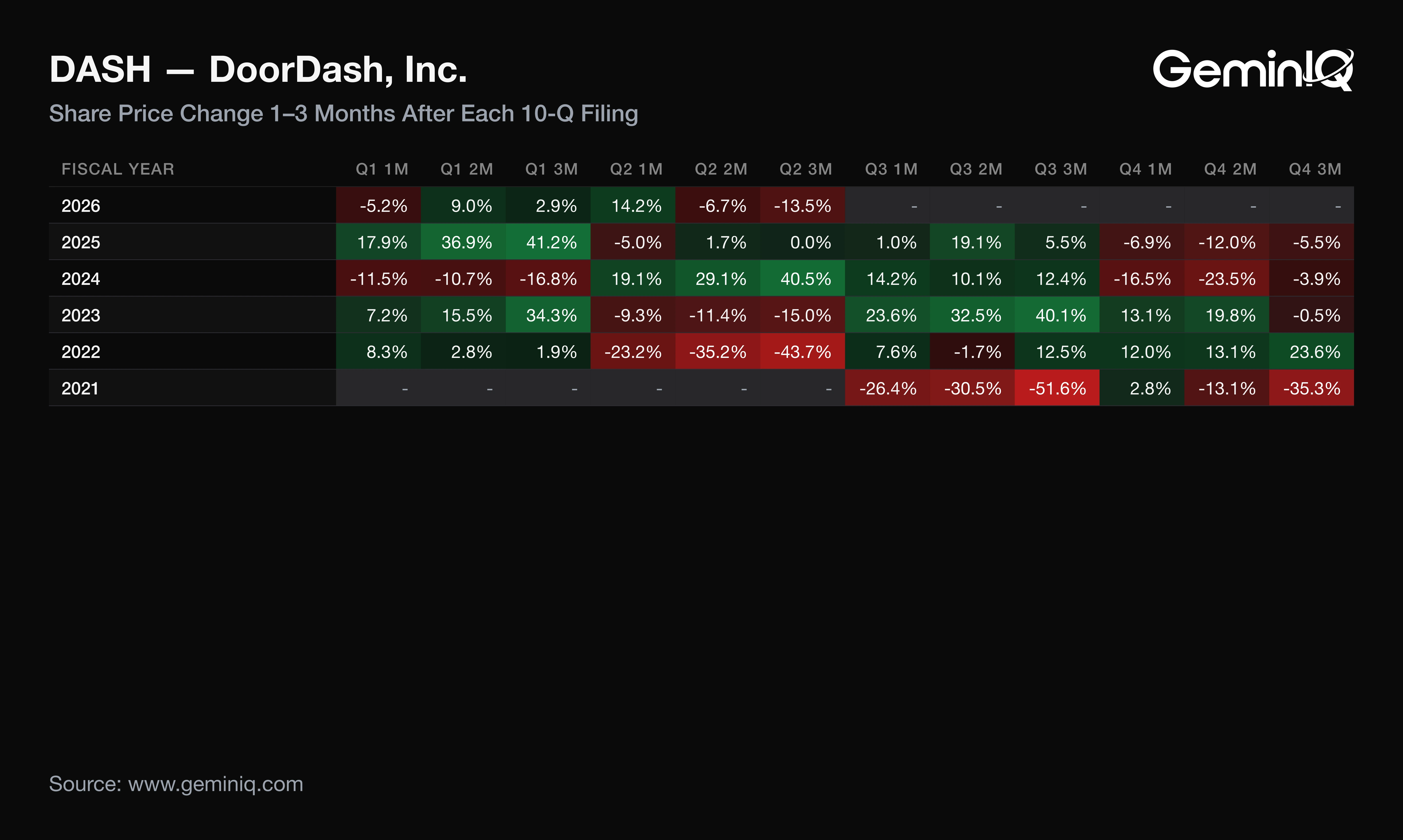
Over the 12 most recent 10-Q filings with a completed one-month window, filed from November 1, 2023 to August 5, 2026, DASH's median one-month return was +7.0%, positive after 7 of 12, with a range of -16.5% to +23.6%. These figures describe how DoorDash's stock moved after its past filings; they are a historical association, not a forecast.
The Data: Past Q3 filings were followed by one-month returns of +23.6% (FY2023), +14.2% (FY2024) and +1.0% (FY2025), a shrinking sequence. The current filing has no return yet because its window has not elapsed. The GeminIQ Earnings Reaction Heat Map below covers 1-3 months after each 10-Q filing.
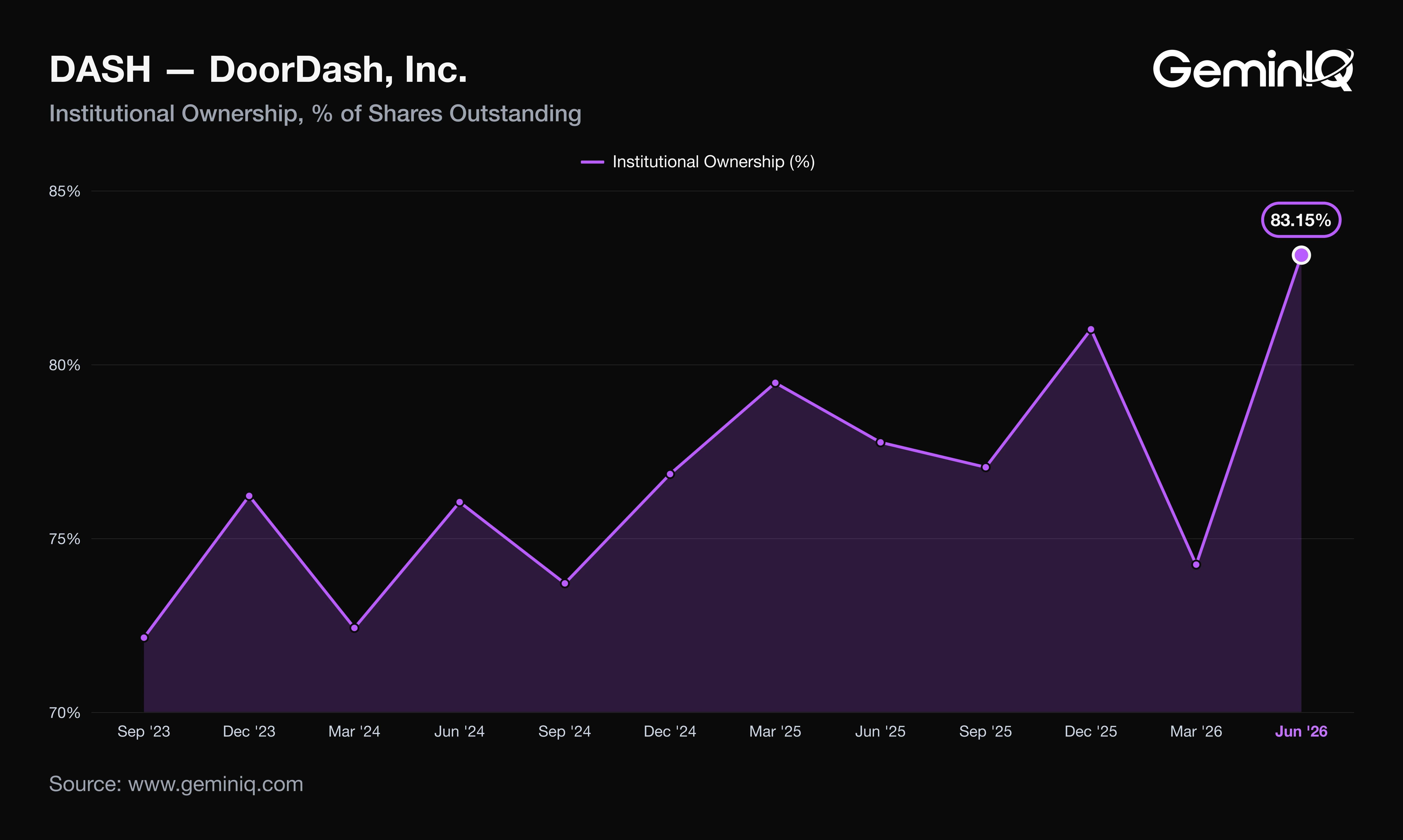
Institutions held 83.15% of shares at June 30, 2026 in SEC Form 13F data, up from 77.76% a year earlier and the highest of the 12 quarter-ends shown; the September 30 filings had not landed at publication. In Form 4 filings through September 28, 2026, insiders sold $326.1 million across 111 transactions and bought $99.9 million across 4 over the prior 12 months, against $778.9 million of sales and no purchases in the 12 months before that.
Why: The history is a distribution, not a mechanism. The 40-point spread from the lowest to the highest one-month return is several times the +7.0% median, so any single window says little about the next one. A reaction record whose spread dwarfs its median describes uncertainty, not a pattern.
Frequently Asked Questions
When does DoorDash report earnings?
DoorDash released its Q3 2026 results on October 29, 2026 and filed its 10-Q on October 30, 2026. Last year it filed its fourth-quarter results on February 18, 2026, which is a filing-record pattern rather than a forecast of the next date.
Is DoorDash profitable?
DoorDash's Q3 2026 net income was $466 million, with a 10.1% net margin. On a trailing twelve-month basis, GeminIQ's Calculated Metrics put the net profit margin at 6.22% against 6.83% a year earlier, and the operating margin at 5.25% against 5.48%, so the quarter's strength has not yet lifted the annual figures.
Does DoorDash pay a dividend?
DoorDash paid no dividend in Q3 2026 or in the trailing twelve months. Dividends paid were $0 in Q3 2026, Q2 2026 and Q3 2025.
What was DoorDash's free cash flow in Q3 2026?
DoorDash's Q3 2026 Free Cash Flow was $787 million by the company's definition, up from $723 million a year earlier. GeminIQ's pre-calculated Free Cash Flow subtracts only property and equipment purchases and stands at $2.69 billion over the trailing twelve months, so the two measures differ by the capitalized software the company deducts.
Wall Street's data. Main Street's price.
Institutional terminals charge thousands a year for as-filed accuracy. GeminIQ gives you the same thing for a fraction of the cost: financials built directly from raw SEC EDGAR filings, not third-party APIs, with full XBRL traceability back to the original 10-K or 10-Q. No normalized guesswork, just calculated metrics, charts, screeners, and watchlists built on numbers exactly as the company reported them. Start researching now at GeminIQ.com.
All financial figures cited in this article reference DOORDASH, INC.'s Q3 2026 10-Q (filed October 30, 2026, period ending September 30, 2026), with guidance and management commentary drawn from the company's Form 8-K earnings release (filed October 29, 2026). All SEC filings are publicly available at SEC EDGAR and SEC EDGAR.
Disclaimer: The content in this blog is for educational and entertainment purposes only and does not constitute financial, legal, or tax advice. Investing involves risk, including the loss of principal. The views expressed are my own and not intended as financial advice or a guarantee of future performance.