
GameStop Q1 2026 10-Q: The $4 Billion Debt Nobody Priced In

By Chad Hartman
Published · Last updated
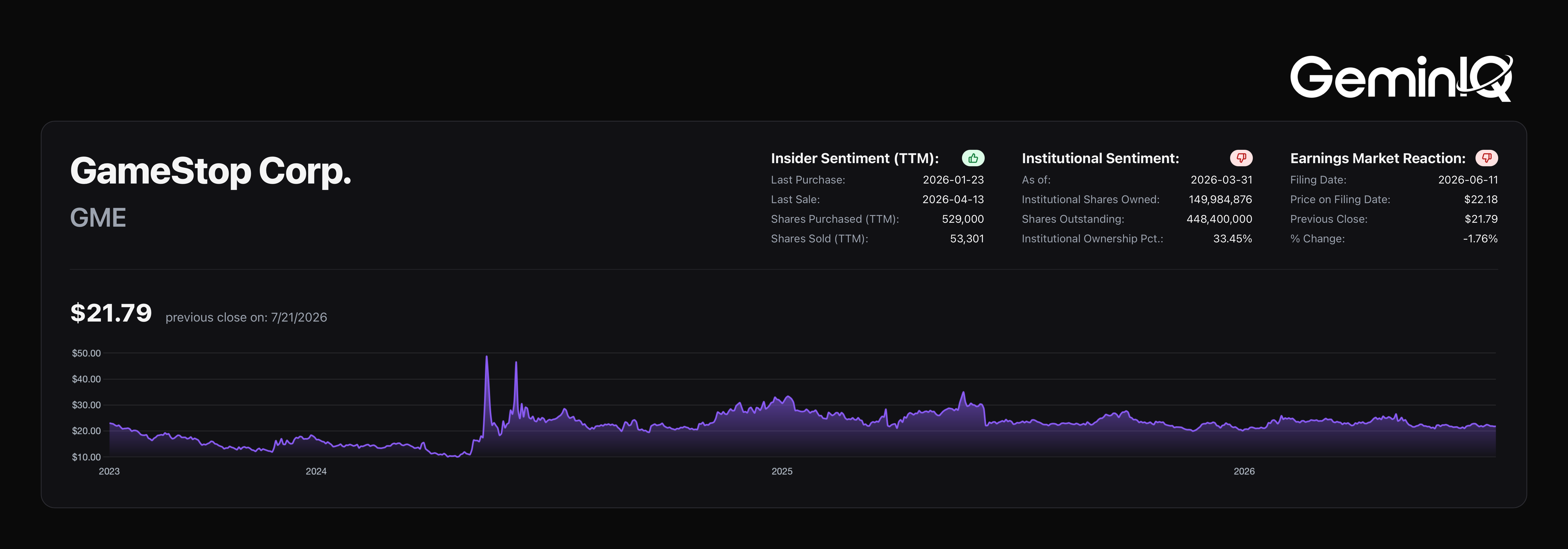
GameStop Corp. ($GME) just dropped its Q1 FY2026 10-Q (filed June 11, 2026). The financial media spent years calling this a dying retailer. Then a "debt-free $9 billion war chest" narrative took over, with GameStop cast as a quiet acquisition vehicle waiting to strike. The raw filing data tells a third story: the company has real debt now, real dilution risk attached to it, and an institutional base that's been shrinking for a year, not accumulating.
| Field | Value |
|---|---|
| Ticker | $GME |
| Filing | Q1 FY2026 10-Q |
| Filed | June 11, 2026 |
| Period End | May 2, 2026 |
| Total Debt | $4.17 Billion |
| ROIC (TTM) | 25.1% |
The Debt That Wasn't Supposed to Exist
For years, GameStop's balance sheet genuinely did carry close to zero debt. That changed in 2025, and the shift doesn't show up in most retail coverage of this name.
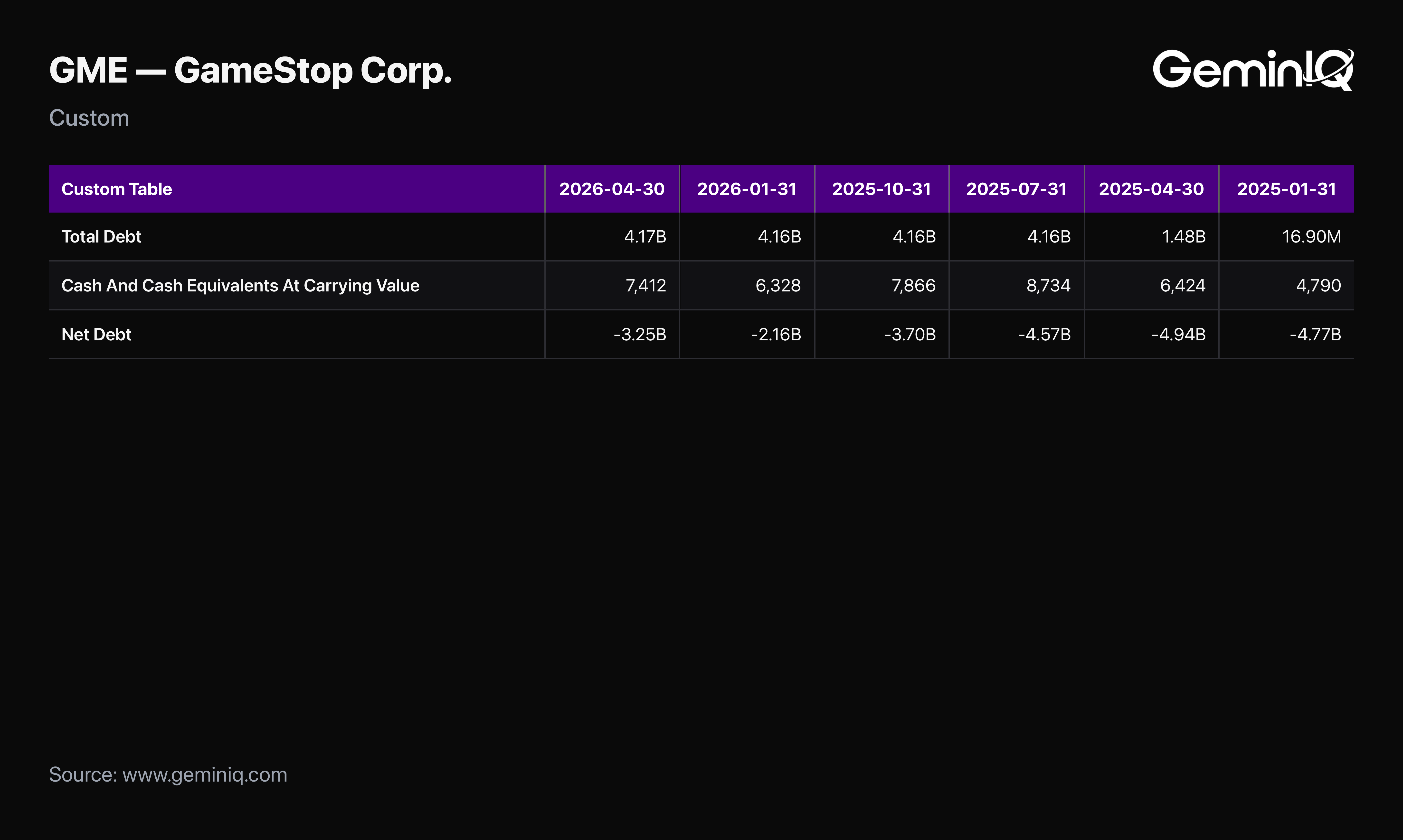
The Data: GameStop closed two rounds of 0.00% Convertible Senior Notes in 2025 — $1.5 Billion due 2030 (closed April 1, 2025) and $2.25 Billion due 2032 (closed June 17, 2025). Combined, the raw Balance Sheet shows Long-Term Debt of $4.17 Billion as of this filing, up from total debt of just $16.90 Million as recently as January 2025 ($6.6 Million of long-term notes payable plus $10.3 Million of current maturities). Against $7.41 Billion in cash, that still nets out to $3.25 Billion in net cash — a real cushion, just not a debt-free one.
The GeminIQ Edge: A screener that only reports a single "debt" figure would have missed both the near-zero baseline and this year's shift entirely. Pulling the raw Financial Statements shows the exact instruments — Long-Term Notes Payable, not a revolving credit facility or legacy retail debt — which matters, because these notes carry conversion terms, not just a repayment schedule.
The Dilution Math Nobody's Pricing In
Convertible notes aren't ordinary debt. GameStop's specific notes convert into stock, at a set price, if the holder chooses — and that math is already showing up in the share count.
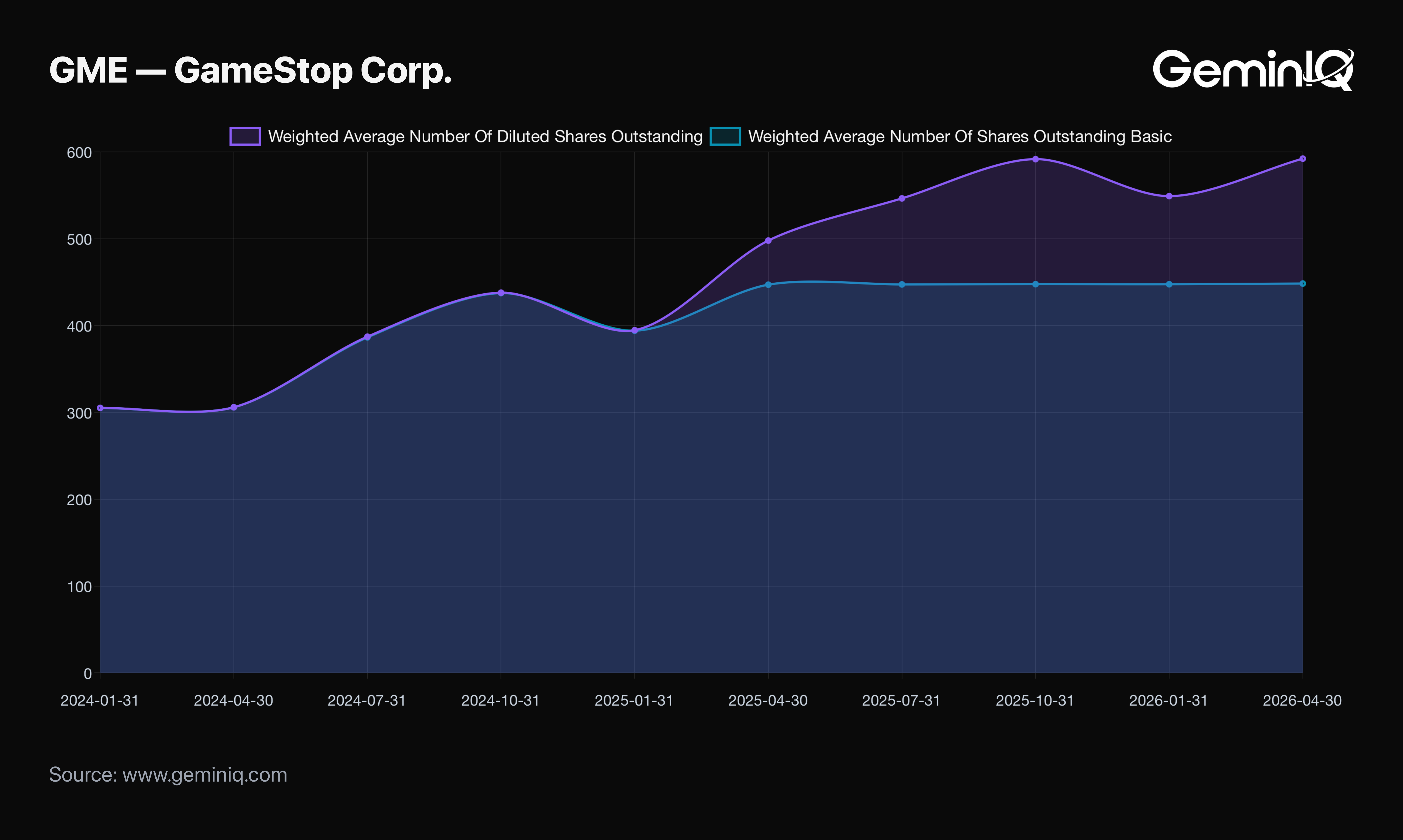
The Data: GameStop's diluted share count sits at 592.3 Million, against 448.4 Million basic shares — a gap of roughly 32%. The 2030 notes alone carry an initial conversion price near $29.85 per share. GameStop's cover page also lists Warrants to Purchase Common Stock (ticker GME WS) as a separately registered, NYSE-listed security.
The GeminIQ Edge: Most retail coverage quotes market cap or share count off the basic figure, understating the real ownership dilution baked into the capital structure. GeminIQ's Financial Statements surfaces both share counts side by side, so the gap is visible rather than buried in a footnote.
What's Actually Working
None of the debt or dilution story changes the fact that GameStop's underlying business has genuinely turned a corner.
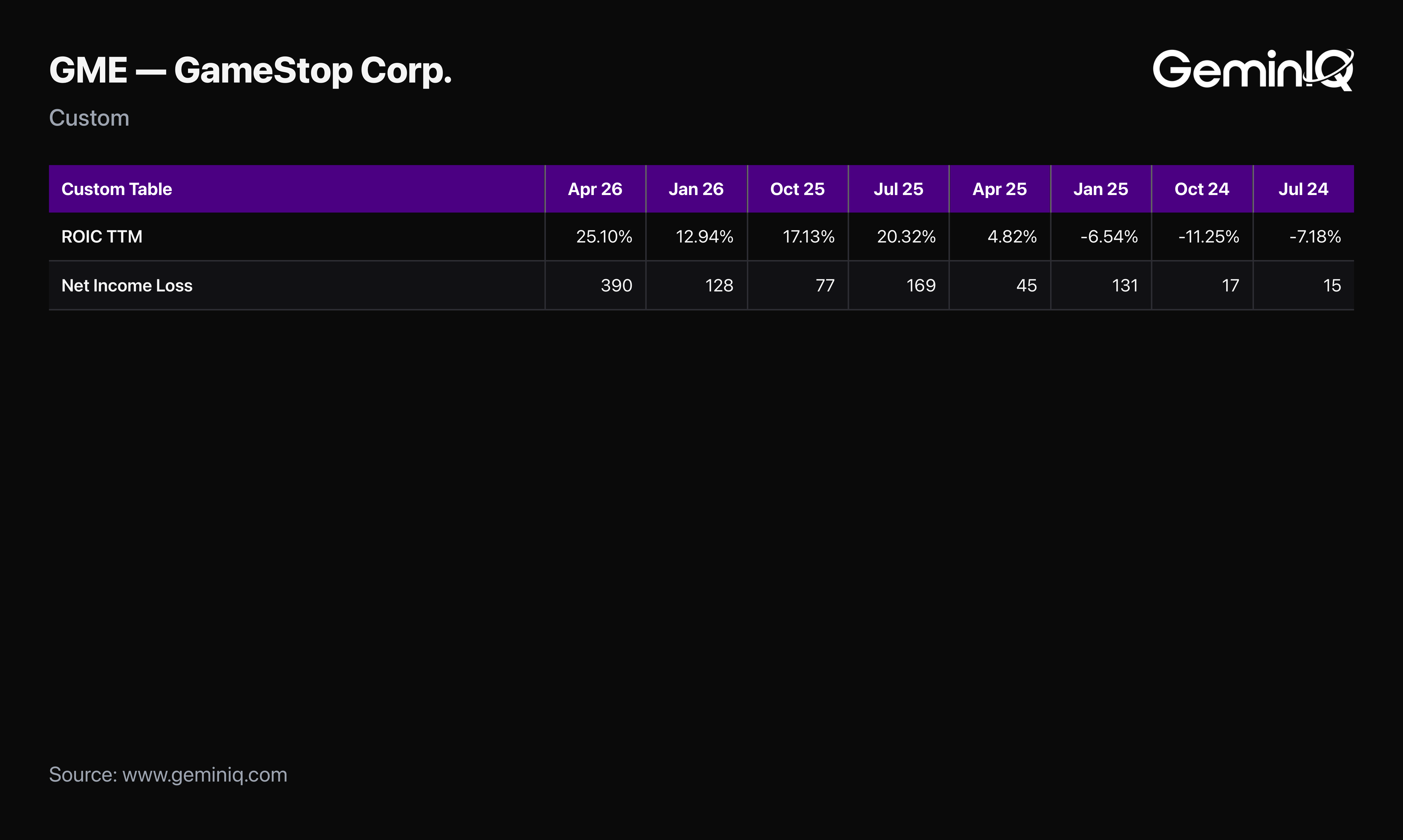
The Data: Quarterly net income hit $389.6 Million in Q1 FY2026, up from $44.8 Million in the same quarter last year. GeminIQ's pre-calculated ROIC (TTM) sits at 25.1%, a sharp recovery from negative 11.2% as recently as the October 2024 quarter.
The GeminIQ Edge: A GAAP-only view would blend interest income from the cash pile with core retail performance into one number. Pulling Calculated Metrics alongside the raw Income Statement shows this isn't just interest income padding the total — the turn to positive ROIC predates most of the 2025 capital raise. The collectibles and trading-card pivot the company has talked about is showing up in the numbers, independent of the war chest.
Institutional Money Is Leaving, Not Accumulating
The "smart money is quietly accumulating" story around GameStop doesn't hold up against the most recent 13F data.
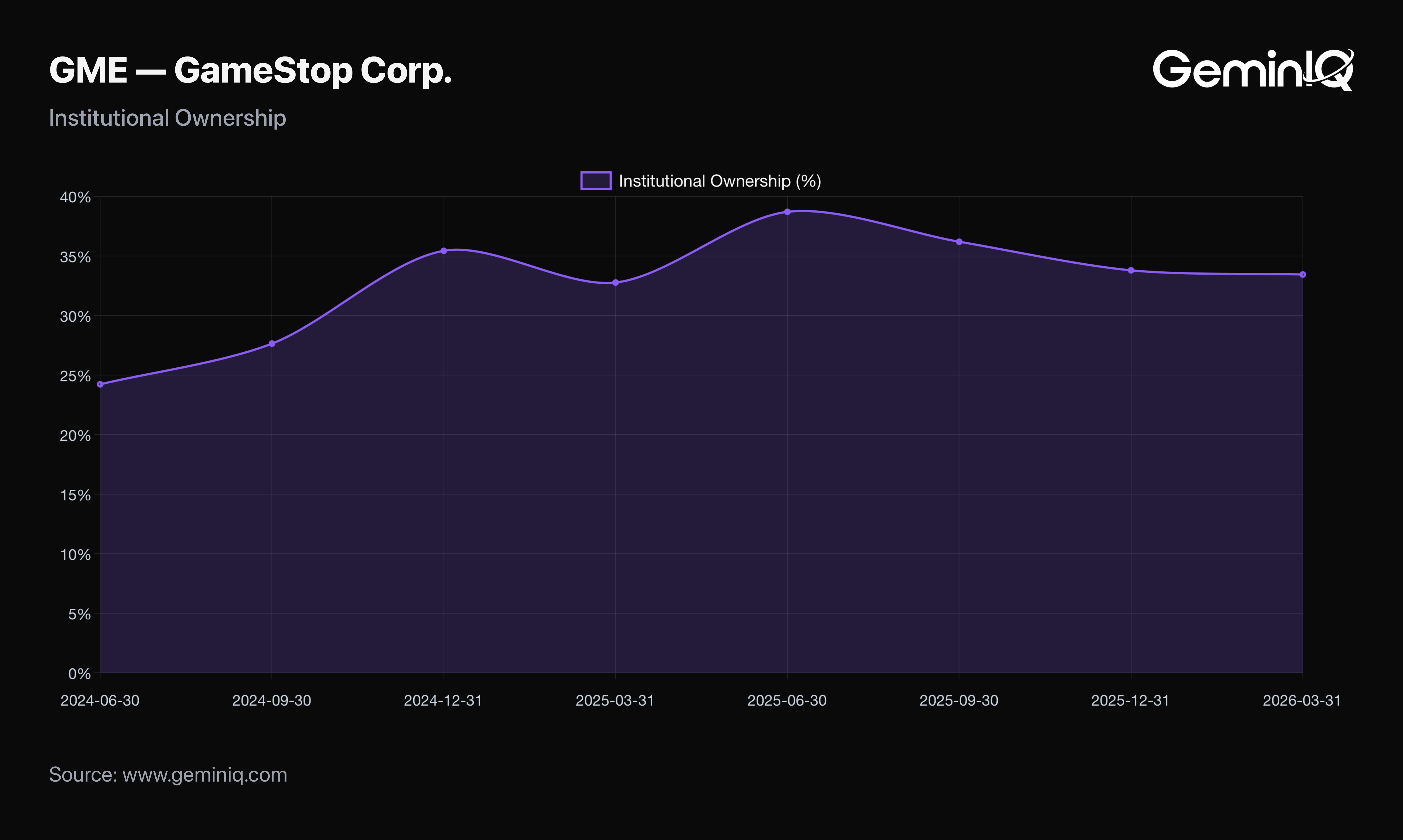
The Data: Institutional Ownership peaked at 38.7% in the June 2025 quarter and has fallen in every reading since, down to 33.4% as of the most recent 13F (March 2026, filed with the standard 45-day lag).
The GeminIQ Edge: A single point-in-time ownership figure can support almost any narrative. Pulling the full trailing trend via GeminIQ's Institutional Ownership tracker instead of one quarter shows a year of net outflows, not accumulation — the opposite of what circulated when the capital raise first happened.
The Insiders Are (Mostly) Still Buying
Insider activity is the one piece of this story that mostly held up under verification — with one correction.
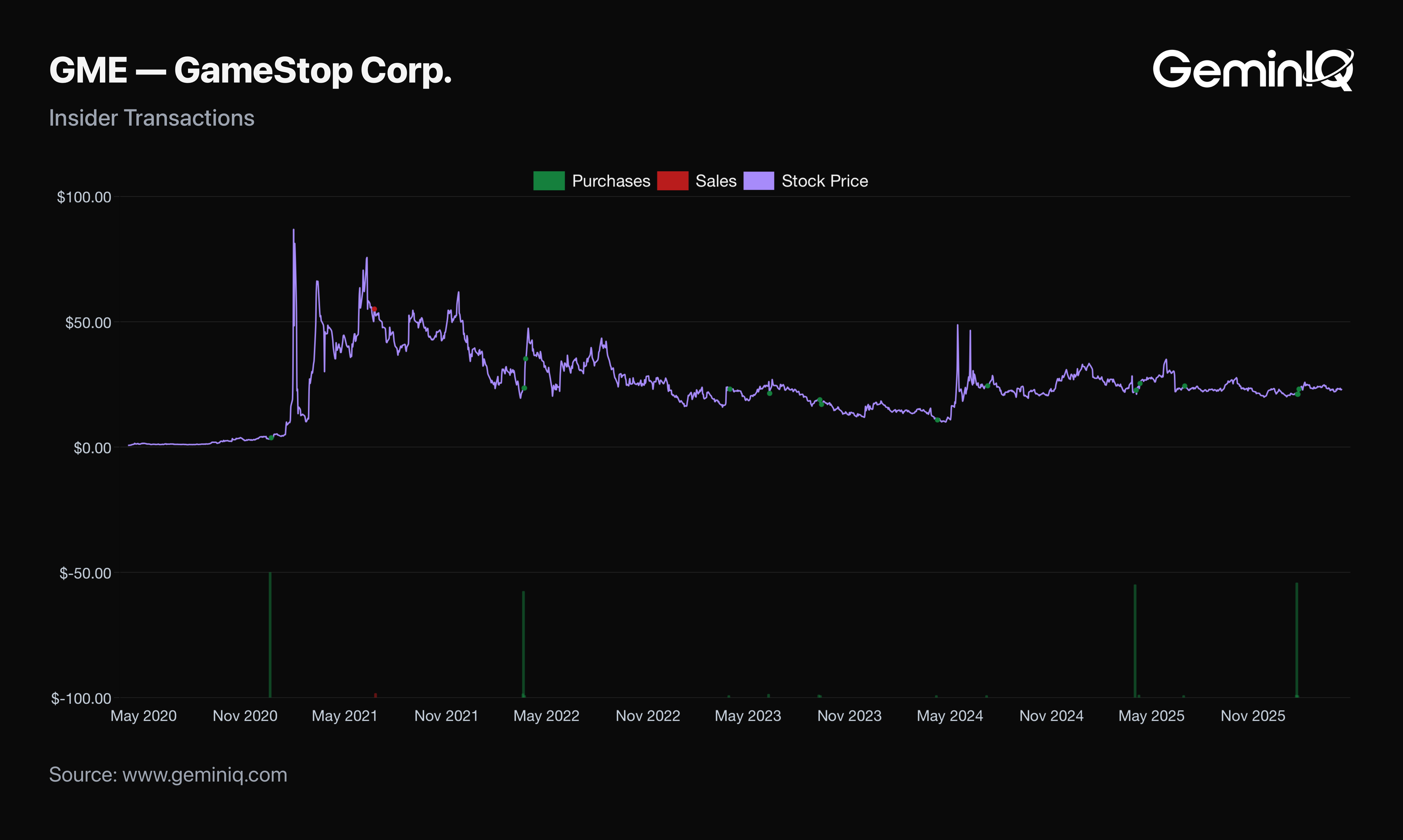
The Data: GameStop's Insider Transactions feed shows Ryan Cohen, Lawrence Cheng, and Alain Attal have made open-market purchases only, every year, going back to 2020-2022. Cohen alone has bought roughly $71.4 Million across seven separate purchases. CFO Jim Grube, sometimes grouped with this same cohort, has one purchase on record (June 2025) and one sale (June 2021) — not the unbroken buying pattern sometimes attributed to him.
The GeminIQ Edge: GeminIQ's Insider Transactions feed pulls every Form 4 individually rather than a pre-summarized "insider sentiment" score, which is the only way to catch a detail like the Grube correction. Separately, and outside what any filing discloses: press reports this spring linked GameStop to a roughly $56 billion non-binding bid for eBay, which eBay reportedly rejected, and reported that Michael Burry — an investor who had publicly compared GameStop's setup to early Berkshire Hathaway — exited his position citing leverage concerns tied to that specific deal. The insiders are still buying. The one prominent bull who compared this to Buffett's early Berkshire isn't anymore. Both are true at the same time, and neither is something a filing discloses.
Frequently Asked Questions
What does GeminIQ's data show about GameStop's debt?
GameStop's Q1 FY2026 10-Q shows $4.17 billion in Long-Term Debt, almost entirely 0.00% Convertible Senior Notes issued in 2025 ($1.5 billion due 2030, $2.25 billion due 2032). This is a substantial change from the near-zero debt GameStop carried as recently as January 2025.
Does GameStop's convertible debt create real dilution risk?
Based on the filing data, yes, potentially. GameStop's diluted share count (592.3 million) already runs about 32% above its basic share count (448.4 million), reflecting the shares the convertible notes and other instruments could convert into.
When did GameStop last file its 10-Q, and what period does it cover?
GameStop's most recent filing is a Form 10-Q filed June 11, 2026, covering the fiscal quarter ended May 2, 2026 (Q1 FY2026).
Where can I verify GameStop's debt figures against the original filing?
The figures are drawn directly from GameStop's Q1 FY2026 10-Q balance sheet, filed with the SEC on June 11, 2026. The full filing is publicly available on SEC EDGAR (linked in the citation block below).
Wall Street's data. Main Street's price.
Institutional terminals charge thousands a year for as-filed accuracy. GeminIQ gives you the same thing for a fraction of the cost: financials built directly from raw SEC EDGAR filings, not third-party APIs, with full XBRL traceability back to the original 10-K or 10-Q. No normalized guesswork, just calculated metrics, charts, screeners, and watchlists built on numbers exactly as the company reported them. Start researching now at GeminIQ.com.
All financial figures cited in this article reference GameStop Corp.'s Q1 FY2026 10-Q (filed June 11, 2026, period ending May 2, 2026). All SEC filings are publicly available at SEC EDGAR.
Disclaimer: The content in this blog is for educational and entertainment purposes only and does not constitute financial, legal, or tax advice. Investing involves risk, including the loss of principal. The views expressed are my own and not intended as financial advice or a guarantee of future performance.