
Kenvue (KVUE) Q3 2026 Earnings: EPS Up 5%, Tax Rate 29.4%

By Chad Hartman
Published · Last updated
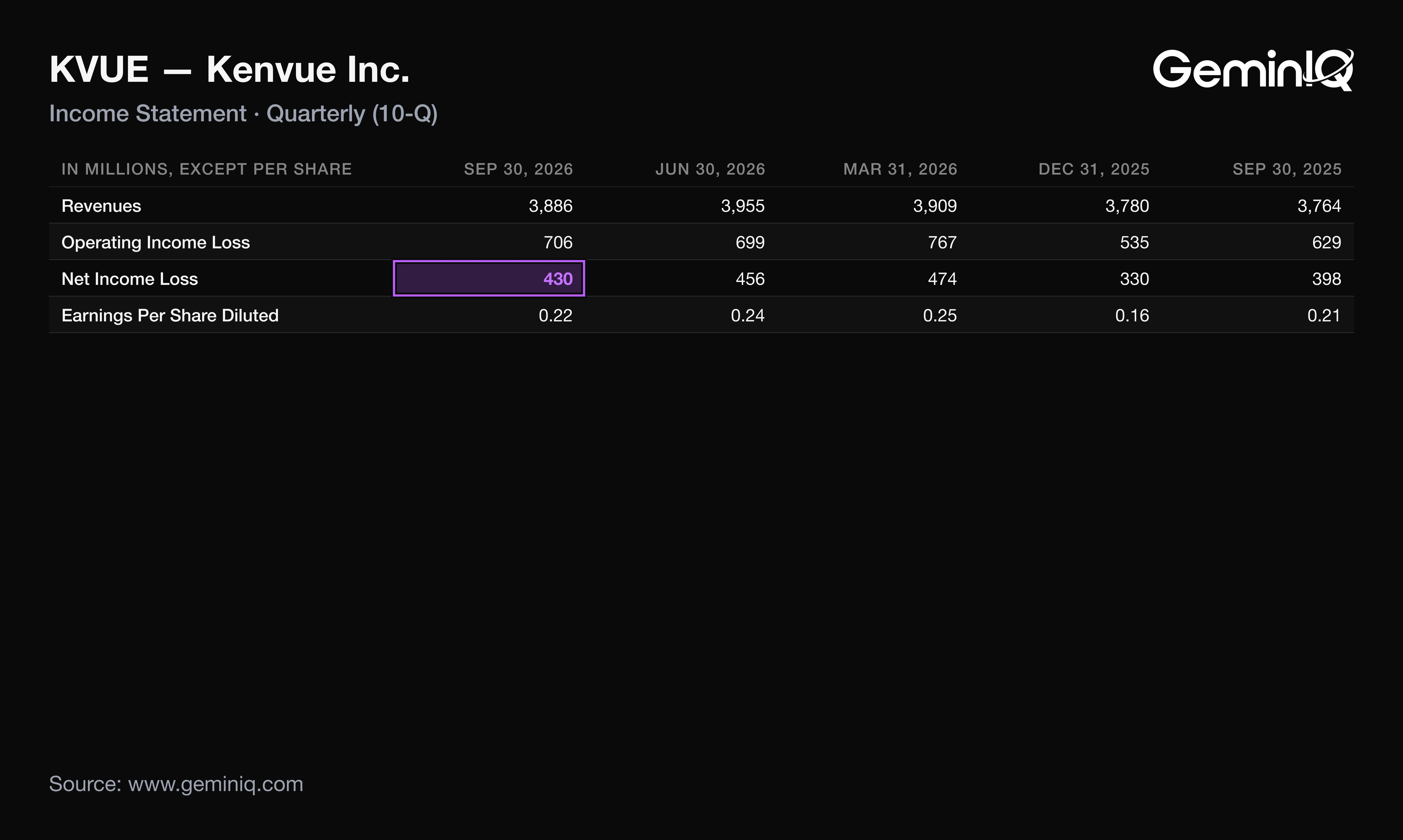
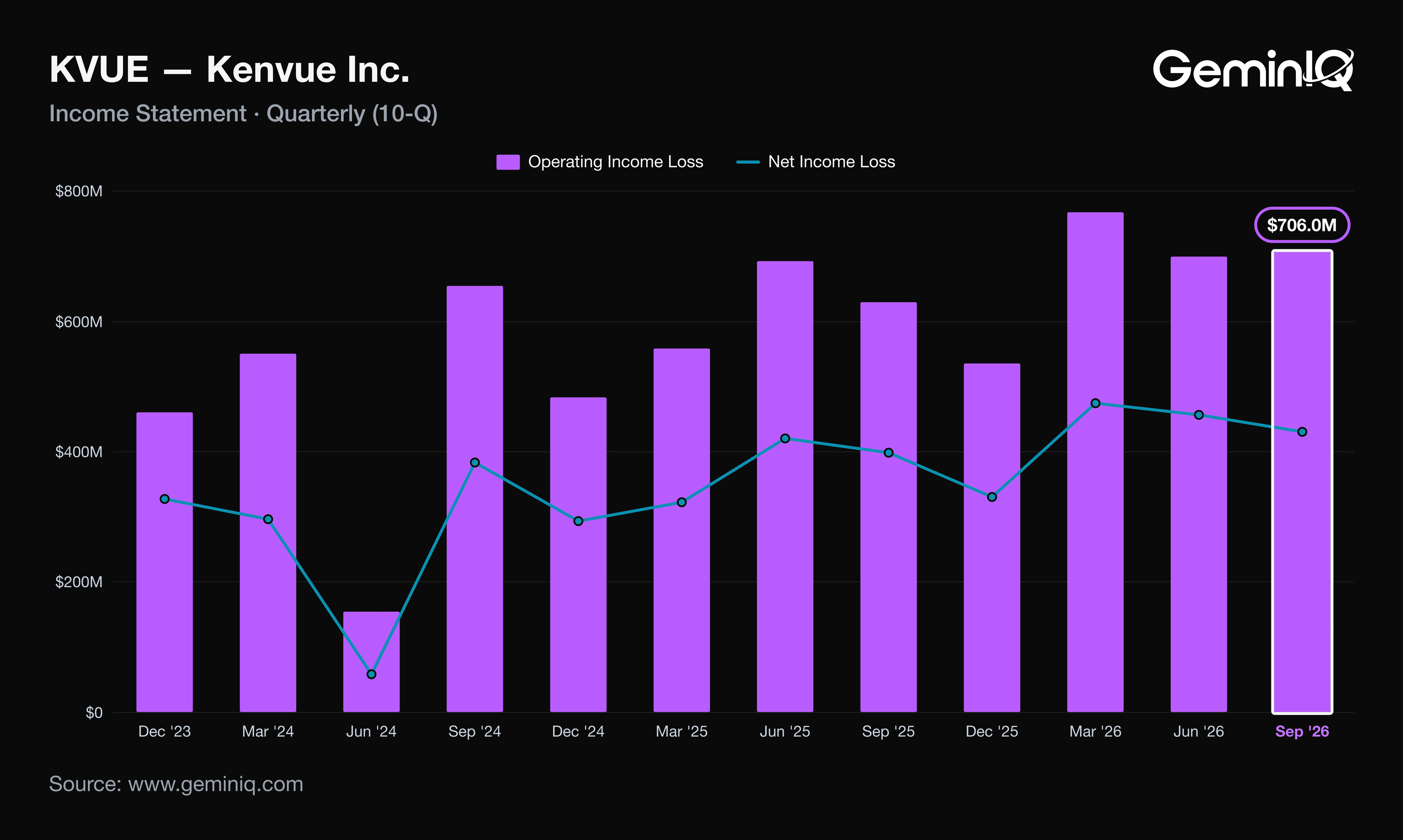
Kenvue (KVUE) reported Q3 FY2026 revenue of $3.89 billion, up 3.2%, and diluted EPS of $0.22, up 4.8%, for the quarter ended September 27, 2026; the company released results and filed its 10-Q on October 30, 2026. Operating income rose 12.2% to $706 million, but a 29.4% effective tax rate, up from 24.3%, held net income growth to 8.0%. Of the $77 million operating-income gain, $51 million came from lower restructuring expense, and operating cash flow of $700 million more than doubled from a year earlier.
| Field | Value |
|---|---|
| Company | Kenvue ($KVUE) |
| Quarter | Q3 FY2026, period ended September 27, 2026 |
| Earnings release | October 30, 2026 (Form 8-K) |
| 10-Q filed | October 30, 2026 |
| Revenue | $3.89 Billion (+3.2% YoY) |
| Diluted EPS | $0.22 (+4.8% YoY) |
| Operating margin | 18.2% (+1.5 pts YoY) |
| Operating cash flow (TTM) | $2.73 Billion |
| Effective tax rate | 29.4% (24.3% a year earlier) |
Kenvue Q3 2026 Revenue, EPS and Margins
Kenvue's Q3 FY2026 diluted EPS was $0.22, up 4.8% from $0.21, on revenue of $3.89 billion, up 3.2%. Operating profit grew far faster than either figure, and the tax line took most of the difference.
A reader who saw operating income up 12.2% would expect EPS to grow at a similar pace. Instead, the tax provision absorbed it.
The Data: Operating income was $706 million, the third-highest of the last 15 quarters, and operating margin was 18.2%, the second-highest. Pretax income rose 15.8% to $609 million. The provision for taxes rose 39.8% to $179 million, a 29.4% effective rate against 24.3%. Net income was $430 million, up 8.0%, and diluted shares were 1,926 million, up 0.2%.
Why: The 10-Q attributes the higher rate to a smaller benefit from U.S. return-to-provision adjustments and a shift in the jurisdictional mix of income, partly offset by the effect of the One Big Beautiful Bill Act and a release of tax reserves. Had the rate held at last year's 24.3%, the provision would have been about $148 million, net income about $461 million and EPS about $0.24 instead of $0.22. That $0.24 is what Kenvue earned in Q2 FY2026, so the tax rate alone explains the sequential dip. At $0.22, Q3 EPS was the sixth-highest of the last 15 quarters.
What Kenvue's 10-Q Shows Beyond the Press Release
The release led with a fourth straight quarter of net and organic sales growth and adjusted diluted EPS of $0.29, up 4%. The 10-Q shows that most of the operating-income gain came from lines other than selling more.
The Data: Restructuring expense fell to $33 million from $84 million, which accounts for $51 million of the $77 million increase in operating income. Segment adjusted operating income, which excludes restructuring, rose 3.8% to $1,001 million against 3.2% sales growth. Self Care sales rose 5.9%, but its segment adjusted margin fell 80 basis points. Skin Health and Beauty organic sales fell 0.5%. Gross margin was 59.5%, the highest of the last 15 quarters. The release's gap between adjusted and GAAP operating margin was 3.7 points (21.9% against 18.2%), against 4.8 points a year earlier.
Why: The 10-Q credits gross margin to supply chain savings, value realization and refunds of tariffs paid on imported goods, and it states that Kenvue recovered all refunds for which it had submitted claims during the quarter. A refund of duties already paid does not repeat unless more claims are approved, and the filing calls the availability of any additional refunds uncertain. The organic growth itself is real, at 1.6% from volume and 1.3% from price and mix, though Asia Pacific Self Care volume benefited from a comparison against prior-year trade inventory depletion. The company gave no guidance, citing the pending Kimberly-Clark transaction, so nothing in the release says whether the refunds recur.
Kenvue Q3 2026 Free Cash Flow, Dividends and Debt
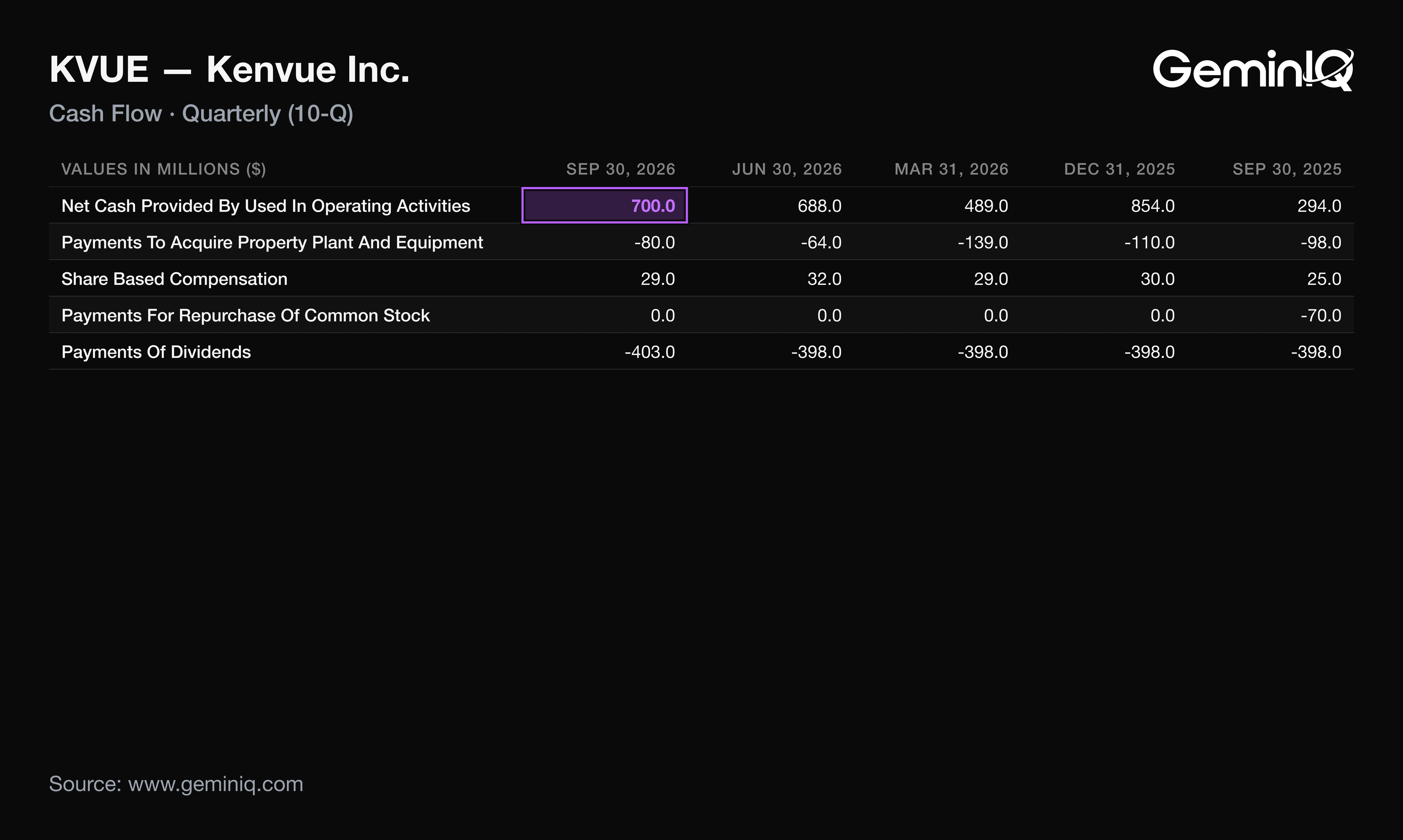
Kenvue's Q3 FY2026 operating cash flow was $700 million, up from $294 million a year earlier, and free cash flow after $80 million of capital expenditure was $620 million against $196 million. Most of that jump is the weakness of the year-ago quarter.
The Data: Operating cash flow rose only 1.7% from the $688 million of Q2 FY2026, and free cash flow slipped from $624 million. Dividends paid were $403 million, the highest of the last 15 quarters, so free cash flow covered the payout about 1.5 times, against about 0.5 times a year earlier. GeminIQ's pre-calculated Free Cash Flow for the trailing twelve months was $2.34 billion, up 42.6%, against $1.60 billion of dividends.
Why: The release credits the nine-month improvement in operating cash flow ($1.9 billion against $1.3 billion) to higher net income and lower use of working capital. Net income rose only $32 million year over year, so working capital explains most of the $406 million quarterly swing. The 10-Q shows total debt of $8.2 billion, down from $8.5 billion at the end of 2025, as Kenvue repaid $750 million of notes while commercial paper rose to $1,120 million from $700 million. Kenvue now covers its dividend with room to spare, which was not the case twelve months ago.
How KVUE Stock Has Moved After Past Earnings Reports
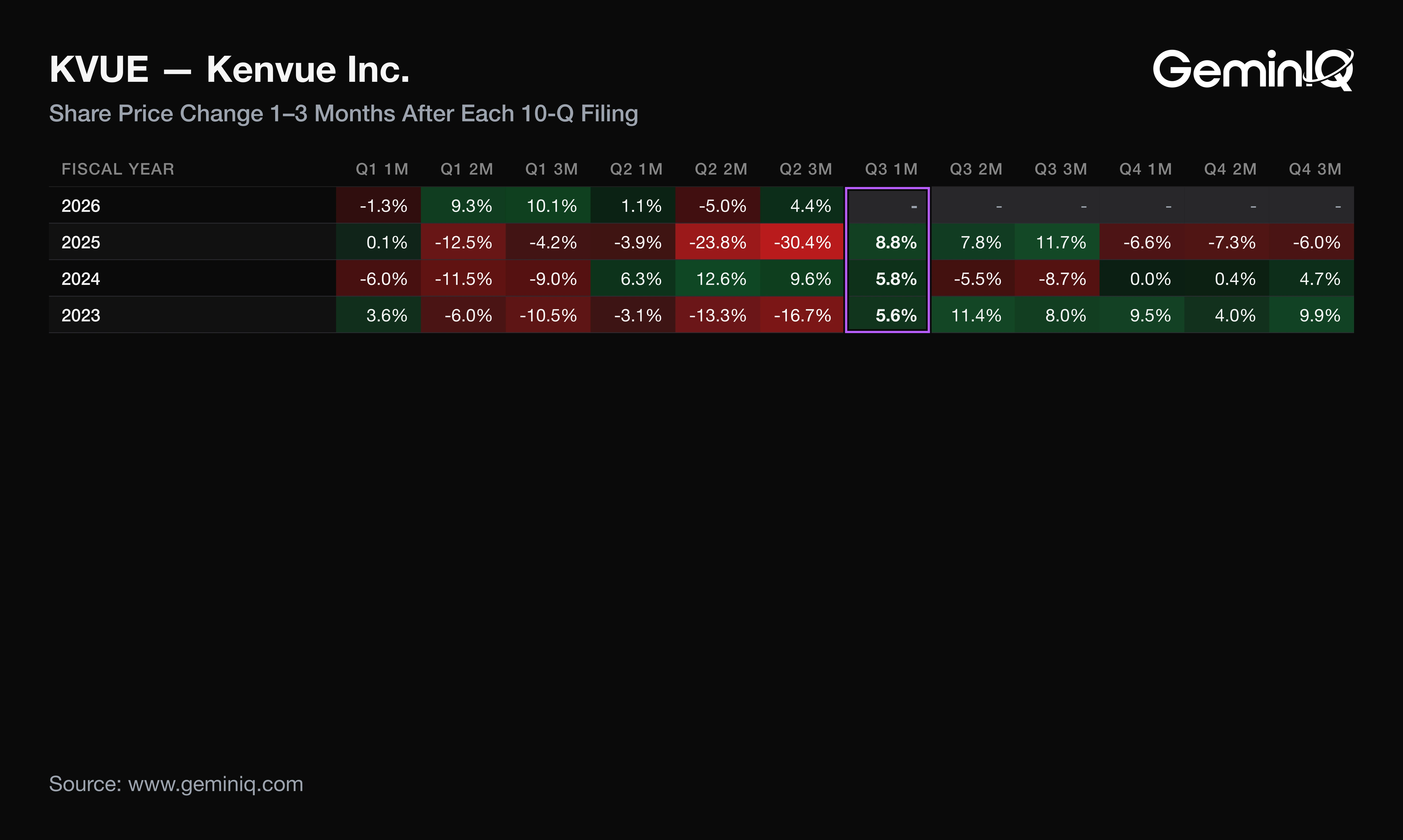
Across the last 12 10-Q filings with a completed one-month window (filed November 3, 2023 to August 6, 2026), KVUE's median one-month return was +0.6% and was positive after 8 of 12. Three-month returns had a median of +4.5%, were positive after 7 of 12 and ranged from -30.4% to +11.7%.
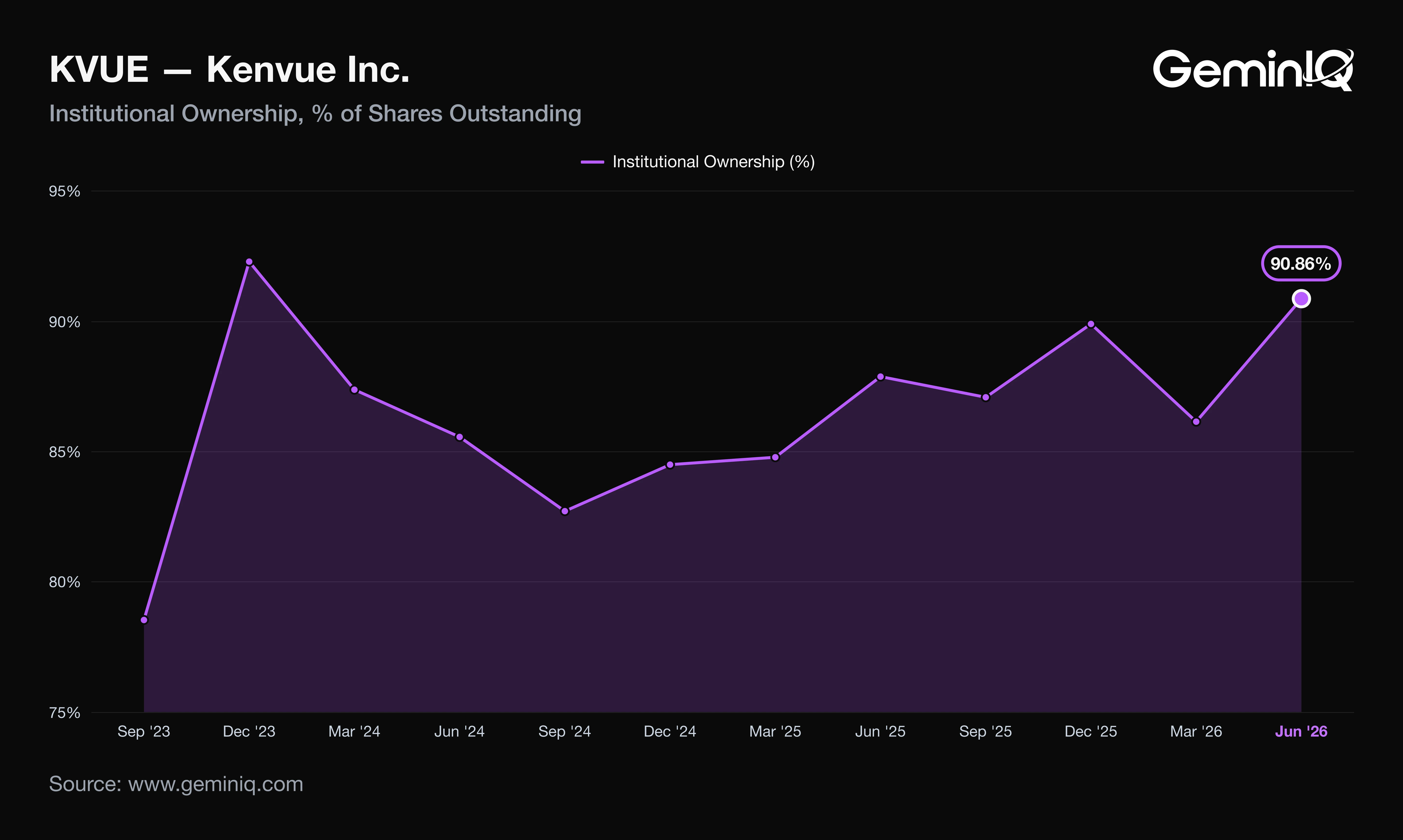
The Data: The three prior Q3 filings were followed by one-month returns of +5.6%, +5.8% and +8.8%, each well above that median. These figures describe how Kenvue's stock moved after its past filings; they are a historical association, not a forecast. The latest 13F, for June 30, 2026, put institutional ownership at 90.86%, up 2.99 points from 87.87% a year earlier and the second-highest of the last 13 quarter ends. Form 4 filings from June 10, 2025 to June 10, 2026 show two purchases totaling $111.0 million and two sales totaling $747 thousand, the latest purchase on December 12, 2025.
Why: The Earnings Reaction Heat Map's recent windows sit inside a different setup than the early ones, since four of the twelve opened after the November 2, 2025 merger agreement the 10-Q describes, under which each share converts to 0.14625 Kimberly-Clark shares plus $3.50 in cash. The earlier history may be a weaker guide for the current one, and the September 30 13F has not been filed. Insiders bought far more than they sold in that window, though the Form 4 data stops at June 10.
When operating profit and net profit move apart, the line between them, tax or one-time costs, can move EPS further than sales did.
Frequently Asked Questions
When does Kenvue report earnings?
Kenvue reported Q3 FY2026 results on October 30, 2026 and filed its 10-Q the same day. Last year it filed its fourth-quarter results on February 20, 2026, a pattern from the filing record and not a forecast of the next date.
Does Kenvue pay a dividend?
Kenvue paid $403 million of dividends in Q3 FY2026 and $1.60 billion over the trailing twelve months, up 1.3%. Trailing free cash flow of $2.34 billion covered that payout about 1.5 times.
Is Kenvue doing well financially?
Kenvue's trailing net profit margin was 10.88%, up from 9.55% a year earlier, and its operating margin was 17.43%, up from 15.74%. ROIC was 17.82% against 15.18%, while the current ratio was 0.96x, a sign that current liabilities slightly exceed current assets.
What was Kenvue's revenue in Q3 2026?
Kenvue's Q3 FY2026 revenue was $3.89 billion, up 3.2%, with organic sales up 2.9% and a 0.3% currency benefit. Revenue for the first nine months, the 10-Q shows, was $11.75 billion, up 3.6%, with organic growth of 1.7%.
Wall Street's data. Main Street's price.
Institutional terminals charge thousands a year for as-filed accuracy. GeminIQ gives you the same thing for a fraction of the cost: financials built directly from raw SEC EDGAR filings, not third-party APIs, with full XBRL traceability back to the original 10-K or 10-Q. No normalized guesswork, just calculated metrics, charts, screeners, and watchlists built on numbers exactly as the company reported them. Start researching now at GeminIQ.com.
All financial figures cited in this article reference Kenvue Inc.'s Q3 2026 10-Q (filed October 30, 2026, period ending September 30, 2026), with guidance and management commentary drawn from the company's Form 8-K earnings release (filed October 30, 2026). All SEC filings are publicly available at SEC EDGAR and SEC EDGAR.
Disclaimer: The content in this blog is for educational and entertainment purposes only and does not constitute financial, legal, or tax advice. Investing involves risk, including the loss of principal. The views expressed are my own and not intended as financial advice or a guarantee of future performance.