
Largest Goodwill Impairment Charges in SEC Filings

By Chad Hartman
Published · Last updated
General Motors wrote down $27.145 Billion of goodwill in its fiscal 2012 10-K — the single largest goodwill impairment charge on record in GeminIQ's as-filed universe. It's a figure large enough that it is worth asking what it takes to make that list at all. A goodwill write-down is one of the few line items on a filing where a company is conceding, in its own regulatory disclosure, that money it already spent will not come back. Most goodwill impairments are small enough to pass without notice. The ones on this list were not.
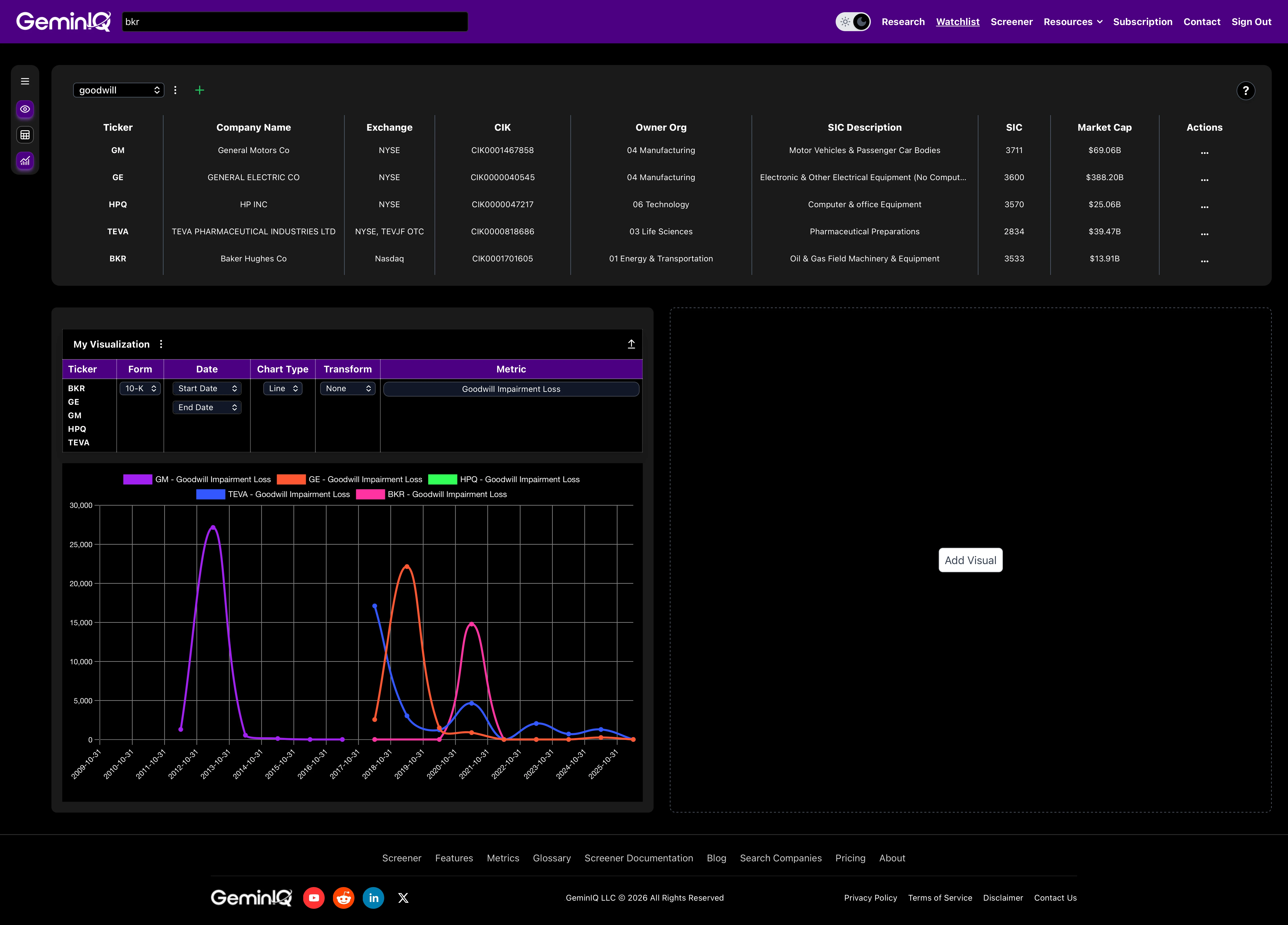
This leaderboard reads GeminIQ's full as-filed financial-statement universe for every disclosed value under the Goodwill Impairment Loss and Goodwill And Intangible Asset Impairment tags, restricted to annual (10-K, full fiscal-year) figures, across 15,083 companies and GeminIQ's complete available filing history. 2,182 companies carry at least one confirmed goodwill impairment charge on record, spanning 4,084 distinct fiscal-year events. This ranks each company by its single largest confirmed annual write-down — it does not measure stock-price reaction, only the disclosed dollar figure itself.
The Ranking
| Rank | Company | Ticker | Fiscal Year | Goodwill Impairment Charge |
|---|---|---|---|---|
| 1 | General Motors Co | GM | 2012 | $27.145 Billion |
| 2 | General Electric Co | GE | 2018 | $22.136 Billion |
| 3 | HP Inc | HPQ | 2012 | $18.035 Billion |
| 4 | Teva Pharmaceutical Industries Ltd | TEVA | 2017 | $17.100 Billion |
| 5 | Baker Hughes Co | BKR | 2020 | $14.773 Billion |
| 6 | Teladoc Health, Inc. | TDOC | 2022 | $13.403 Billion |
| 7 | Walgreens Boots Alliance, Inc. | WBA | 2024 | $12.701 Billion |
| 8 | Bank of America Corp | BAC | 2010 | $12.400 Billion |
| 9 | Lumen Technologies, Inc. | LUMN | 2023 | $10.693 Billion |
| 10 | Berkshire Hathaway Inc | BRK-A | 2020 | $10.671 Billion |
| 11 | Comcast Corp | CMCSA | 2022 | $8.583 Billion |
| 12 | Kraft Heinz Co | KHC | 2018 | $7.008 Billion |
| 13 | DXC Technology Co | DXC | 2020 | $6.794 Billion |
| 14 | Microsoft Corp | MSFT | 2012 | $6.193 Billion |
| 15 | CVS Health Corp | CVS | 2018 | $6.149 Billion |
The Concentration
Most companies that impair goodwill do it quietly. Across the full 2,182-company universe carrying a confirmed impairment on record, the median company's single largest write-down is $37.1 Million — a rounding error against the fifteen names above. Those fifteen alone account for $193.8 Billion of the $718.2 Billion in combined single-largest write-downs across the entire confirmed universe, or 27.0% of it. A handful of household names, almost all built on a single oversized acquisition, carry a quarter of all the goodwill destruction on record. The rest of the universe writes down small, forgettable amounts tied to smaller deals that simply didn't work out; the mega-write-downs are a different phenomenon entirely, and they cluster around a small, recognizable list of specific transactions.
General Motors: $27.145 Billion, Fiscal 2012
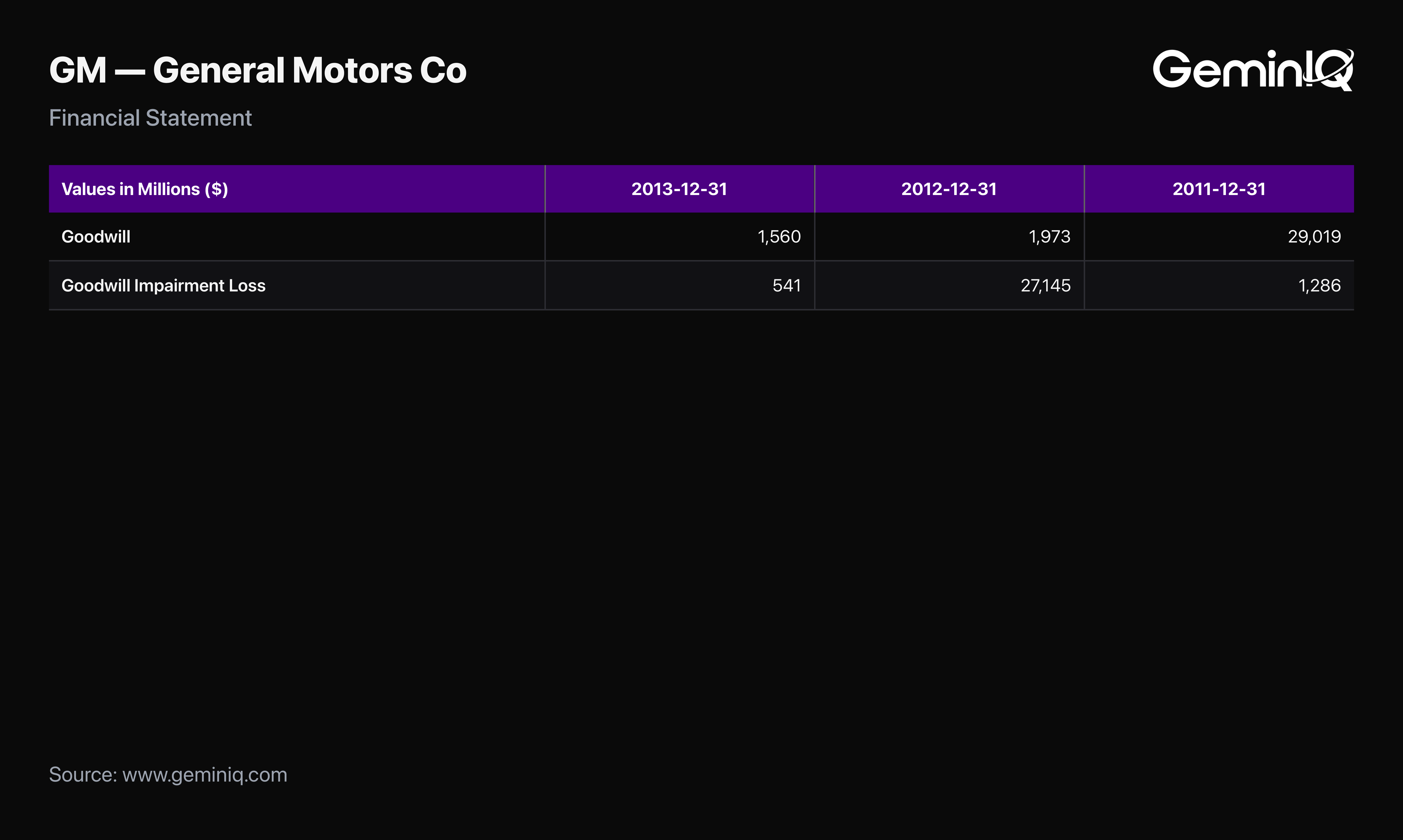
General Motors carries the single largest confirmed goodwill impairment charge in GeminIQ's data: $27.145 Billion, disclosed in the fiscal 2012 10-K under the Goodwill Impairment Loss tag. GM's own balance sheet shows the mechanism directly: Goodwill stood at $29.019 Billion at the end of fiscal 2011 and fell to $1.973 Billion by the end of fiscal 2012. That's a single-year collapse that wiped out roughly 93% of the balance. That drop confirms the impairment charge as the driver, not a divestiture or reclassification.
General Electric: $22.136 Billion, Fiscal 2018
General Electric disclosed a $22.136 Billion Goodwill Impairment Loss in its fiscal 2018 10-K, the second-largest confirmed charge in the data. The prior year's 10-K had already flagged a smaller $2.550 Billion impairment for fiscal 2017 under the same tag. GE's goodwill trouble was visible in the filings a full year before the far larger 2018 charge landed — not a single unexpected event.
HP Inc: $18.035 Billion, Fiscal 2012
HP Inc reported an $18.035 Billion charge under the Goodwill And Intangible Asset Impairment tag for the fiscal year ended October 31, 2012 — one of the earliest and largest confirmed write-downs in the dataset. It is also disclosed under a combined goodwill-and-intangibles tag, rather than the goodwill-only tag most other companies on this list used. Because the tag bundles goodwill with other intangible assets, the confirmed figure is the combined impairment charge as HP itself reported it, not an isolated goodwill number.
Teva Pharmaceutical: $17.100 Billion, Fiscal 2017
Teva Pharmaceutical Industries disclosed a $17.100 Billion Goodwill Impairment Loss for fiscal 2017, the fourth-largest confirmed charge on record and the only name in the top five headquartered outside the United States. It is also the only healthcare name in the top five, in a list otherwise dominated by industrial, technology, and financial companies.
Baker Hughes: $14.773 Billion, Fiscal 2020
Baker Hughes recorded a $14.773 Billion Goodwill Impairment Loss for fiscal 2020, rounding out the top five and standing as the largest confirmed charge among oilfield-services companies in the dataset. The prior fiscal year's 10-K shows no comparable charge under the same tag, meaning the full write-down landed within a single fiscal year rather than building gradually across several.
The Method
GeminIQ reads every figure in this leaderboard directly from each company's own as-filed 10-K, under the Goodwill Impairment Loss or Goodwill And Intangible Asset Impairment XBRL tag. No figure is inferred from a change in the balance-sheet Goodwill line itself, since a balance decline can also come from a divestiture, a spinoff, or a foreign-currency translation adjustment rather than a genuine impairment charge. Each company's ranking reflects its single largest confirmed annual charge; a company that impaired goodwill in more than one fiscal year is ranked by its biggest year only.
Check Your Holdings
Pull up any position's Goodwill balance by quarter on GeminIQ's Financial Statements view and watch for a Goodwill Impairment Loss or Goodwill And Intangible Asset Impairment line appearing in the same period the balance drops. A falling goodwill balance with no matching impairment charge nearby is a divestiture or reclassification, not a write-down — checking both lines together, rather than trusting the balance-sheet delta alone, is the difference between a real finding and an artifact.
Frequently Asked Questions
How many companies in GeminIQ's data have disclosed a goodwill impairment?
2,182 companies carry at least one confirmed goodwill impairment charge under a core goodwill-impairment tag across GeminIQ's full available filing history, spanning 4,084 distinct fiscal-year events in total.
Does a falling goodwill balance always mean a company took an impairment?
No. Two of the largest goodwill-balance declines found while building this leaderboard — at companies with declines in the tens of billions of dollars — carried no matching value under any core goodwill-impairment tag for that fiscal year. Both were excluded from the ranking rather than credited with an unconfirmed impairment.
What's the difference between "Goodwill Impairment Loss" and "Goodwill And Intangible Asset Impairment"?
Goodwill Impairment Loss is a goodwill-only figure. Goodwill And Intangible Asset Impairment is a combined tag some companies use to report a goodwill write-down together with impairments of other intangible assets in a single line. HP Inc's $18.035 Billion figure in this ranking is reported under the combined tag, as HP itself chose to disclose it.
Wall Street's data. Main Street's price.
Institutional terminals charge thousands a year for as-filed accuracy. GeminIQ gives you the same thing for a fraction of the cost: financials built directly from raw SEC EDGAR filings, not third-party APIs, with full XBRL traceability back to the original 10-K or 10-Q. No normalized guesswork, just calculated metrics, charts, screeners, and watchlists built on numbers exactly as the company reported them. Start researching now at GeminIQ.com.
All figures are drawn from each company's as-filed 10-K filings, publicly available on SEC EDGAR. Impairment charges were identified and cross-checked directly against each company's own disclosed XBRL tag values, not inferred from balance-sheet changes; the ranking methodology is described above.
Disclaimer: The content in this blog is for educational and entertainment purposes only and does not constitute financial, legal, or tax advice. Investing involves risk, including the loss of principal. The views expressed are my own and not intended as financial advice or a guarantee of future performance.