Meta (META) Q3 2026 Earnings: EPS Up 265%, Pretax Income Down 40%

By Chad Hartman
Published · Last updated
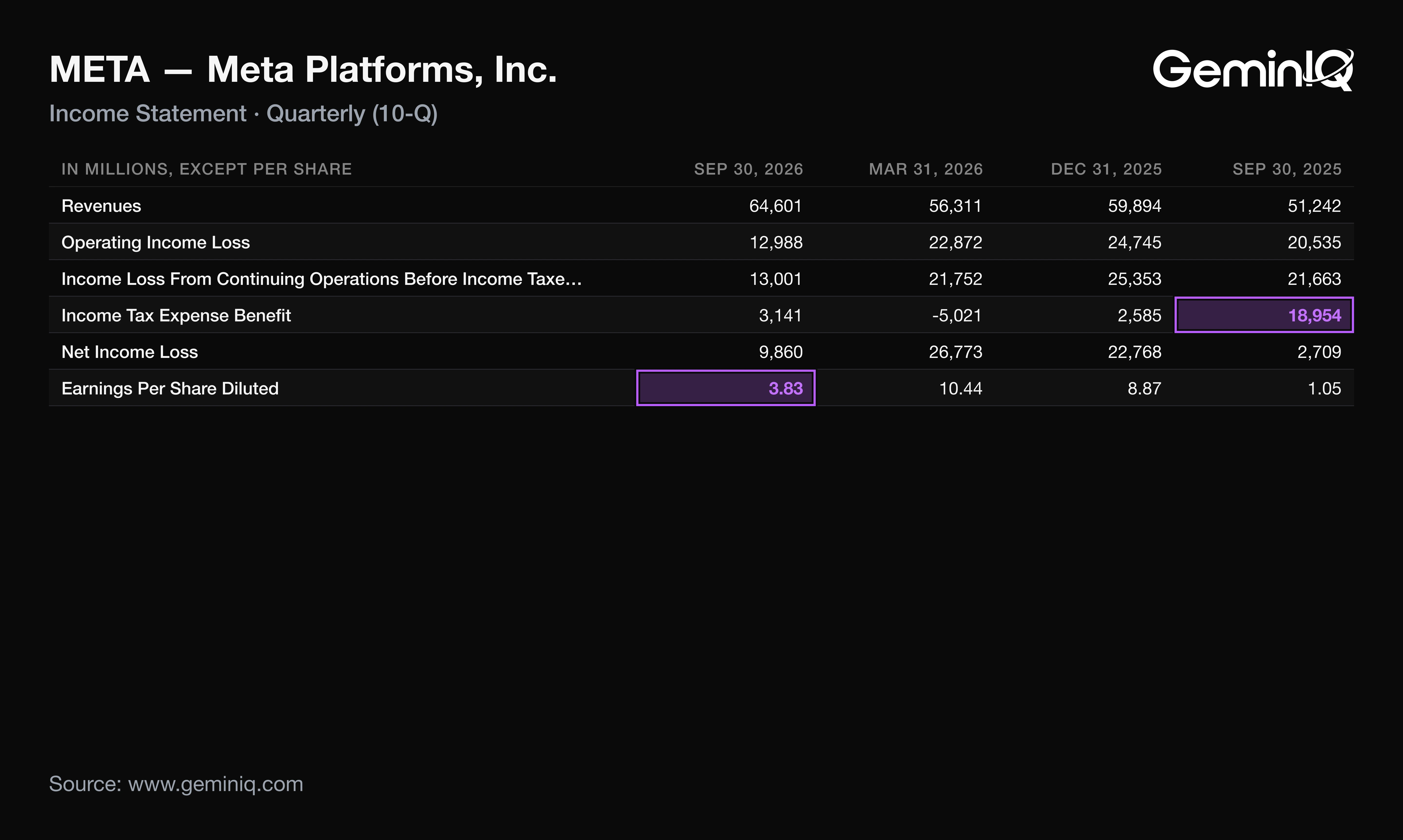
Meta (META) reported Q3 2026 revenue of $64.60 billion, up 26%, and diluted EPS of $3.83, up 265%, for the quarter ended September 30, 2026. Pretax income fell 40% to $13.00 billion; EPS rose only because the income tax provision dropped from $18.95 billion to $3.14 billion. The company released results on October 21, 2026 and filed its 10-Q on October 22, and the filing shows costs outgrowing revenue even after the $9.89 billion legal charge the release highlights is removed. Operating cash flow of $32.79 billion, per the 8-K, fell short of the quarter's $33.94 billion of property and equipment purchases.
| Field | Value |
|---|---|
| Company | Meta ($META) |
| Quarter | Q3 FY2026, period ended September 30, 2026 |
| Earnings release | October 21, 2026 (Form 8-K) |
| 10-Q filed | October 22, 2026 |
| Revenue | $64.60 Billion (+26.1% YoY) |
| Diluted EPS | $3.83 (+264.8% YoY) |
| Operating margin | 20.1% (-20.0 pts YoY) |
| Operating cash flow (TTM) | Not computable from as-filed quarterly rows (Q3 2026: $32.79 Billion per 8-K; nine months: $96.87 Billion) |
| Pretax income (YoY) | -40.0% ($13.00 Billion vs $21.66 Billion) |
Meta Q3 2026 Revenue, Operating Margin and EPS
Meta's Q3 2026 diluted EPS was $3.83, up 265% from $1.05, on revenue that was the highest of the last 16 quarters. The tax line, not operations, produced the EPS gain.
A reader who saw 26% revenue growth and 265% EPS growth would expect operating income to have risen too. Instead it fell.
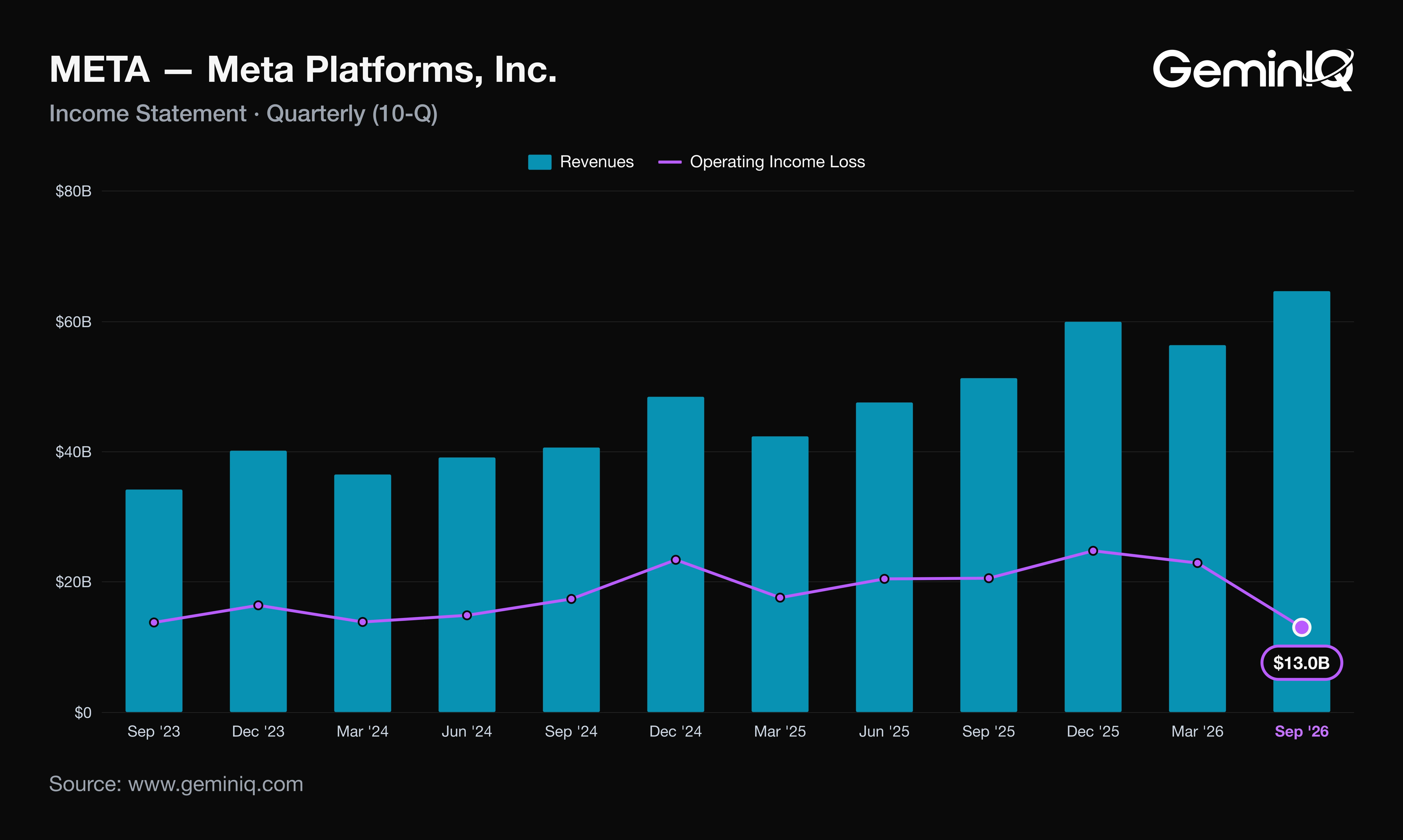
The Data: Operating income was $12.99 billion, down 37% from $20.54 billion and the fifth-lowest of the last 16 quarters. Operating margin was 20.1%, against 40.1% a year earlier and the second-lowest of the last 16 quarters. Interest and other income shrank to $13 million from $1.13 billion, so pretax income was $13.00 billion against $21.66 billion. The provision for income taxes fell to $3.14 billion from $18.95 billion, an effective rate of 24% against 87%.
Why: The 10-Q attributes the lower rate mostly to the effects of the One Big Beautiful Bill Act enacted in Q3 2025, which inflated the year-ago base. At this quarter's 24% rate, the year-ago pretax income would have produced about $16.5 billion of net income and EPS near $6.40, which makes $3.83 a decline of roughly 40%. Diluted shares were flat at 2,573 million, so EPS tracked net income.
What Meta's Q3 2026 10-Q Adds to the Release: Costs Beyond the Legal Charge
Meta's Q3 2026 costs and expenses were $51.61 billion, up 68%, and the release attributes the jump to a $9.89 billion charge from the August 2026 agreement with 52 attorneys general. That charge explains the operating-income drop only in part.
The release states that without the charge, operating income would have been $22.88 billion and diluted EPS $7.40. Strip the charge and margin should recover to the year-ago 40%.
The Data: The 10-Q shows costs excluding the charge were about $41.72 billion, up 36% against revenue growth of 26%, which puts operating margin near 35.4% against 40.1%, a gap of 4.7 points. Research and development rose $4.91 billion to $20.05 billion, and cost of revenue rose 45% to $13.37 billion. Interest expense reached $977 million from $227 million.
Why: The 10-Q's MD&A attributes the cost growth to data-center, technical-infrastructure and third-party cloud expenses, plus third-party AI token costs, partly offset by a 15% fall in headcount to 66,775. The interest line follows the balance sheet: face value of long-term debt was $84.00 billion, against $59.00 billion at December 31, 2025, after a $25.00 billion note issuance in May 2026. The charge is a one-time item; the infrastructure and interest costs are not.
Meta Q3 2026 Free Cash Flow, Capex and Share Count
Meta generated $32.79 billion of operating cash flow in Q3 2026 and bought $33.94 billion of property and equipment, leaving free cash flow at negative $2.12 billion after finance leases, per the 8-K's non-GAAP reconciliation. A year earlier the same measure was positive $10.63 billion.
The Data: Operating cash flow rose 9% from $30.00 billion while property and equipment purchases rose 80% from $18.83 billion. Over nine months, purchases were $83.06 billion against $48.31 billion, and operating cash flow was $96.87 billion against $79.59 billion. No shares were repurchased in the nine months, and $25.03 billion of authorization remains unused. The 10-Q's cash flow statement shows taxes paid on net share settlement of employee stock awards were $12.77 billion, against $4.06 billion of dividends.
Why: Capital spending outran operating cash flow, and the May note issuance covered the gap: it raised $24.91 billion net. Without buybacks, the diluted share count still sat at 2,573 million, flat on a year earlier, so the $12.77 billion paid to settle employee tax obligations kept dilution level while cash left the company at three times the dividend.
Meta's Q4 2026 Guidance After Q3
Meta guided Q4 2026 revenue to $73–76 billion in the 8-K, after reporting $64.60 billion in Q3 against the $61–64 billion it guided in the prior quarter's release.
The Data: The company raised full-year 2026 total expenses to $175–179 billion from $165–169 billion and narrowed capital expenditures to $135–145 billion from $130–145 billion. Nine-month expenses were $127.08 billion and capital expenditures, including finance leases, were $85.82 billion. The implied fourth quarter is therefore $47.9–51.9 billion of expenses and $49.2–59.2 billion of capital expenditures, against $34.91 billion in Q3.
Why: Against the $41.72 billion of Q3 expenses excluding the charge, the implied Q4 range is 15% to 24% higher. Set against the revenue guide, the implied operating margin is roughly 29% to 37%, below the 40.1% of Q3 2025. The company says it expects 2026 operating income, excluding the Q3 legal charge, to exceed 2025's, and Reality Labs losses of $18–19 billion in 2026.
How META Stock Has Moved After Past 10-Q Filings
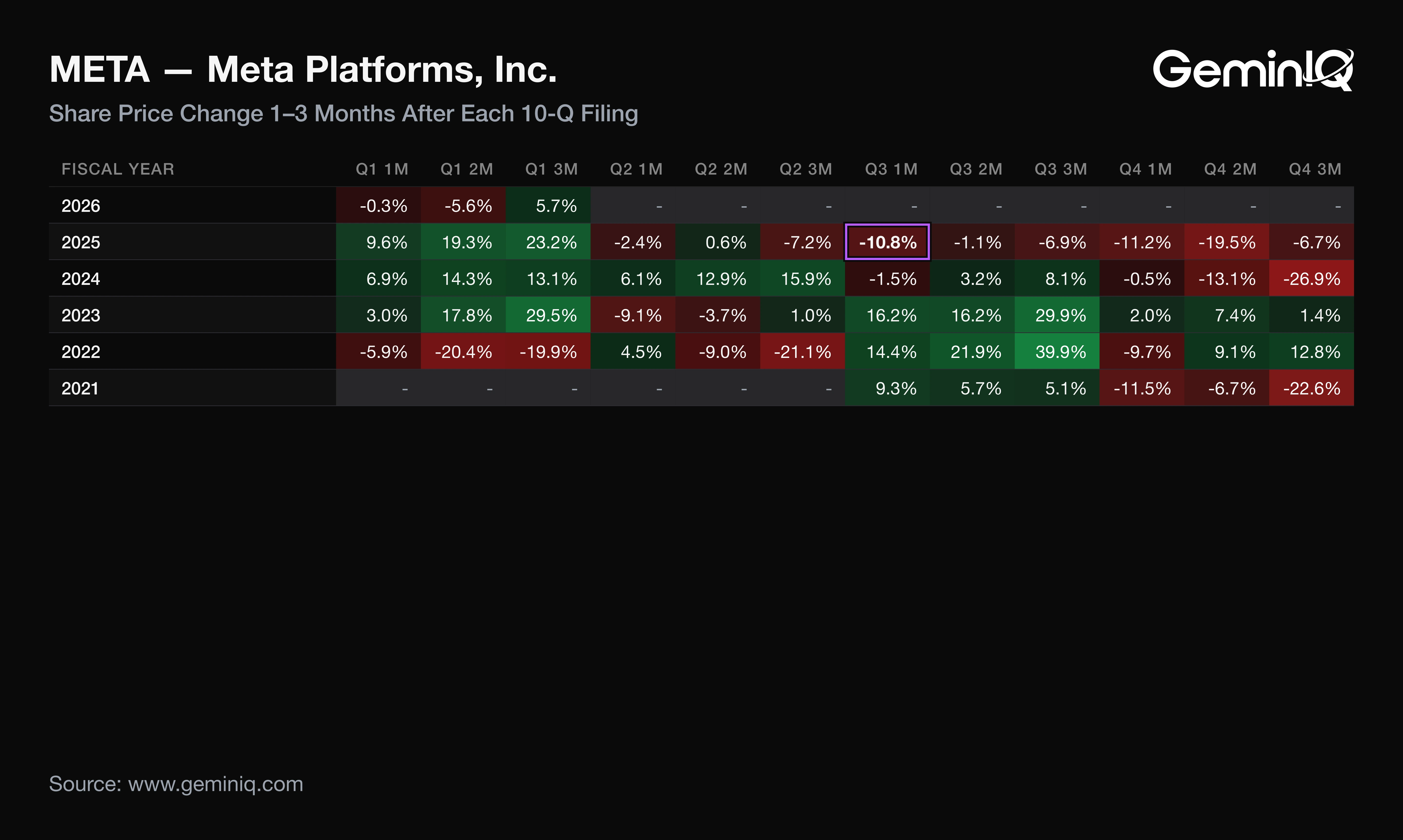
Across Meta's last 12 10-Q filings with completed one-month windows (filed July 27, 2023 to April 30, 2026), the median one-month return was −0.4% and the stock was higher after 5 of 12. The three-month median was +3.5%, with 8 of 12 positive.
The Data: One-month returns ranged from −11.2% to +16.2%, a spread of 27 points around a median near zero. Past Q3 filings were followed by one-month returns of +16.2%, −1.5% and −10.8%, each lower than the one before. This filing's window has not yet elapsed. These figures describe how Meta's stock moved after its past filings; they are a historical association, not a forecast, and the Earnings Reaction Heat Map shows each window.
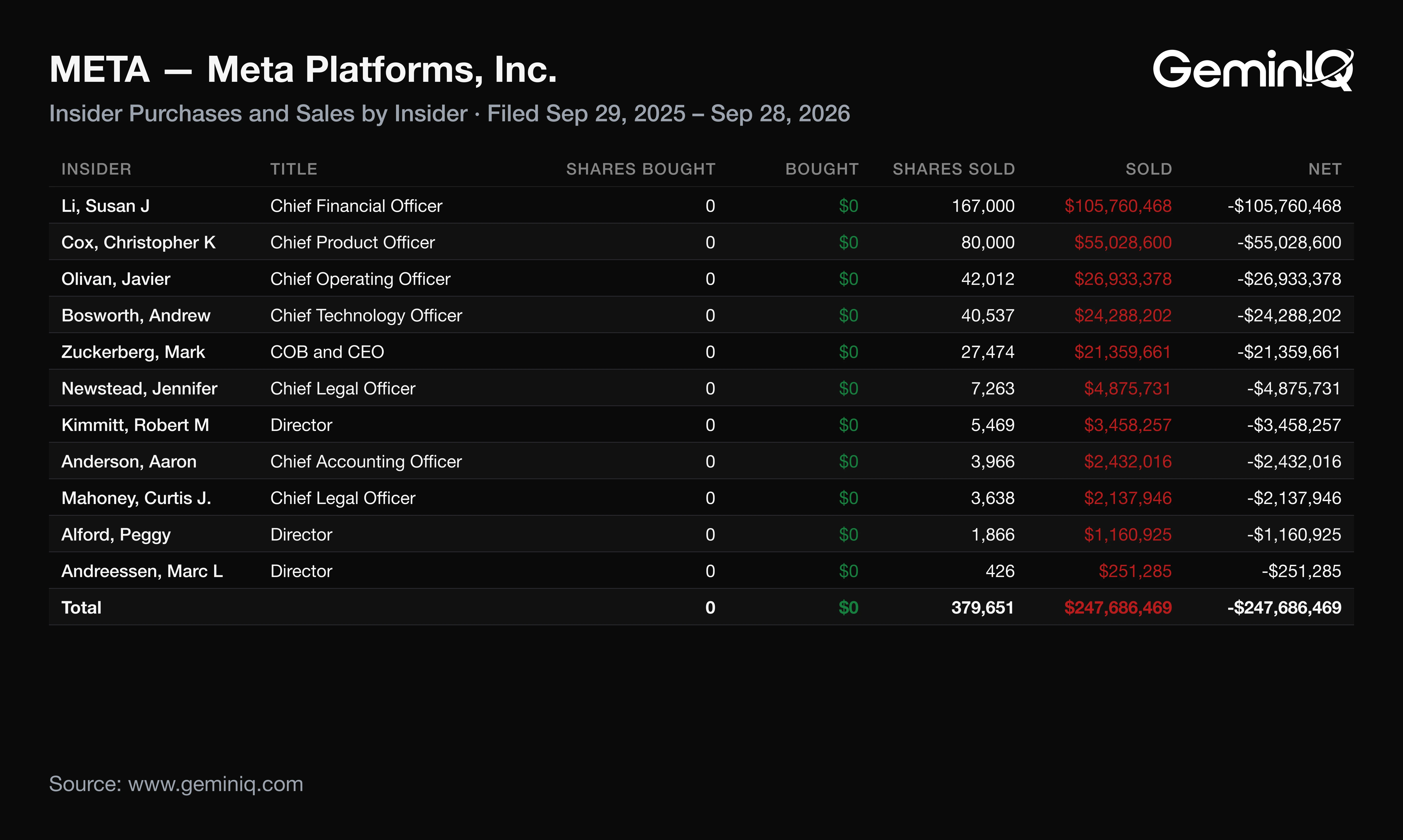
Why: A median near zero with that spread means the typical outcome says little about any single filing. On ownership, the latest 13F quarter end, June 30, 2026, showed institutions holding 65.01% of shares, up 2.23 points from a year earlier and the highest of the last 16 quarters. Form 4 data through filings dated September 28, 2026 shows 97 sales totaling $247.7 million and no purchases, against 215 sales totaling $1.35 billion in the prior 12 months, when Mark Zuckerberg accounted for 82%. No insider has bought since 2019; the 82% drop in dollar value is the change.
Any growth rate measured against a quarter with an abnormal tax charge describes the tax line more than the business, so restate the base before trusting the rate.
Frequently Asked Questions
When does Meta report earnings?
Meta reported Q3 2026 results on October 21, 2026 and filed its 10-Q on October 22, 2026. Last year it filed its fourth-quarter FY2025 results on January 29, 2026, which is the pattern for the next report, not a forecast of its date.
Is Meta doing well financially?
Meta's trailing operating margin was 34.97% in Q3 2026, down from 43.23% a year earlier, and its net margin was 26.77%, down from 30.89%. GeminIQ's pre-calculated Net Debt to EBITDA was 0.48x against 0.17x, as debt rose to fund capital spending.
Does Meta pay a dividend?
Yes. Meta paid $1.36 billion of dividends and dividend equivalents in Q3 2026, 2.3% above the year-ago quarter. Trailing-twelve-month dividends paid were $5.38 billion.
What is going on with Meta after its Q3 2026 earnings?
The 8-K says Meta's board approved a new non-voting Class C common stock, effective January 19, 2027, with a one-time stock dividend of one Class C share per Class A or Class B share. The company says the Class A price should then reflect a two-for-one split.
Wall Street's data. Main Street's price.
Institutional terminals charge thousands a year for as-filed accuracy. GeminIQ gives you the same thing for a fraction of the cost: financials built directly from raw SEC EDGAR filings, not third-party APIs, with full XBRL traceability back to the original 10-K or 10-Q. No normalized guesswork, just calculated metrics, charts, screeners, and watchlists built on numbers exactly as the company reported them. Start researching now at GeminIQ.com.
All financial figures cited in this article reference Meta Platforms, Inc.'s Q3 2026 10-Q (filed October 22, 2026, period ending September 30, 2026), with guidance and management commentary drawn from the company's Form 8-K earnings release (filed October 21, 2026). All SEC filings are publicly available at SEC EDGAR and SEC EDGAR.
Disclaimer: The content in this blog is for educational and entertainment purposes only and does not constitute financial, legal, or tax advice. Investing involves risk, including the loss of principal. The views expressed are my own and not intended as financial advice or a guarantee of future performance.