
Robinhood (HOOD) Q3 2026 Earnings: EPS Down 16%, Tax Up 91%

By Chad Hartman
Published · Last updated
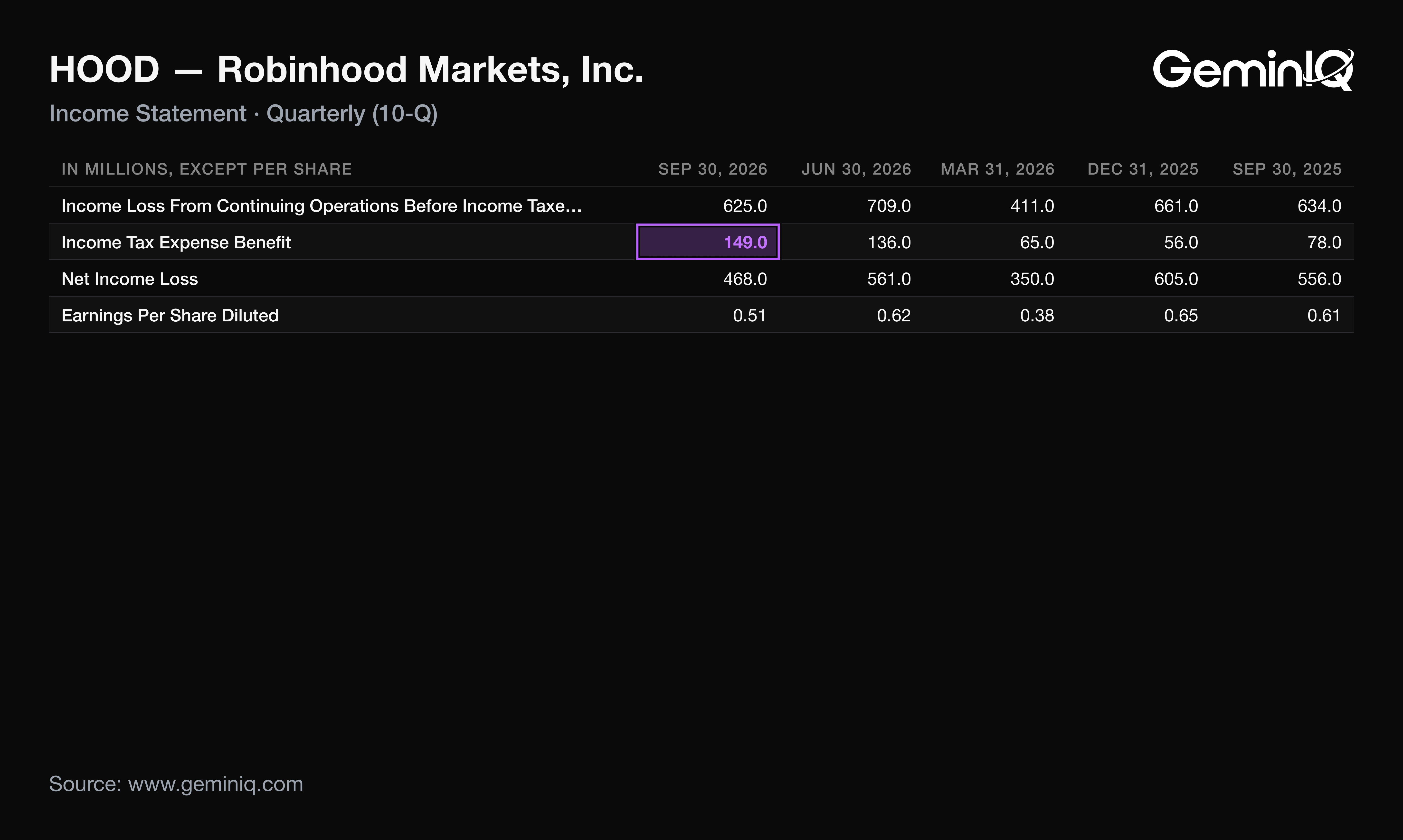
Robinhood (HOOD) reported Q3 2026 revenue of $1.42 billion, up 11.8% year over year, and diluted EPS of $0.51, down 16.4%, for the quarter ended September 30, 2026. Pretax income was nearly flat at $625 million against $634 million, so the earnings decline sits below that line: the income tax provision rose 91% to $149 million. Robinhood issued its release on October 27, 2026 and filed its 10-Q on October 28, 2026. The release's new Adjusted EPS of $0.60 adds back a $67 million investment loss but leaves the higher tax in.
| Field | Value |
|---|---|
| Company | Robinhood ($HOOD) |
| Quarter | Q3 FY2026, period ended September 30, 2026 |
| Earnings release | October 27, 2026 (Form 8-K) |
| 10-Q filed | October 28, 2026 |
| Revenue | $1.42 Billion (+11.8% YoY) |
| Diluted EPS | $0.51 (-16.4% YoY) |
| Operating margin | 48.1% (-1.7 pts YoY) |
| Operating cash flow (TTM) | $3.05 Billion |
| Income tax provision | $149 Million (+91% YoY) |
Robinhood Q3 2026 Revenue, EPS and Margins
Robinhood's Q3 2026 total net revenues were $1,424 million, up 11.8% from $1,274 million a year earlier and up 9% from $1,308 million in Q2, a record quarter per the release. Diluted EPS still fell to $0.51 from $0.61, the fifth-highest of the last 16 quarters.
The Data: Revenue less total operating expenses was $685 million, up 8% from $635 million (derived). Other income swung to a $60 million expense from a $1 million expense, mostly mark-to-market losses on the RVI and RVII investments. The tax provision rose to $149 million from $78 million. Net income before non-controlling interests fell $80 million: operating gains of $50 million, less $59 million from other income, less $71 million from tax.
Why: Tax is the largest single drag. Pretax income of $625 million taxed at last year's 12.3% effective rate (provision divided by pretax income, derived) would have left about $540 million for Robinhood's shareholders and diluted EPS near $0.59, against the $0.51 reported. Tax accounts for about $0.08 of the $0.10 decline.
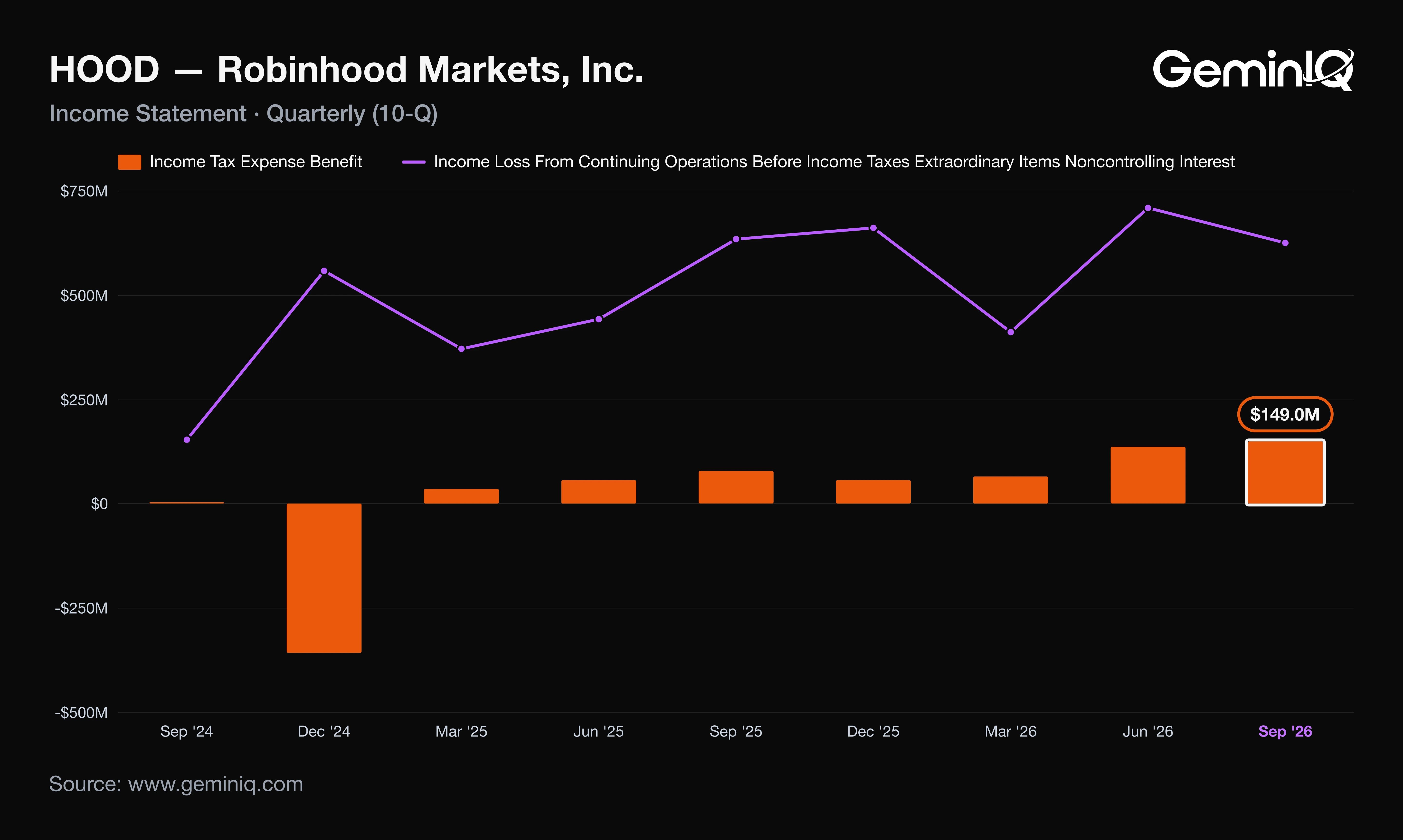
What Robinhood's Q3 2026 10-Q Shows Beyond the Press Release
Robinhood's Q3 2026 10-Q shows a $149 million tax provision on $625 million of pretax income, a 23.8% effective rate (derived) against 12.3% a year earlier. The release led with revenue and a new Adjusted EPS, and neither carries that rate.
The Data: Adjusted Net Income of $542 million (non-GAAP, per the 8-K) adds back $67 million of unrealized losses, which is why Adjusted EPS fell 3% while GAAP EPS fell 16%. The 10-Q attributes the $71 million tax increase to "the growth of the business along with a decrease in excess tax benefits from SBC." Pretax income fell 1.4%, so growth in the business cannot be the main driver. The cash flow statement adds that $61 million of the provision was deferred income tax, against none a year earlier.
Why: The rate has risen in every quarter of 2026: 15.8% in Q1, 19.2% in Q2 and 23.8% in Q3 (derived from the nine-month totals and the quarterly rows). The MD&A does not quantify the lost excess tax benefits, so the split between that factor and ordinary growth is not stated. Revenue grew 11.8%; the tax rate, not the business, took the EPS.
Robinhood Q3 2026 Operating Cash Flow, Buybacks and Debt
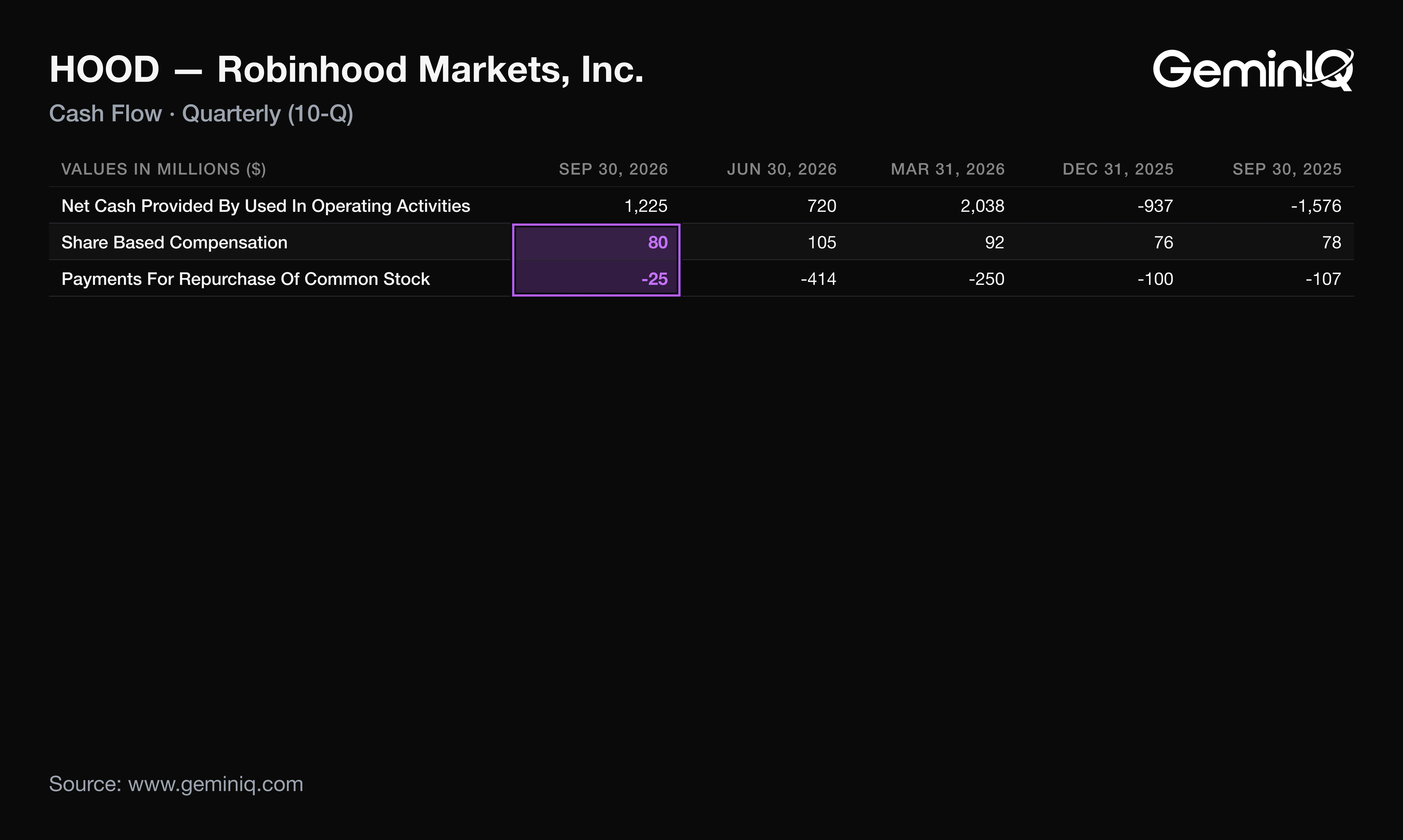
Robinhood's Q3 2026 operating cash flow was $1.23 billion, against an outflow of $1.58 billion a year earlier, the fourth-highest of the last 16 quarters. A reader would expect a swing that large to say something about earnings quality. Instead, the 10-Q ties it to customer balances.
The Data: Nine-month operating cash flow was $3,983 million against $2,575 million, a $1,408 million improvement. The 10-Q lists a $2,693 million increase in payables to users, driven by higher customer free credit balances, while net income after non-cash adjustments added only $274 million. Repurchases were $25 million in Q3 (0.2 million shares at about $105), against $80 million of share-based compensation, so buybacks covered 31% of it. Diluted shares were 911 million against 918 million a year earlier, down 0.8%.
Why: At a broker, operating cash flow carries customers' cash, so it follows deposits rather than profit. Cumulative repurchases since Q3 2024 total $1.3 billion, per the 8-K, but this quarter's buying did not cover the equity it issued. Long-term borrowings were $2.7 billion against none at year-end 2025.
Robinhood's 2026 Expense Outlook After Q3
Robinhood's 2026 outlook for Adjusted Operating Expenses and SBC is $2.675 billion to $2.75 billion, per the 8-K, after the company cut the top of its July 29 range of $2.675 billion to $2.775 billion by $25 million. A lower ceiling reads as cost discipline. The outlook omits the cost line growing fastest.
The Data: Q3 Adjusted Operating Expenses and SBC rose 8% to $664 million, while total operating expenses rose 16% to $739 million. The $75 million gap is mostly the provision for credit losses, which rose 173% to $71 million from $26 million. The 8-K states that the outlook excludes that provision, pending-acquisition costs and CFO-transition equity modifications.
Why: The credit card book is the source. Credit-card provisions were $61 million against $23 million a year earlier, and exceeded the $50 million of credit card net interest revenue, per the MD&A. The company guided no total operating expense figure.
How HOOD Stock Has Moved After Past Earnings Reports
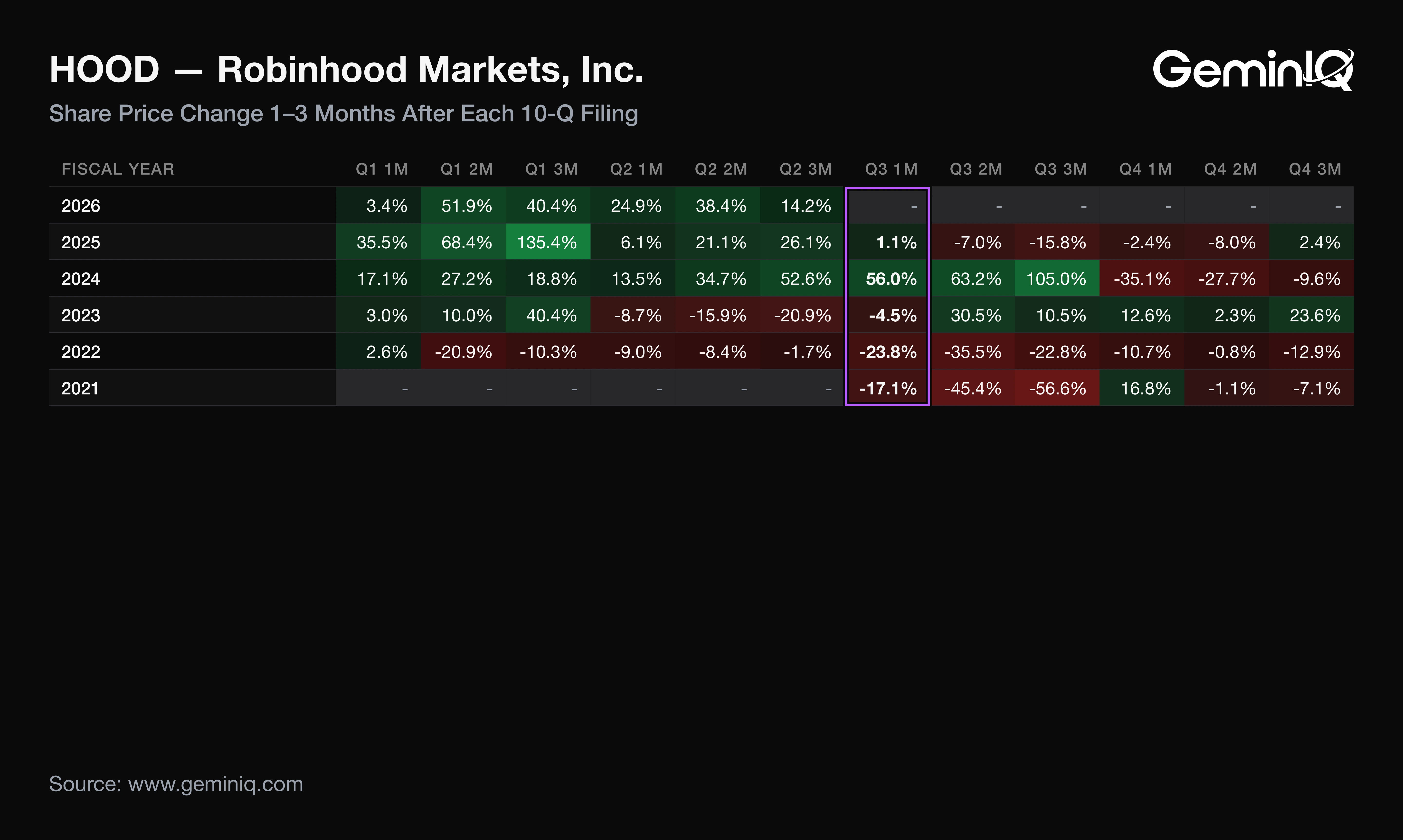
Robinhood's stock returned a median of +9.3% in the month after each of its last 12 10-Q filings (November 7, 2023 to July 30, 2026), and was positive after 9 of them. The range ran from -35.1% after the FY2024 Q4 filing to +56.0% after FY2024 Q3. The three-month median was +22.4%, positive after 10 of 12.
The Data: The three prior Q3 filings were followed by one-month and three-month returns of -4.5% and +10.5% (FY2023), +56.0% and +105.0% (FY2024), and +1.1% and -15.8% (FY2025). The Q3 2026 filing has no return yet because its window has not elapsed. These figures describe how Robinhood's stock moved after its past filings; they are a historical association, not a forecast. The Earnings Reaction Heat Map shows each cell.
Why: The spread is wide enough that the median says little about any single quarter: returns split by more than 90 points between best and worst.
Insider selling was lighter than a year earlier. Form 4 filings dated September 22, 2025 to September 22, 2026 show 62 sales totaling $731.8 million and 3 purchases totaling $55.3 million. That compares with 94 sales totaling $1.57 billion in the prior 12 months. Baiju Bhatt ($316.1 million) and Vlad Tenev ($283.2 million) account for 82% of the dollars sold, and the latest filing in the data is dated September 22, so the weeks after the release are not covered.
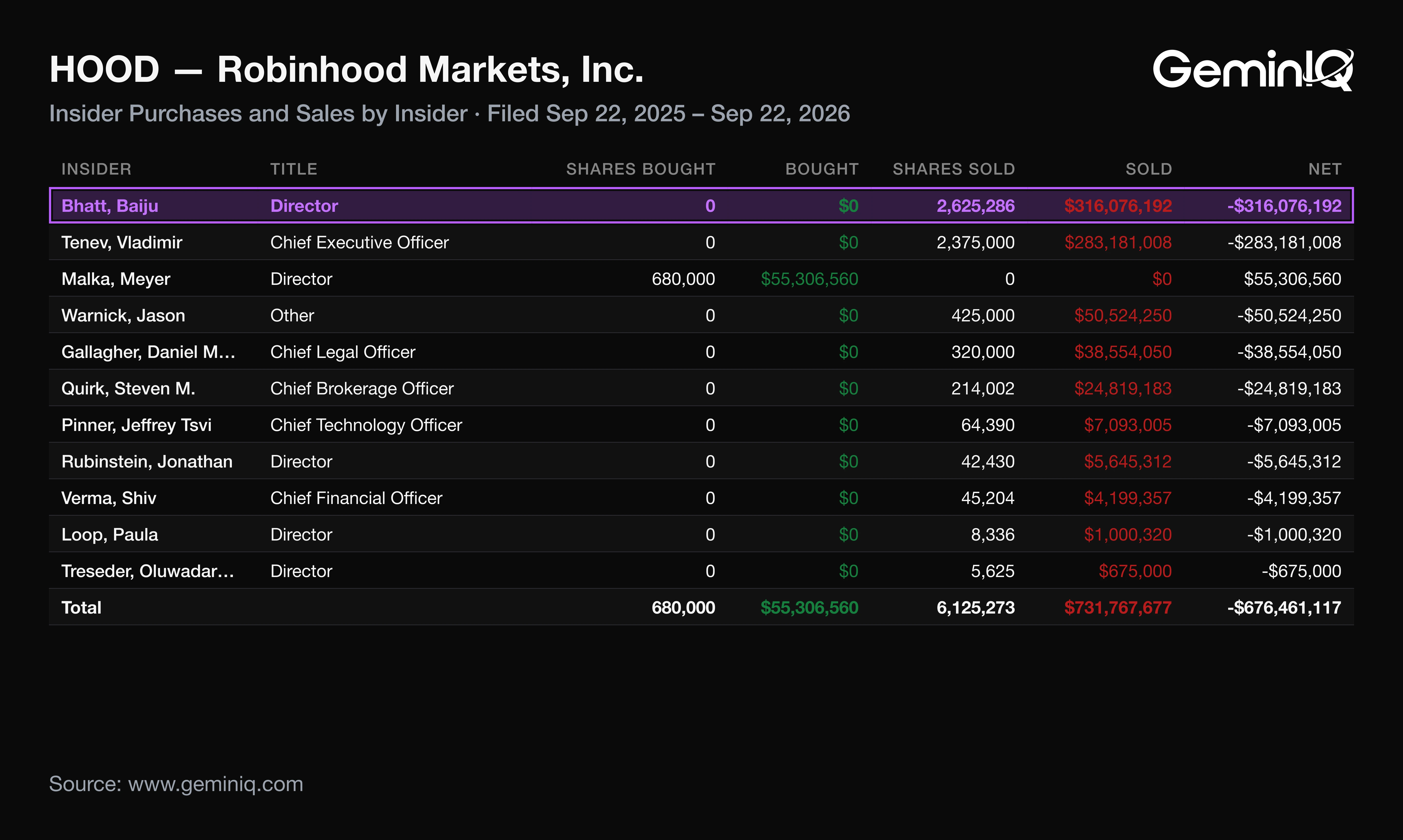
A quarter in which EPS falls while pretax income holds is decided by the tax line, so the first figure to read in the next 10-Q is the effective rate.
Frequently Asked Questions
Is Robinhood doing well financially?
Robinhood earned $1,379 million attributable to shareholders in the nine months ended September 30, 2026, up 8% from $1,278 million. Funded Customers reached 28.7 million (+7%), Robinhood Gold Subscribers 5.18 million (+34%) and Total Platform Assets $395.9 billion (+19%), per the 10-Q. Cash and cash equivalents were $5.83 billion against $2.66 billion of long-term borrowings on the balance sheet.
When does Robinhood report earnings?
Robinhood issued its Q3 2026 release on October 27, 2026 and filed the 10-Q on October 28, 2026. Last year it filed its fourth-quarter results on February 18, 2026. That is a pattern from the filing record, not a forecast of the next date.
Does Robinhood pay a dividend?
Robinhood paid no dividends in Q3 2026 or in the trailing twelve months, per its cash flow statement. It returns capital through repurchases: $399 million of its $1.5 billion program in the first nine months of 2026, plus $290 million in Q2 funded by convertible note proceeds.
Where can I verify Robinhood's Q3 2026 figures?
The figures come from Robinhood's Q3 2026 10-Q on EDGAR, filed October 28, 2026. The earnings release exhibit carries the guidance and non-GAAP reconciliation.
Wall Street's data. Main Street's price.
Institutional terminals charge thousands a year for as-filed accuracy. GeminIQ gives you the same thing for a fraction of the cost: financials built directly from raw SEC EDGAR filings, not third-party APIs, with full XBRL traceability back to the original 10-K or 10-Q. No normalized guesswork, just calculated metrics, charts, screeners, and watchlists built on numbers exactly as the company reported them. Start researching now at GeminIQ.com.
All financial figures cited in this article reference Robinhood Markets, Inc.'s Q3 2026 10-Q (filed October 28, 2026, period ending September 30, 2026), with guidance and management commentary drawn from the company's Form 8-K earnings release (filed October 28, 2026). All SEC filings are publicly available at SEC EDGAR and SEC EDGAR.
Disclaimer: The content in this blog is for educational and entertainment purposes only and does not constitute financial, legal, or tax advice. Investing involves risk, including the loss of principal. The views expressed are my own and not intended as financial advice or a guarantee of future performance.