Rocky Mountain Chocolate (RMCF) Q2 FY2027 Earnings: Covenants Broken

By Chad Hartman
Published · Last updated
Rocky Mountain Chocolate Factory (RMCF) reported fiscal Q2 2027 revenue of $6.65 million, down 2.5% from a year earlier, and a diluted loss of $0.14 per share against $0.09, for the quarter ended August 31, 2026. The company released results and filed its 10-Q on October 19, 2026, and led with a gross margin that recovered to 8.0% from (0.6)%. The filing shows the operating loss more than doubled to $1.09 million and that the company was out of compliance with both financial covenants on its credit agreements, a breach the release's results bullets never mention.
| Field | Value |
|---|---|
| Company | Rocky Mountain Chocolate Factory ($RMCF) |
| Quarter | Q2 FY2027, period ended August 31, 2026 |
| Earnings release | October 19, 2026 (Form 8-K) |
| 10-Q filed | October 19, 2026 |
| Revenue | $6.65 Million (-2.5% YoY) |
| Diluted EPS | -$0.14 (-55.6% YoY) |
| Operating margin | -16.3% (-9.3 pts YoY) |
| Operating cash flow (TTM) | -$2.17 Million |
| Current ratio | 0.52x |
Rocky Mountain Chocolate Factory Q2 FY2027 Revenue, EPS and Margins
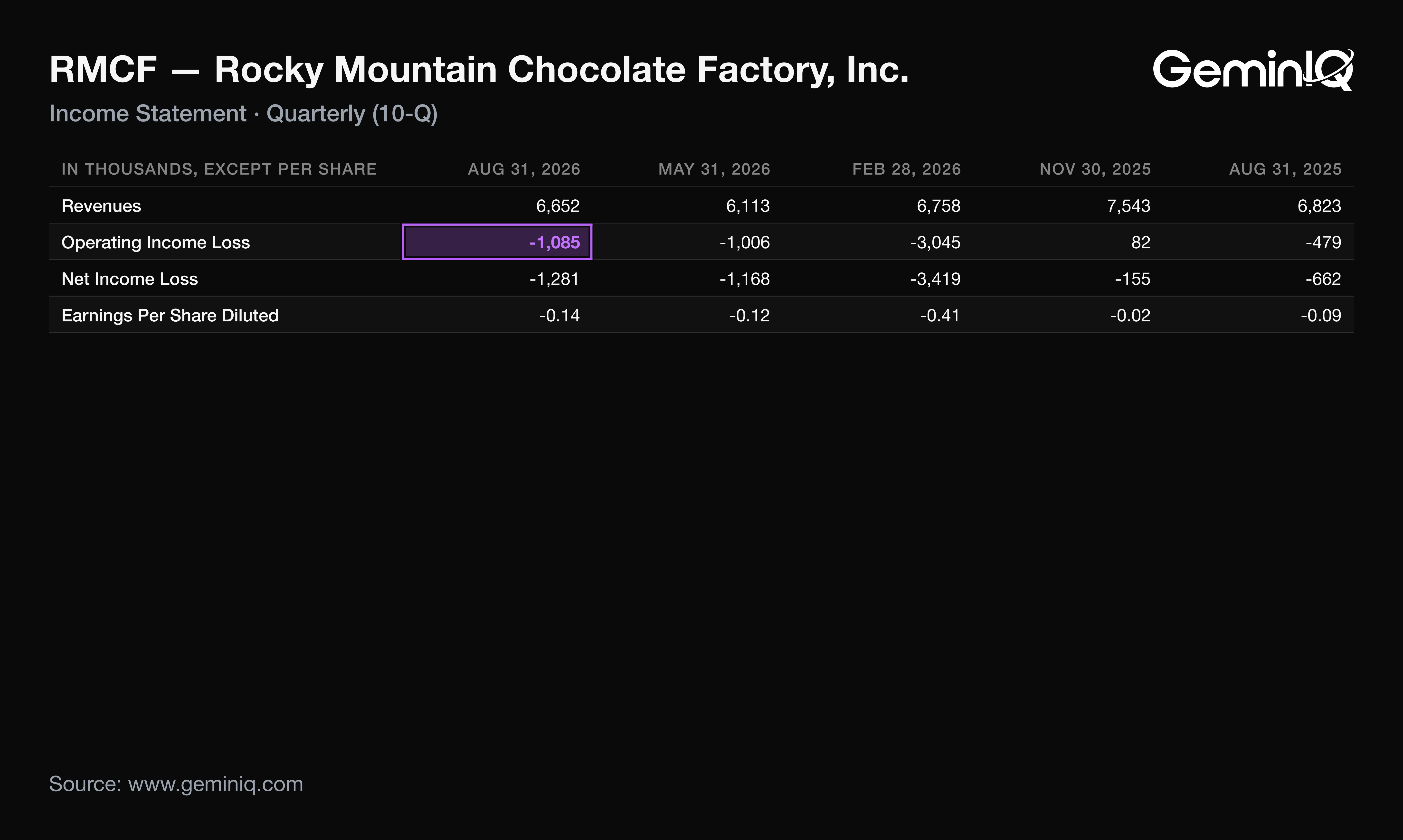
Rocky Mountain Chocolate Factory's Q2 FY2027 revenue was $6.65 million, down 2.5% from $6.82 million, and its diluted loss per share was $0.14, against $0.09. The operating loss widened faster than either, even as gross margin improved.
The Data: Gross margin on product and retail sales rose $456 thousand, to $423 thousand from a $33 thousand gross loss. The operating loss still widened $606 thousand, to $1,085 thousand, because franchise and royalty revenue fell $298 thousand, franchise costs rose $232 thousand, general and administrative expense rose $352 thousand (up 36.1%) and retail operating expense rose $208 thousand. Operating margin was -16.3% against -7.0%, the eighth-weakest of the last 16 quarters. Net loss grew 93.5% to $1.28 million; a diluted share count of 9.45 million, up 21.3% and the highest of the last 16 quarters, held the reported per-share loss increase to 55.6%.
Why: The release credits pricing and production efficiencies. Cost of sales fell $329 thousand while sales rose only $127 thousand, so lower cost supplied about 72% of the margin gain. The 10-Q's MD&A attributes the 2.5% rise in Durango product and retail sales to price increases, yet Note 4 shows retail sales up $337 thousand to $770 thousand as company-owned stores grew to five, while Durango product sales fell $210 thousand to $4.54 million. The loss sits in franchising: segment profit fell to $373 thousand from $861 thousand, and at last year's level the operating loss would have been about $0.6 million. Sequentially nothing moved; the prior quarter's operating margin was -16.5%. The recovery sits in the factory, and the loss sits in franchising and overhead.
What Rocky Mountain Chocolate Factory's 10-Q Shows Beyond the Press Release
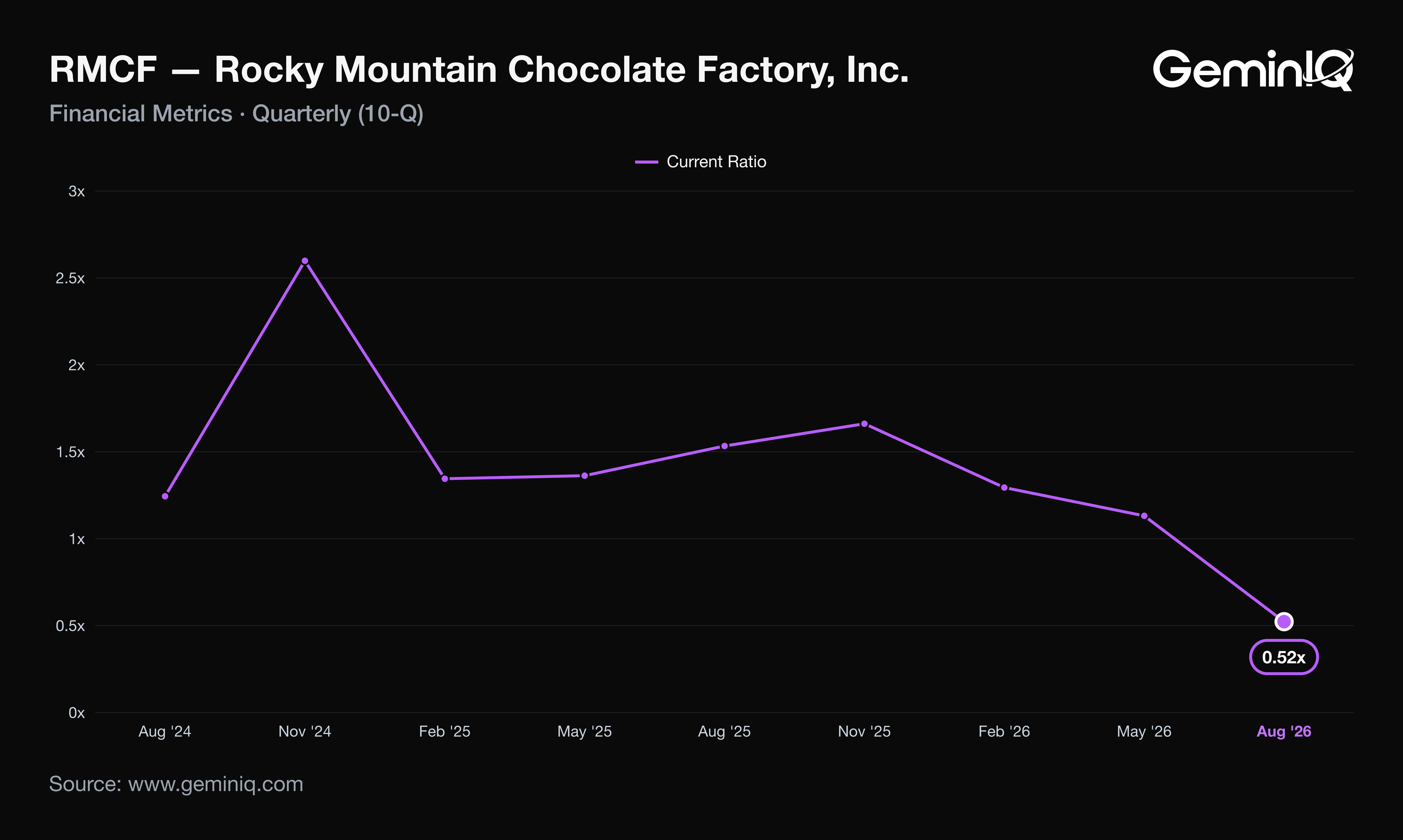
Rocky Mountain Chocolate Factory's 10-Q states that it was not in compliance with either covenant in its two credit agreements at August 31, 2026. GeminIQ's pre-calculated Current Ratio was 0.52x against a 1.25 minimum, down from 1.53x a year earlier.
The Data: Total liabilities to tangible net worth was 8.96 to 1.0 against a 2.0 maximum. The company reports no waiver from either lender through quarter end, so $6.78 million of notes payable moved to current liabilities from zero at February 28. Working capital swung to a $6.5 million deficit from positive $2.2 million, and the 10-Q repeats the substantial doubt about going concern that the auditor raised on the February 2026 statements. Both lenders are tied to the board: RMC Credit Facility to director Steven Craig, RMCF2 Credit to former interim CEO Jeffrey Geygan.
Why: The release's results bullets omit all of this; the words "ability to continue as a going concern" appear only in its forward-looking-statements boilerplate. The cure came after quarter end. On October 16 the company sold and leased back its Durango plant, which secured the notes, for $6.6 million and used the proceeds to repay $6.6 million of 12% debt, incurring $0.3 million of prepayment penalties. It also took a $2.0 million Alpine Bank loan at prime plus 1%, due October 2028. The covenants were cured by removing the debt, not by meeting the ratios. The 12% notes cost about $0.8 million a year in interest; the release does not state the leaseback rent, which decides whether that saves anything. The ratios describe a balance sheet that no longer exists in that form. Net of penalties, about $1.7 million of new cash arrived against $416 thousand on hand at August 31.
Rocky Mountain Chocolate Factory Q2 FY2027 Cash Flow, Inventory and Cash
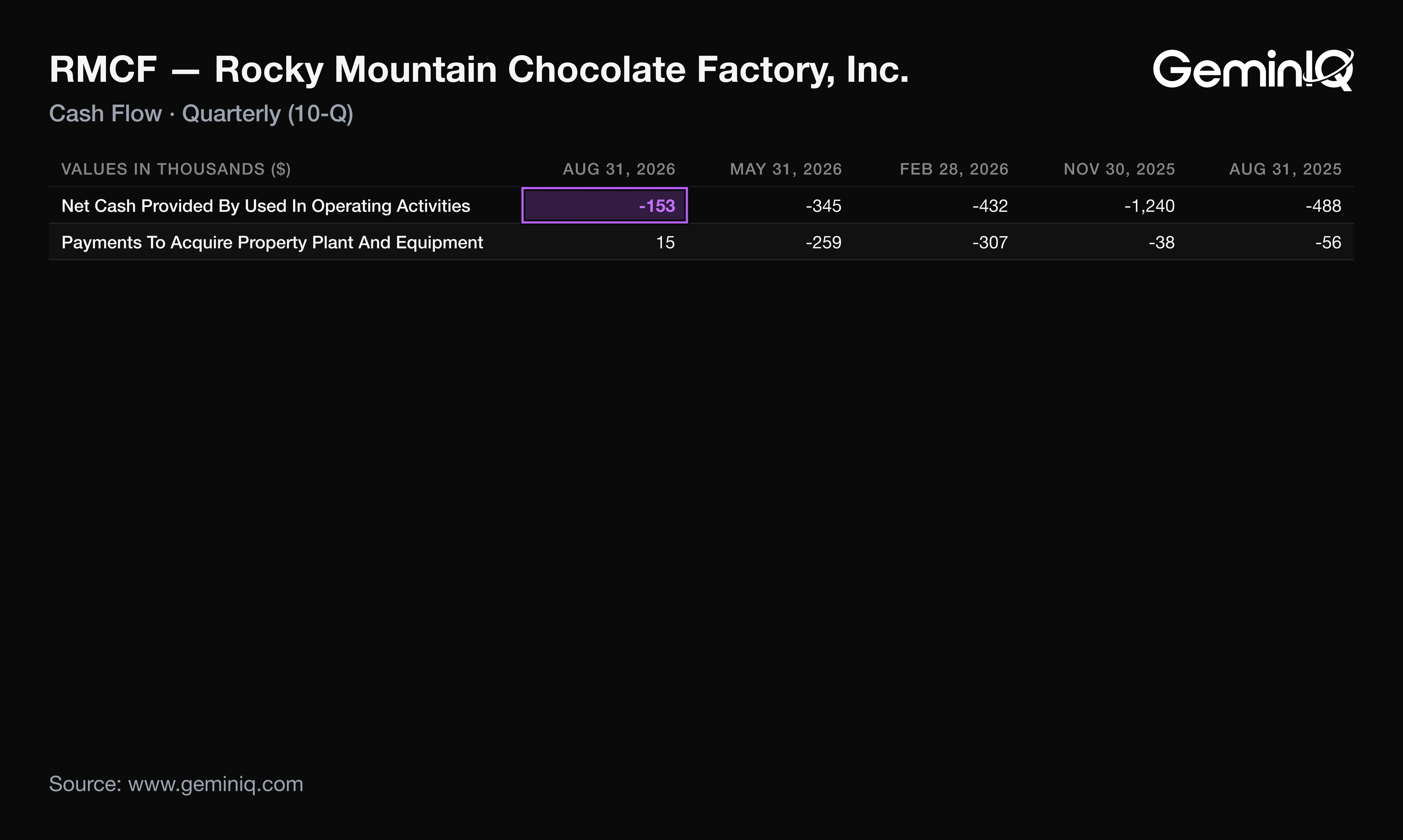
Rocky Mountain Chocolate Factory's Q2 FY2027 operating cash flow was -$153 thousand, an improvement of 68.6% from -$488 thousand a year earlier and the fifth-highest of the last 16 quarters. A company losing $1.28 million in a quarter would be expected to burn comparable cash; it burned 12% of that loss.
The Data: Non-cash depreciation and amortization of $373 thousand covers part of the gap. The balance sheet covers more: inventory fell to $2.59 million from $4.06 million at February 28, a $1.47 million release. Capital expenditure was $15 thousand, the lowest of the last 16 quarters, and free cash flow was -$168 thousand. Over the trailing twelve months, operating cash flow was -$2.17 million against -$1.1 million a year earlier, and GeminIQ's pre-calculated Free Cash Flow was -$2.8 million against -$3.5 million.
Why: The smaller burn came from working capital and withheld investment, not from earning more. Inventory can be drawn down once, and capital expenditure was $259 thousand the quarter before. Receivables moved the other way: up $406 thousand to $2.95 million (16%) since February while six-month revenue fell 3.3%, though a February-to-August comparison spans seasons and some of it may be timing. Accounts payable of $4.92 million were nearly twelve times cash.
How RMCF Stock Has Moved After Past Earnings Reports
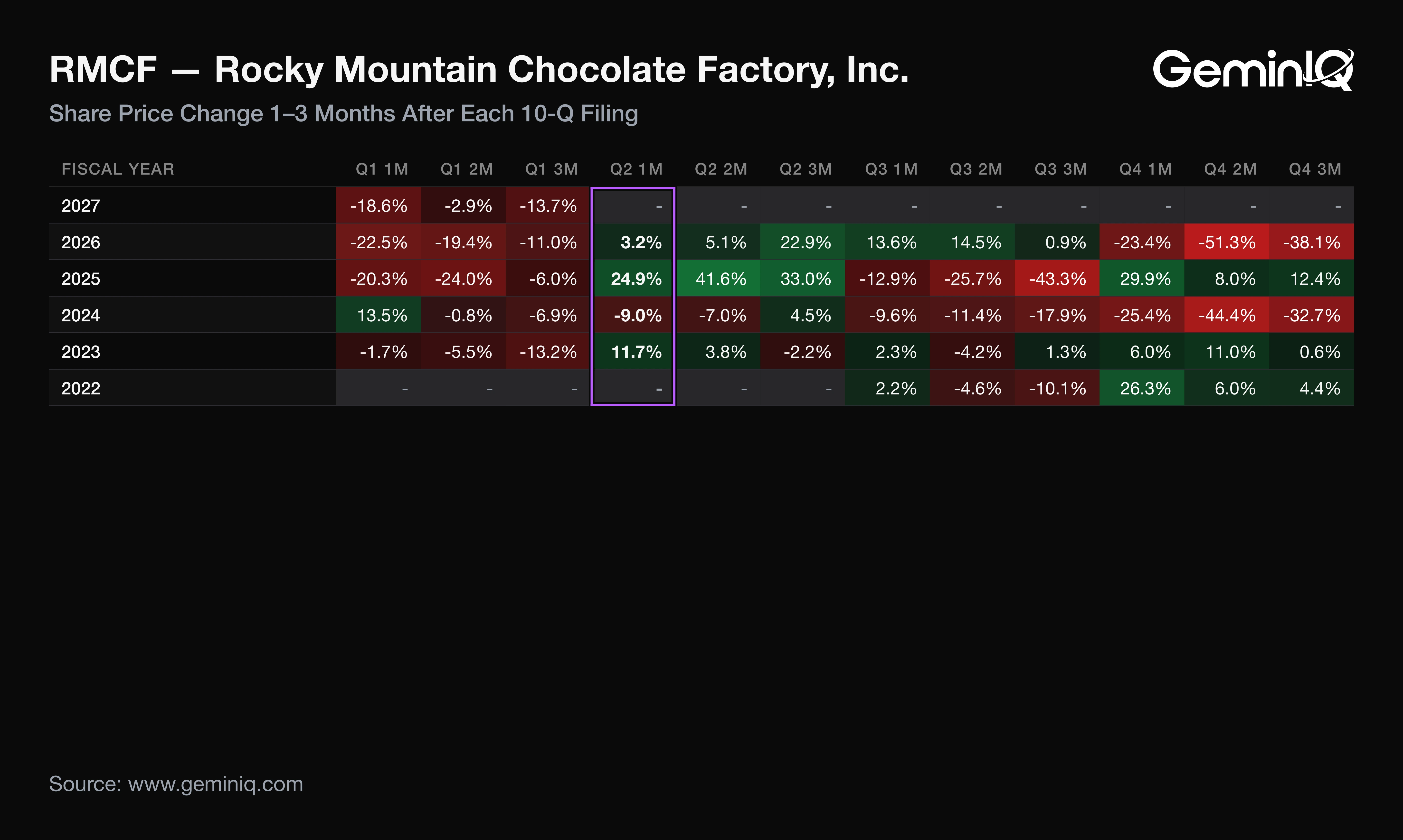
Across the last 12 10-Q filings with a completed one-month window (filed October 2023 to July 2026), RMCF's stock was followed by a median one-month return of -11.2% and was positive after 4 of 12.
The Data: The three-month median was -8.5%, positive after 5 of 12. The one-month range ran from -25.4% after the June 2024 filing to +29.9% after the June 2025 filing, a spread of 55 points. Past Q2 filings were followed by one-month returns of -9.0%, +24.9% and +3.2%, and three-month returns of +4.5%, +33.0% and +22.9%. This filing's windows have not elapsed. These figures describe how Rocky Mountain Chocolate Factory's stock moved after its past filings; they are a historical association, not a forecast.
Why: Q2 reports arrive before the holiday season the 10-Q calls historically the strongest, which may be why the three Q2 three-month windows sit above the 12-filing median; three observations is too few to say.
The release adds that the Board formed a strategic committee during the quarter to explore a sale, merger or going-private transaction, and that the company has received expressions of interest from third parties, with no assurance of any transaction. A margin recovery earns the headline, but a covenant ratio decides how long a company keeps the chance to repeat it.
Frequently Asked Questions
When does Rocky Mountain Chocolate Factory report earnings?
Rocky Mountain Chocolate Factory released its Q2 FY2027 results and filed its 10-Q on October 19, 2026. Last year it filed Q2 on October 14, 2025 and the following quarter, Q3 FY2026, on January 13, 2026. That is a filing pattern, not a forecast of the next date.
Does Rocky Mountain Chocolate Factory pay a dividend?
Rocky Mountain Chocolate Factory paid no dividends in Q2 FY2027 or over the trailing twelve months, per its cash flow statement. Trailing operating cash flow was -$2.17 million.
Is Rocky Mountain Chocolate Factory profitable?
No. Rocky Mountain Chocolate Factory's trailing net profit margin was -22.25% at Q2 FY2027, against -15.77% a year earlier, and its operating margin was -18.67%. Stockholders' equity fell to $3.03 million from $5.23 million at February 28, 2026.
What was Rocky Mountain Chocolate Factory's Q2 FY2027 revenue?
Rocky Mountain Chocolate Factory's Q2 FY2027 revenue was $6.65 million, with six-month revenue of $12.77 million. The quarter split into $5.31 million of Durango product and retail sales, $1.31 million of royalty and marketing fees and $28 thousand of franchise fees.
Wall Street's data. Main Street's price.
Institutional terminals charge thousands a year for as-filed accuracy. GeminIQ gives you the same thing for a fraction of the cost: financials built directly from raw SEC EDGAR filings, not third-party APIs, with full XBRL traceability back to the original 10-K or 10-Q. No normalized guesswork, just calculated metrics, charts, screeners, and watchlists built on numbers exactly as the company reported them. Start researching now at GeminIQ.com.
All financial figures cited in this article reference Rocky Mountain Chocolate Factory, Inc.'s Q2 FY2027 10-Q (filed October 19, 2026, period ending August 31, 2026), with guidance and management commentary drawn from the company's Form 8-K earnings release (filed October 19, 2026). All SEC filings are publicly available at SEC EDGAR and SEC EDGAR.
Disclaimer: The content in this blog is for educational and entertainment purposes only and does not constitute financial, legal, or tax advice. Investing involves risk, including the loss of principal. The views expressed are my own and not intended as financial advice or a guarantee of future performance.