
Sonos (SONO) Q4 2026 Earnings: Revenue Up 20%, Refund Cut the Loss

By Chad Hartman
Published · Last updated
Sonos (SONO) reported fiscal fourth-quarter 2026 revenue of $344.4 million, up 19.6% from a year earlier, and a diluted loss of $(0.04) per share, against $(0.31), for the 14 weeks ended October 3, 2026. Adjusted EBITDA stayed flat at $6.0 million, because $18.0 million of the quarter's gross profit was a one-time IEEPA tariff refund and about $24.6 million of full-year revenue came from an extra week. Sonos released results on November 10, 2026 and filed its 10-K on November 18; without the refund, the operating loss was about $28.8 million, against $34.4 million a year earlier.
| Field | Value |
|---|---|
| Company | Sonos ($SONO) |
| Quarter | Q4 FY2026, 14 weeks ended October 3, 2026 |
| Earnings release | November 10, 2026 (Form 8-K) |
| 10-K filed | November 18, 2026 |
| Revenue | $344.44 Million (+19.6% YoY) |
| Diluted EPS | $(0.04) (improved from $(0.31) a year earlier) |
| Operating margin | -3.1% (+8.8 pts YoY) |
| Operating cash flow (TTM) | $144.67 Million |
| Full-year revenue | $1,546.9 Million (+7.2% YoY) |
| IEEPA tariff refund in Q4 gross profit (8-K) | $18.0 Million |
Sonos Q4 2026 Revenue, EPS and Margins
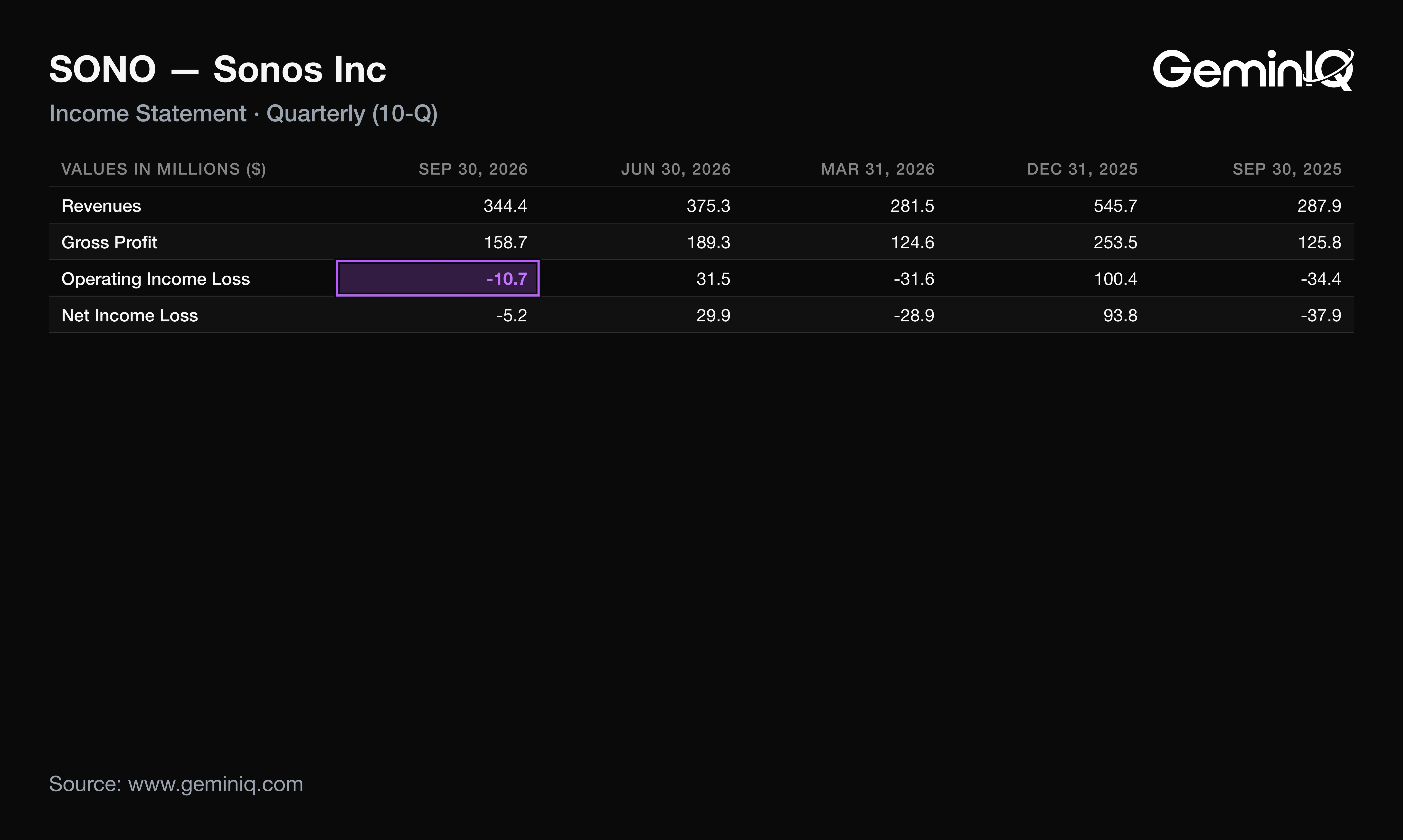
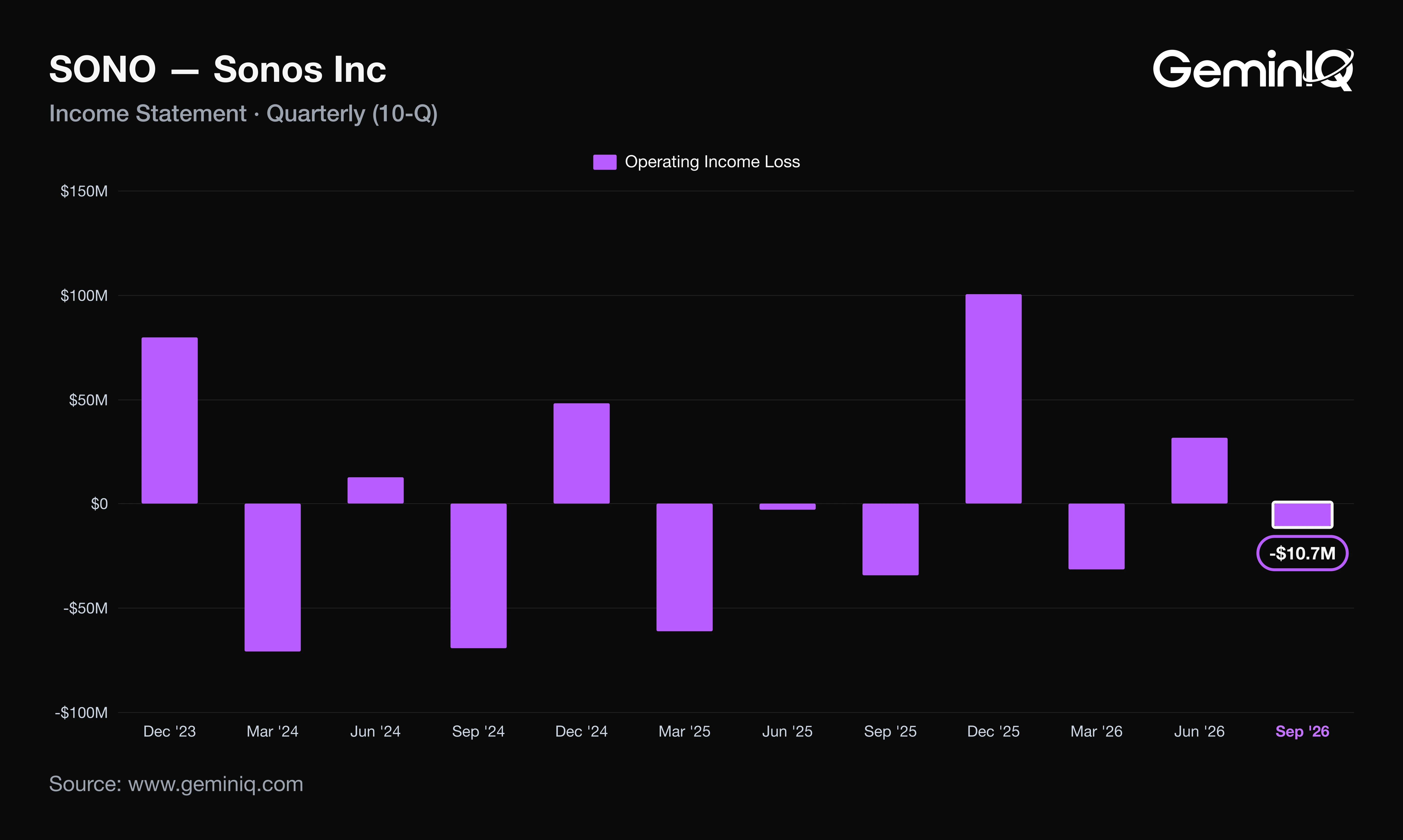
Sonos's Q4 2026 revenue was $344.4 million, up 19.6% from $287.9 million a year earlier and down 8.2% from the June quarter's $375.3 million. The GAAP operating loss narrowed to $10.7 million from $34.4 million, and most of that narrowing was not operating performance.
Revenue growth of 20% usually brings operating leverage, yet Adjusted EBITDA was $6.0 million against $6.4 million a year earlier, on $56.5 million more revenue (8-K).
The Data: The fiscal year ran 53 weeks, and the 10-K places the extra week in the fourth quarter. Without its roughly $24.6 million, Q4 revenue was about $319.8 million, up 11.1%. Net loss improved $32.7 million to $5.2 million: $23.7 million from operating income, $8.3 million from a $4.8 million tax benefit replacing a $3.5 million provision, and $0.7 million from other items. Diluted shares were 118.3 million against 120.6 million (8-K).
Why: One item carries the operating gain. Q4 gross profit of $158.7 million includes an $18.0 million IEEPA tariff refund, which the 8-K excludes from non-GAAP measures but keeps in the GAAP headline. Without it, the operating loss was $28.8 million, a margin of -8.4% against -12.0%, and gross margin was 40.9% against 43.7%. The reported -3.1% operating margin ranked eighth highest of the last 16 quarters. Refund-adjusted, the loss narrowed about $5.6 million, not $23.7 million.
What Sonos's FY2026 10-K Shows Beyond the Q4 Press Release
Sonos's 10-K puts fiscal 2026 revenue at $1,546.9 million, up 7.2%, with the 53rd week adding about $24.6 million; excluding it, growth was about 5.5%. The release led with double-digit fourth-quarter growth and a $151 million GAAP net income gain, and the filing shows both rest partly on items that do not recur.
The Data: The extra week supplied about 8.5 points of Q4's 19.6% growth and about $5.0 million of operating expenses for the year. Tariff refunds totaled $41.2 million for the year, $18.0 million of it in Q4. The 10-K credits them with 270 basis points of the 320-point gross margin gain, against 360 basis points of cost from roughly $56.0 million of higher memory prices. Net income was $89.6 million, against a $61.1 million loss; the 8-K's non-GAAP reconciliation removes $42.6 million of refund and interest.
Why: A reader who saw double-digit growth and a smaller loss would expect operating leverage. Instead the company attributes the other 50 basis points of gross margin gain to pricing, material savings, fewer inventory write-downs and currency, net of memory costs. The cost cuts were real, though: operating expenses net of restructuring fell $21.1 million, or 3.2%. That is the repeatable part of the year's profit.
Sonos Q4 2026 Cash Flow, Inventory and Buybacks
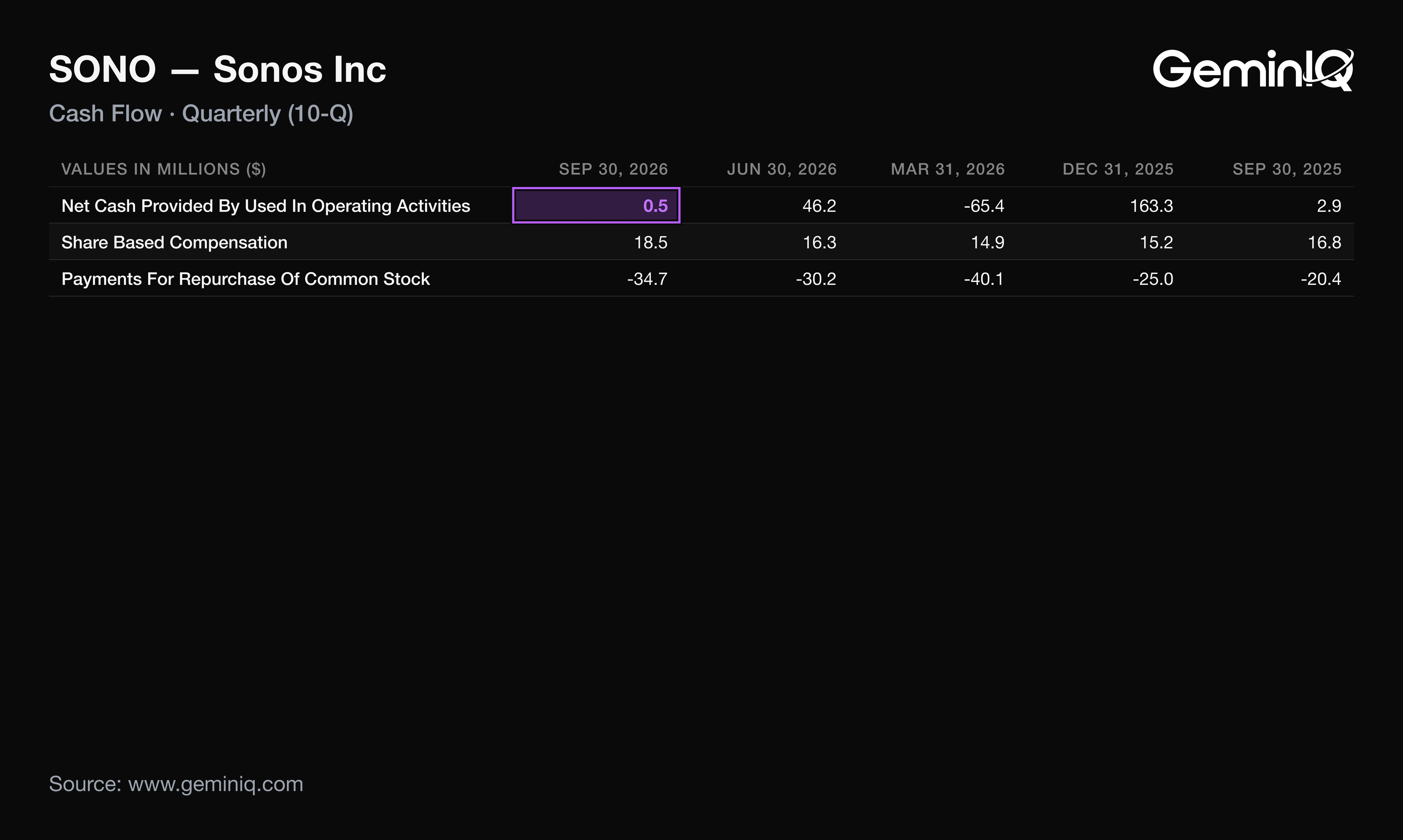
Sonos's Q4 2026 operating cash flow was $0.5 million, against $2.9 million a year earlier and $46.2 million in the June quarter, the sixth lowest of the last 16 quarters. The year closed with cash generation stalled, though full-year operating cash flow was $144.7 million, up 5.7%.
The Data: The 10-K shows inventories absorbed $104.0 million over the year, citing memory costs and finished goods for new launches, and receivables $39.0 million; payables and accruals released $83.0 million. Q4 free cash flow was -$4.6 million, against -$2.3 million, and full-year free cash flow $122.9 million (8-K). Buybacks of $130.0 million for 8.2 million shares at $15.78 exceeded that, and cash rose only $3.4 million to $178.1 million. Sonos has no borrowings, and GeminIQ's pre-calculated Net Debt to EBITDA was -1.30x.
Why: Employees received about 7.4 million shares through option exercises and RSU and PSU releases, so net repurchases retired only about 0.8 million. Non-GAAP diluted shares for the year were 122.3 million against 122.9 million (8-K). The buyback mostly offset issuance, as stock compensation of $65.1 million is recurring.
How SONO Stock Has Moved After Past Earnings Reports
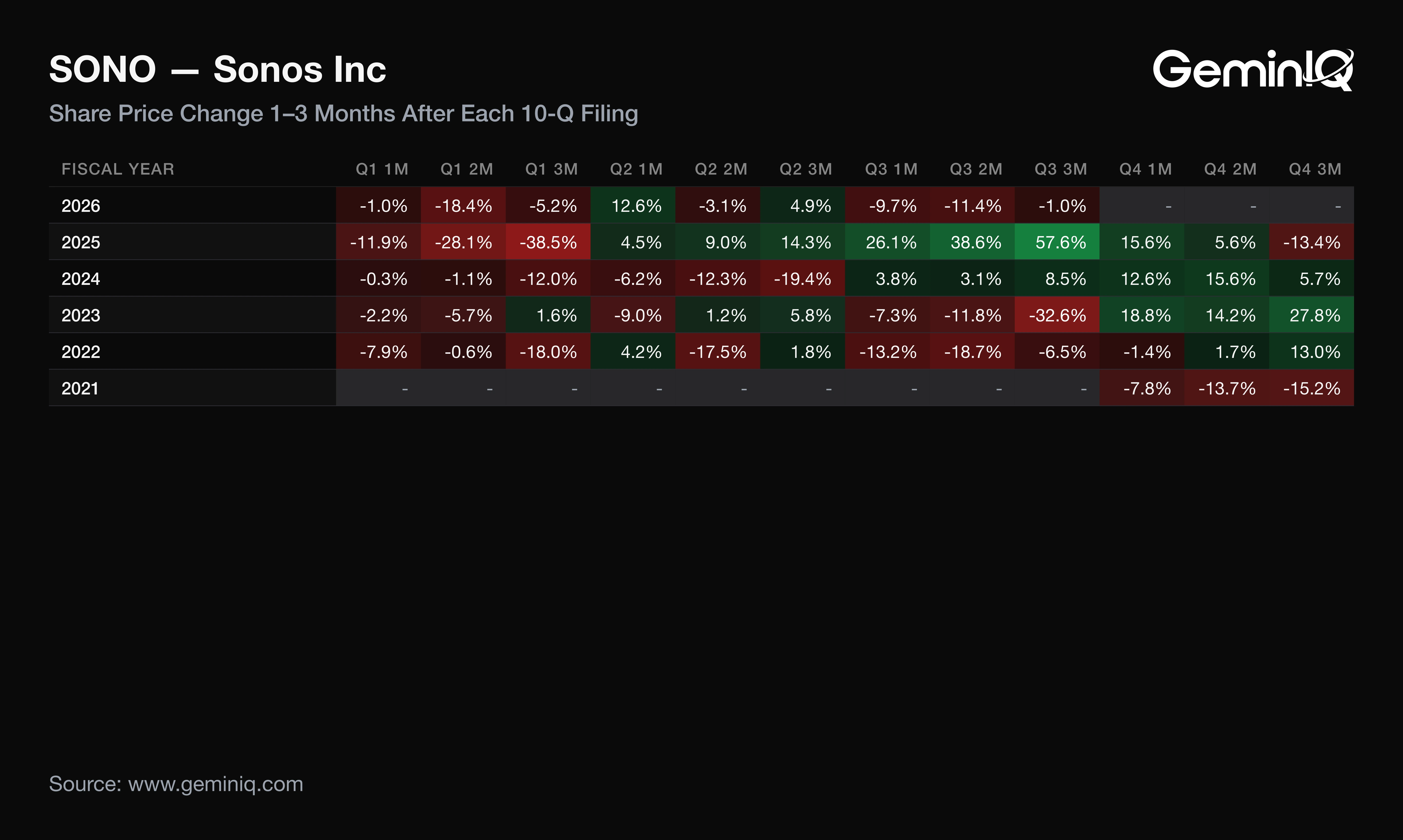
Across its last twelve 10-Q filings, Sonos's one-month post-filing return had a median of -1.6%, was positive after four, and ranged from -11.9% to +26.1%. The three past fourth-quarter filings were followed by one-month returns of +18.8%, +12.6% and +15.6%, each above that median, and three-month returns of +27.8%, +5.7% and -13.4%.
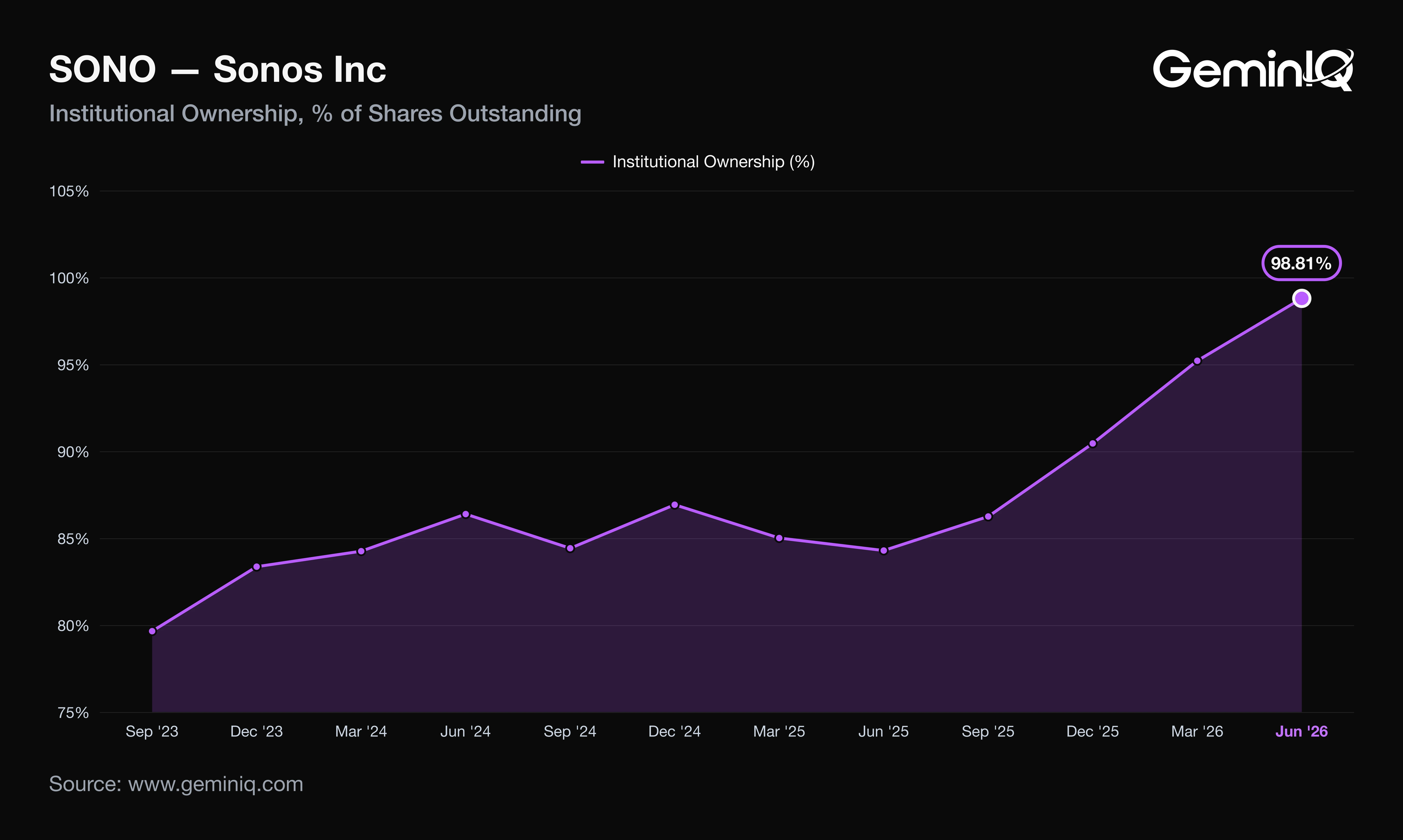
The Data: The Earnings Reaction Heat Map covers 1-3 months after each filing; this filing's window has not elapsed. For context, see how stocks react after earnings. GeminIQ's 13F institutional holdings show 98.81% ownership at June 30, 2026, up from 84.29% a year earlier and the highest of the last 16 quarters. Form 4 filings through September 25, 2026 show 17 purchases totaling $47.9 million and five sales totaling $1.9 million over twelve months, against 20 purchases and one sale in the prior twelve.
Why: These figures describe how Sonos's stock moved after its past filings; they are a historical association, not a forecast. Three fourth-quarter observations are a thin sample, the release left guidance to the call, and the 13F figure is lagged by a quarter.
When a loss narrows in the same quarter a one-time credit lands, subtract the credit before giving the operations the credit.
Frequently Asked Questions
Is Sonos doing well financially?
Sonos earned $89.6 million in fiscal 2026 against a $61.1 million loss, a TTM net profit margin of 5.79% against -4.24%. The year includes $42.6 million of tariff refund and interest. Its current ratio was 1.50x, and TTM return on invested capital was 37.47%.
When does Sonos report earnings?
Sonos released fiscal 2026 fourth-quarter results on November 10, 2026 and filed its 10-K on November 18. Last year it filed its first-quarter fiscal 2026 10-Q on February 4, 2026, a filing-record pattern and not a forecast of the date.
Does Sonos pay a dividend?
Sonos paid no dividends in Q4 2026 or the trailing twelve months. It spent $130.0 million on buybacks in fiscal 2026, and on November 10 announced a new $150 million repurchase authorization (8-K).
What was Sonos's free cash flow in Q4 2026?
Sonos's Q4 2026 free cash flow was -$4.6 million per the 8-K, after $5.1 million of property and equipment purchases, against -$2.3 million a year earlier. Full-year free cash flow rose to $122.9 million from $108.2 million.
Wall Street's data. Main Street's price.
Institutional terminals charge thousands a year for as-filed accuracy. GeminIQ gives you the same thing for a fraction of the cost: financials built directly from raw SEC EDGAR filings, not third-party APIs, with full XBRL traceability back to the original 10-K or 10-Q. No normalized guesswork, just calculated metrics, charts, screeners, and watchlists built on numbers exactly as the company reported them. Start researching now at GeminIQ.com.
All financial figures cited in this article reference SONOS, INC.'s fiscal 2026 10-K (filed November 18, 2026, period ending September 30, 2026), with guidance and management commentary drawn from the company's Form 8-K earnings release (filed November 10, 2026). All SEC filings are publicly available at SEC EDGAR and SEC EDGAR.
Disclaimer: The content in this blog is for educational and entertainment purposes only and does not constitute financial, legal, or tax advice. Investing involves risk, including the loss of principal. The views expressed are my own and not intended as financial advice or a guarantee of future performance.