Ashland (ASH) Q4 FY2026 Earnings: Operating Income Down 52%

By Chad Hartman
Published · Last updated
Ashland (NYSE: ASH) reported fourth-quarter fiscal 2026 revenue of $498 million, up 4.4% from a year earlier, and a net loss of $16 million, or $0.35 per diluted share, against net income of $31 million a year earlier, for the quarter ended September 30, 2026. Gross margin reached 35.9%, the highest of the last 16 quarters, yet operating income fell 52% to $29 million. The November 3 earnings release led with adjusted operating income of $77 million; the 10-K filed November 20 shows $48 million separating the two, against $10 million a year earlier, and cost items of the same kind excluded in each of the last three fiscal years.
| Field | Value |
|---|---|
| Company | Ashland ($ASH) |
| Quarter | Q4 FY2026, period ended September 30, 2026 |
| Earnings release | November 3, 2026 (Form 8-K) |
| 10-K filed | November 20, 2026 |
| Revenue | $498.00 Million (+4.4% YoY) |
| Diluted EPS | -$0.35 (per the 8-K; net loss of $16 Million) |
| Operating margin | 5.8% (-7.0 pts YoY) |
| Operating cash flow (TTM) | $385.00 Million |
| Full-year revenue | $1.863 Billion (+2.1% YoY) |
| Gross margin / operating margin (Q4) | 35.9% / 5.8% |
Ashland Q4 FY2026 Revenue, Gross Margin and Operating Income
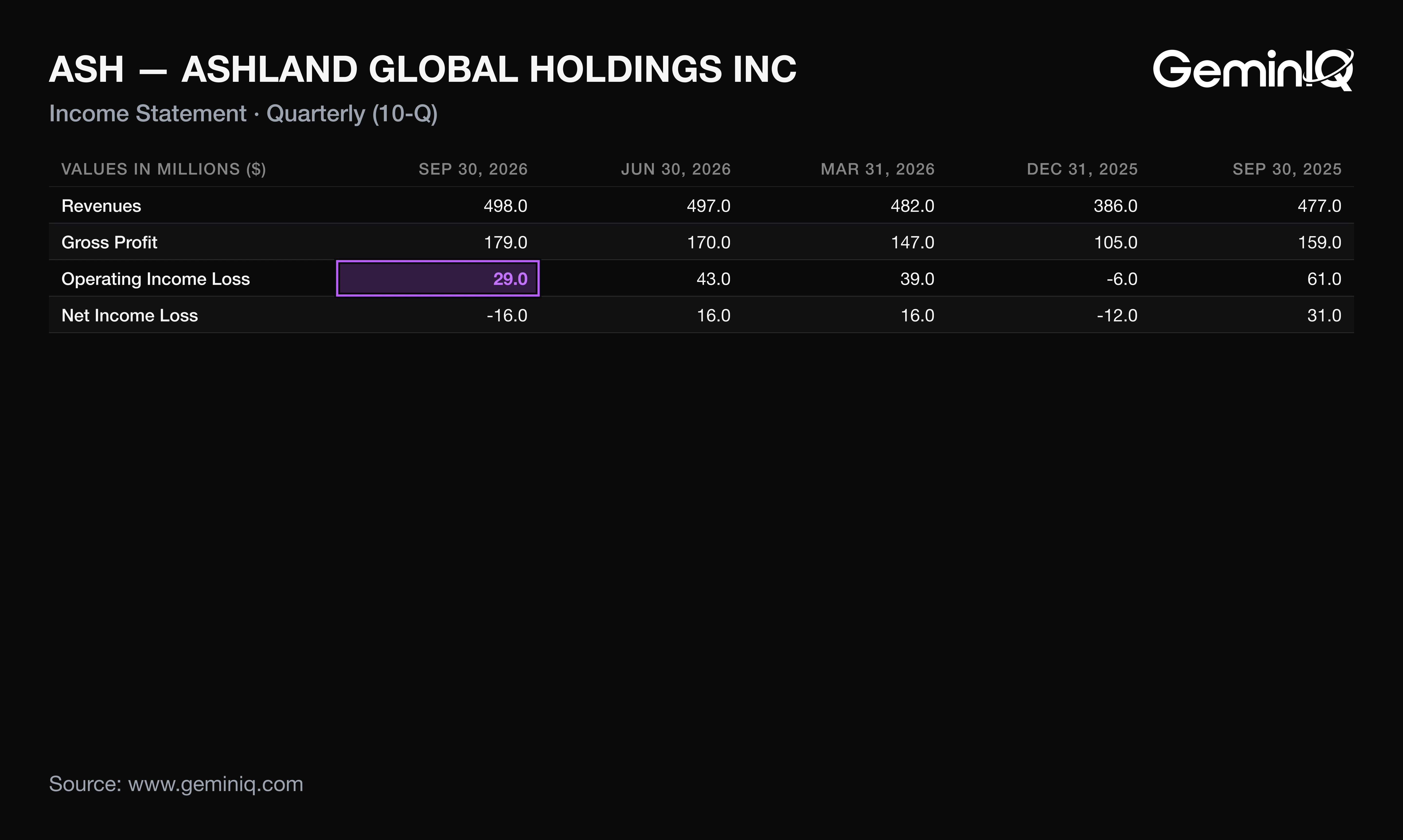
Ashland's Q4 FY2026 revenue was $498 million, up 4.4% from $477 million a year earlier and level with the prior quarter's $497 million, while operating income fell 52% to $29 million.
A company posting its highest gross margin in 16 quarters would be expected to report rising operating profit. Instead the profit line halved, and the release's adjusted figures do not show where.
The Data: Gross profit rose 12.6% to $179 million from $159 million, lifting gross margin to 35.9% from 33.3%, the highest of the last 16 quarters and the fourth-highest of 40 since 2016. Operating income fell to $29 million from $61 million, and operating margin dropped to 5.8% from 12.8%, the eighth-lowest of the last 16 quarters.
Why: Gross profit gained $20 million year over year while operating income lost $32 million, so the costs between the two lines grew $52 million, to $150 million from $98 million (derived). The release credits a 3% volume gain and 2% pricing that covered raw-material inflation for the top line, which fits the margin; neither explains the lower lines.
What Ashland's 10-K Shows Beyond the Q4 FY2026 Press Release
Ashland's November 3 release led with adjusted EBITDA of $121 million, up 2%, and adjusted operating income of $77 million, up from $71 million; the as-filed operating income was $29 million. That leaves $48 million of Q4 costs outside the adjusted line, against $10 million a year earlier (derived from the 8-K and the filed figures).
The Data: The 10-K lists portfolio-optimization costs of $49 million in fiscal 2026, $85 million in 2025 and $97 million in 2024, and pre-tax key items hitting operating income of $103 million in 2026. The release puts unallocated and other expense at $44 million against $11 million, which it ties to higher restructuring charges and the liquidation of Ashland's Argentine entity.
Why: The Argentina piece is irregular: a $13 million pre-tax loss from recognizing accumulated translation adjustments, per the 10-K. Removing it still leaves $35 million of the Q4 gap (derived). The rest sits in programs with a three-year record, since plant-optimization and restructuring costs were excluded in each of fiscal 2024, 2025 and 2026. A cost excluded three years running behaves like an operating expense with a different label.
Ashland Q4 FY2026 Cash Flow, Dividends and Net Debt
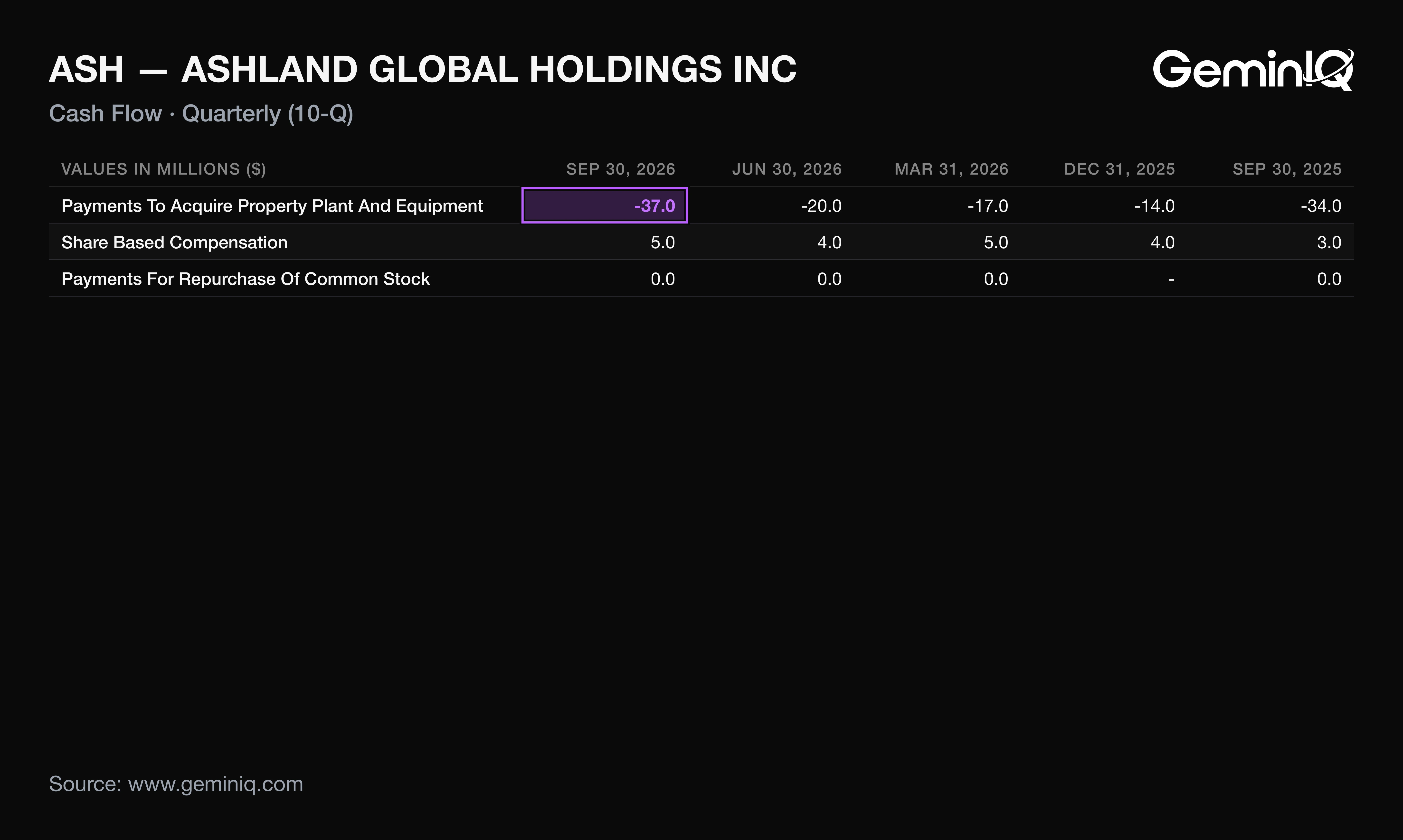
Ashland's Q4 FY2026 operating cash flow was $90 million, up from $40 million a year earlier and down from $120 million in Q3; capital expenditure of $37 million left free cash flow of $53 million.
The Data: Trailing-twelve-month operating cash flow was $385 million against $134 million a year earlier, while fiscal 2026 net income was $4 million. GeminIQ's pre-calculated Free Cash Flow for the same twelve months was $297 million; the 8-K's Ongoing Free Cash Flow, which adds the company's own adjustments, was $232 million. Dividends were $19 million in each of the last four quarters, $76 million in total, covered 3.9 times by the $297 million. Diluted shares were 46 million, unchanged from a year earlier per the 8-K, with no repurchases in fiscal 2026 against $100 million in 2025 and $380 million in 2024 (10-K).
Why: The release attributes the cash gain to lower working capital, driven by reduced inventory, which is a release of cash already spent. Q4 capital expenditure rose 85% from $20 million in Q3, the fourth-highest of the last 16 quarters. On debt, the 8-K states net debt of $891 million and net leverage of 2.3x on Adjusted EBITDA; GeminIQ's pre-calculated Net Debt to EBITDA is 3.06x, because it divides the same debt by as-filed earnings. Cash from shrinking inventory funds the dividend this year; it cannot fund it again until inventory has been rebuilt.
Ashland's Fiscal 2027 Guidance After Q4 FY2026
Ashland guided fiscal 2027 sales of $1,905 million to $1,975 million and Adjusted EBITDA of $405 million to $435 million in the 8-K, against fiscal 2026 sales of $1,863 million and Adjusted EBITDA of $385 million.
The Data: Against its own fiscal 2026 guide, sales of $1,863 million landed in the upper half of the $1,835 million to $1,870 million range, and Adjusted EBITDA of $385 million sat at the bottom of the $385 million to $400 million range. For fiscal 2027 the 8-K guides Ongoing Free Cash Flow conversion above 40% of Adjusted EBITDA, down from above 50% for fiscal 2026, with capital expenditures of up to about $140 million against about $90 million.
Why: The 8-K points to "non-recurring events and improved manufacturing productivity." Its quantified EBITDA levers are about $10 million of net productivity benefit and a currency drag of $7 million to $10 million, so most of the guided $35 million midpoint gain rests on volume, price and unquantified items. A 40% floor on $405 million to $435 million implies at least $162 million to $174 million of Ongoing Free Cash Flow, against $232 million in fiscal 2026. Ashland's fiscal 2027 plan asks for higher earnings and commits to less cash than the year just ended.
How ASH Stock Has Moved After Past Earnings Reports
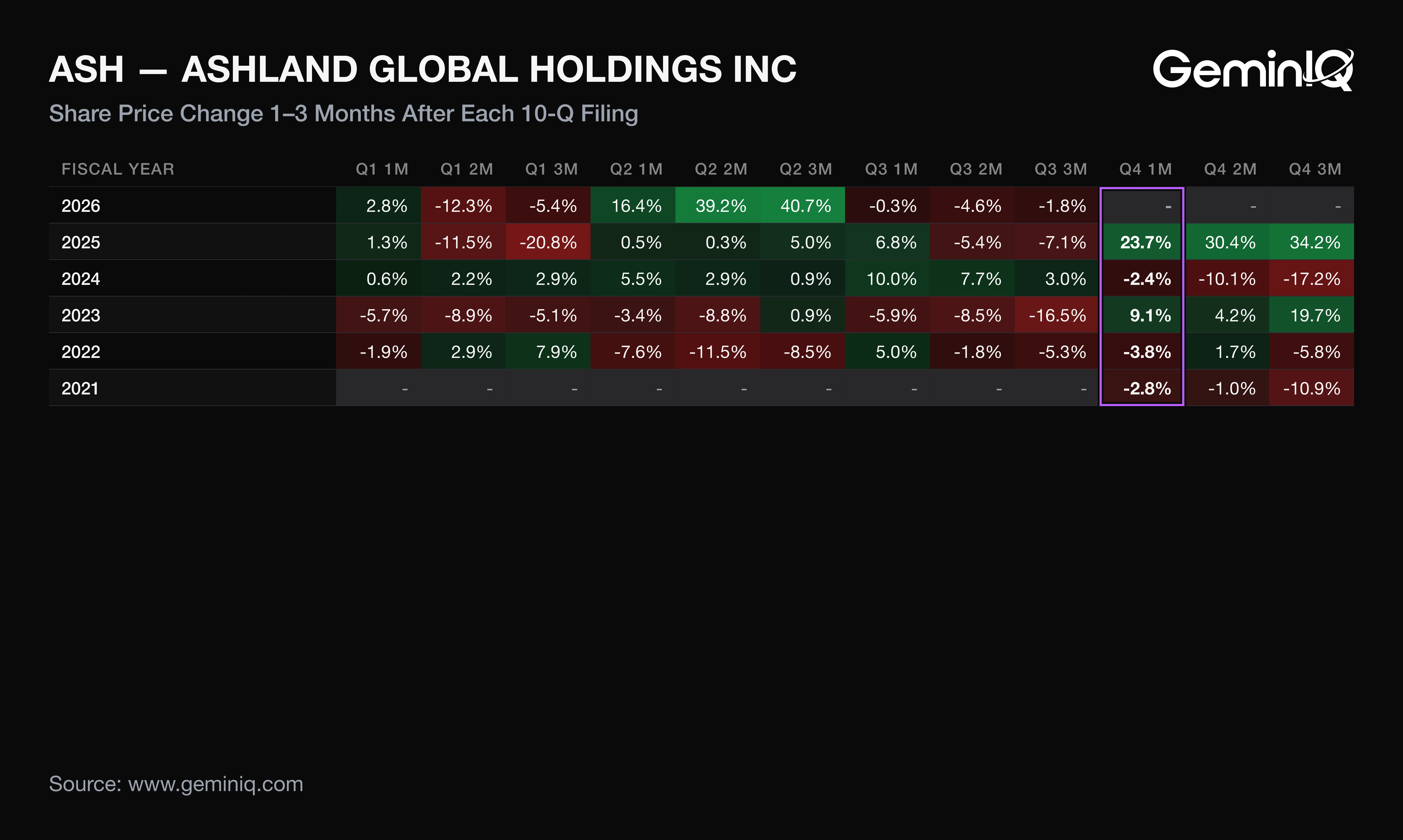
Ashland's stock was followed by a median one-month return of +4.1% across its last 12 10-Q filings, filed November 17, 2023 to July 29, 2026, and the return was positive after 10 of the 12. The filing covered here has no return yet because its window has not elapsed.
The Data: The three-month median was +1.9%, positive after 7 of 12. One-month returns after fiscal fourth-quarter filings were +9.1% (FY2023), -2.4% (FY2024) and +23.7% (FY2025), the highest of the 12.
Why: The three-month median is under half the one-month median, so early gains have often been partly given back, as in the FY2024 Q4 filing, which was followed by -2.4% at one month and -17.2% at three. These figures describe how Ashland's stock moved after its past filings; they are a historical association, not a forecast. The Earnings Reaction Heat Map plots each window. When gross margin and operating income move in opposite directions, the explanation sits in the lines between them, and that is where adjusted measures draw their exclusions.
Frequently Asked Questions
When does Ashland report earnings?
Ashland reported Q4 FY2026 results on November 3, 2026 and filed its 10-K on November 20, 2026, the same filing date as its fiscal 2025 10-K a year earlier. Last year it filed its fiscal first-quarter results on February 3, 2026. That is a pattern from the filing record, not a forecast of the next date.
Is Ashland doing well financially?
Ashland earned $4 million on $1.863 billion of revenue in fiscal 2026, so GeminIQ's pre-calculated Net Profit Margin was 0.21% for the trailing twelve months, and its Operating Profit Margin was 5.64%. Operating cash flow was $385 million.
Does Ashland pay a dividend?
Yes. Ashland paid $19 million of common dividends in Q4 FY2026, the same amount as in each of the prior three quarters, for $76 million over the trailing year.
What was Ashland's revenue in fiscal 2026?
Ashland's fiscal 2026 revenue was $1.863 billion, up 2.1% from $1.824 billion. The 10-K attributes the $39 million increase to $29 million of volume and $25 million of currency, offset by $4 million of unfavorable price and mix and $11 million from divestitures.
Wall Street's data. Main Street's price.
Institutional terminals charge thousands a year for as-filed accuracy. GeminIQ gives you the same thing for a fraction of the cost: financials built directly from raw SEC EDGAR filings, not third-party APIs, with full XBRL traceability back to the original 10-K or 10-Q. No normalized guesswork, just calculated metrics, charts, screeners, and watchlists built on numbers exactly as the company reported them. Start researching now at GeminIQ.com.
All financial figures cited in this article reference ASHLAND INC.'s fiscal 2026 10-K (filed November 20, 2026, period ending September 30, 2026), with guidance and management commentary drawn from the company's Form 8-K earnings release (filed November 3, 2026). All SEC filings are publicly available at SEC EDGAR and SEC EDGAR.
Disclaimer: The content in this blog is for educational and entertainment purposes only and does not constitute financial, legal, or tax advice. Investing involves risk, including the loss of principal. The views expressed are my own and not intended as financial advice or a guarantee of future performance.