
Companies With Net Cash: Balance Sheets With No Debt

By Chad Hartman
Published · Last updated
Oracle Corp holds $31.3 billion in cash against $7.2 billion in short- and long-term debt — a net cash position of $24.1 billion. Negative net debt is not a leverage ratio in the way a debt-to-EBITDA multiple is; it describes an entirely different kind of balance sheet, one where the interest-bearing liabilities side of the equation has effectively been erased by cash on hand. The as-filed data shows which large, real, revenue-generating companies are currently running one.
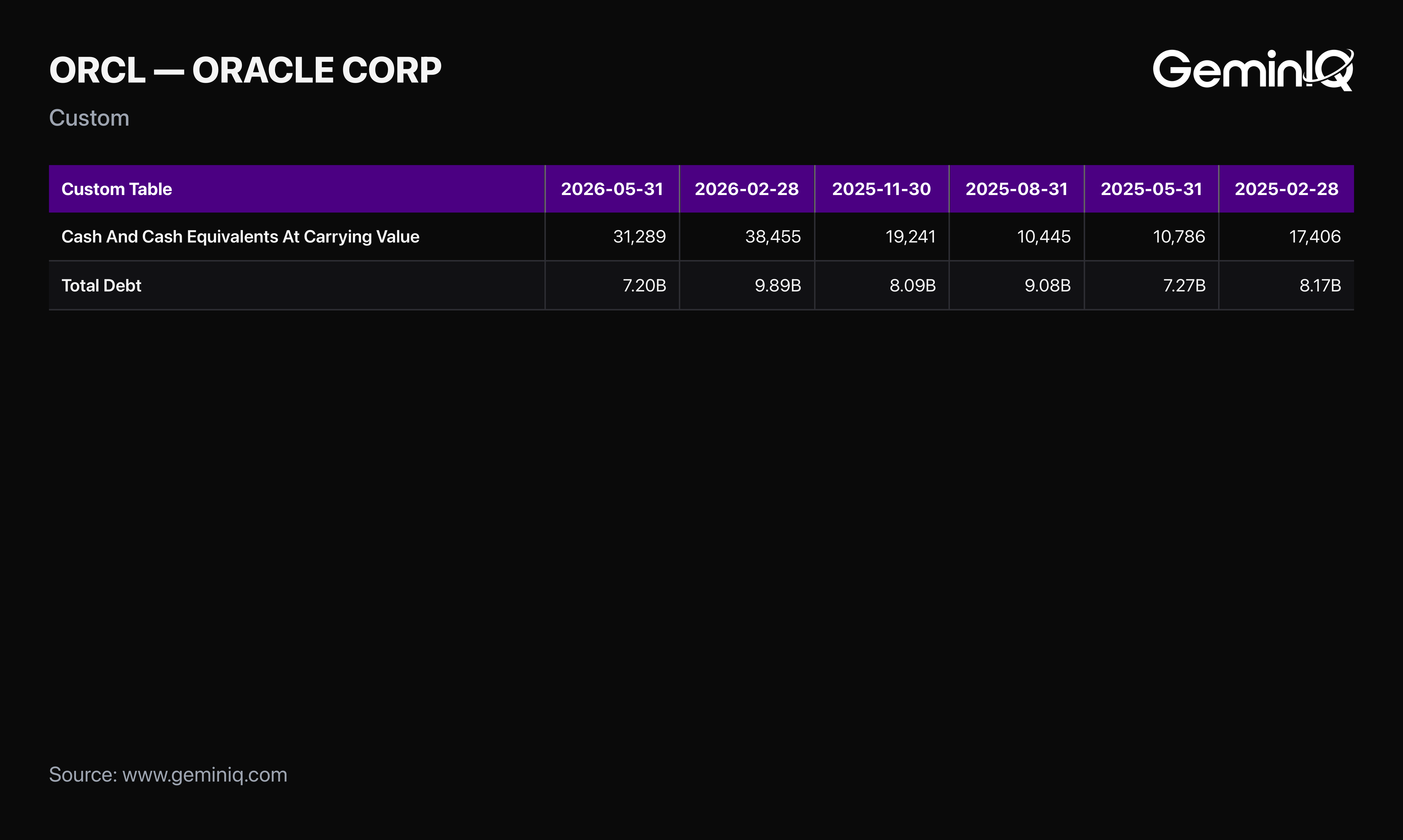
This study reads GeminIQ's as-filed universe as of the most recent trailing-twelve-month filing period, restricted to non-financial companies with at least $5 billion in trailing revenue and a market capitalization above $1 billion. Critically, it also requires a verified nonzero debt figure built from GeminIQ's Short-Term Debt and Long-Term Debt line items rather than a single pre-aggregated debt column, so a company only appears here because its cash actually exceeds real, confirmed debt, not because a data field returned zero.
The Pattern
A company with negative net debt has effectively unlimited flexibility to fund growth, buybacks, or acquisitions from its own balance sheet without touching capital markets — the opposite risk profile of a company carrying multiples of its EBITDA in debt. This is not a story about weak, low-growth businesses avoiding leverage out of necessity; the largest names on this list include one of the biggest software companies in the world mid-buildout and one of the largest e-commerce and retail names on the planet. Net cash at this scale is a choice about capital structure, not a constraint on it.
The Data
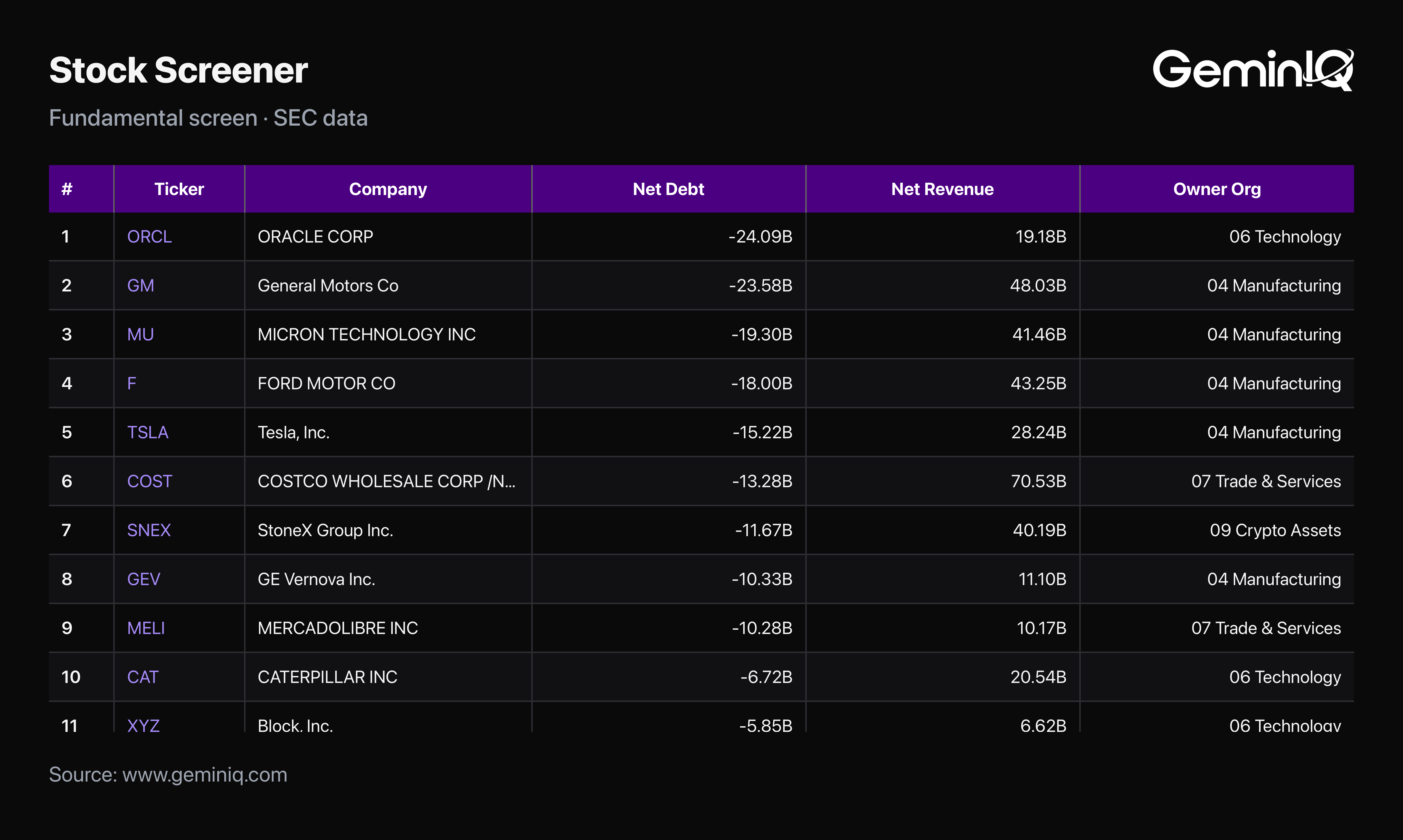
| Rank | Company | Ticker | Sector | Net Cash | Cash | Debt |
|---|---|---|---|---|---|---|
| 1 | Oracle Corp | ORCL | Services | $24.1B | $31.3B | $7.2B |
| 2 | Micron Technology, Inc. | MU | Manufacturing | $19.3B | $25.0B | $5.7B |
| 3 | Costco Wholesale Corp | COST | Retail Trade | $13.3B | $18.9B | $5.7B |
| 4 | MercadoLibre, Inc. | MELI | Services | $10.3B | $16.8B | $6.5B |
| 5 | Block, Inc. | XYZ | Services | $5.9B | $6.4B | $0.6B |
| 6 | Intuit Inc. | INTU | Services | $5.8B | $11.9B | $6.2B |
| 7 | Automatic Data Processing Inc | ADP | Services | $5.7B | $10.6B | $5.0B |
| 8 | Accenture plc | ACN | Services | $5.0B | $10.2B | $5.1B |
| 9 | NVIDIA Corp | NVDA | Manufacturing | $4.8B | $13.2B | $8.5B |
| 10 | Newmont Corp | NEM | Mining | $4.0B | $9.0B | $5.1B |
| 11 | Expedia Group, Inc. | EXPE | Transportation | $3.6B | $9.1B | $5.5B |
| 12 | Coupang, Inc. | CPNG | Retail Trade | $3.6B | $6.2B | $2.6B |
| 13 | Ross Stores, Inc. | ROST | Retail Trade | $3.2B | $4.2B | $1.0B |
| 14 | TJX Companies Inc. | TJX | Retail Trade | $2.7B | $5.6B | $2.9B |
| 15 | Fortinet, Inc. | FTNT | Manufacturing | $2.4B | $2.9B | $0.5B |
The ASC 842 Caveat Worth Naming
Third-party aggregators routinely fold operating lease liabilities under ASC 842 into a "total debt" figure, which can turn what is actually a net-cash company into an apparently net-debt one purely from a classification choice. An operating lease is a contractual rental commitment, not a note payable, and GeminIQ's debt calculation excludes it for exactly that reason — the debt figures above are commercial paper and term debt only, not lease obligations. A company that looks levered on a platform that merges the two may be a genuine net-cash story once operating leases are separated back out, and this ranking is built specifically to avoid that distortion.
Costco and MercadoLibre are useful illustrations of why the distinction matters. Both operate large physical or logistics-heavy footprints — the kind of business where lease obligations tend to be substantial — and both still clear this list on genuine interest-bearing debt versus cash alone.
The Method
Net cash is computed as GeminIQ's as-filed cash and cash equivalents minus total debt. Total debt is Short-Term Debt plus Long-Term Debt as separately filed for each company — the same two-line construction documented in GeminIQ's Net Debt methodology, excluding operating lease liabilities. Companies where this debt figure resolved to exactly zero were excluded from the ranking rather than treated as verified zero-debt, since a zero can reflect either a truly debt-free balance sheet or an unresolved data field — this study only ranks companies with a confirmed, nonzero debt figure that cash still exceeds. Full methodology is covered in How GeminIQ Builds Filing Data Studies.
Check Your Holdings
Pull up any position's Net Debt on GeminIQ and check the sign, then check the underlying Short-Term Debt and Long-Term Debt line items directly rather than trusting a single aggregated figure — the distinction between "zero debt" and "debt data not fully resolved" matters, and the as-filed line items are the only way to tell them apart. Every reader can run that same check for their own holdings.
Frequently Asked Questions
What does negative net debt mean?
It means a company holds more cash and short-term investments than it owes in interest-bearing debt. In GeminIQ's data, Oracle currently holds the largest net cash position among large non-financial companies at $24.1 billion.
Do companies with net cash actually have no debt?
Not in this ranking. Every company listed carries real, confirmed debt — Oracle owes $7.2 billion, Micron $5.7 billion — but each holds more cash than it owes, so net debt is negative. Companies that report literally zero debt are a different, smaller group, and this study excludes them because a zero can also mean an unresolved data field.
Why do some companies with net cash still appear leveraged on other platforms?
Third-party aggregators often fold operating lease liabilities under ASC 842 into a single "total debt" figure, even though a lease is a contractual rental commitment rather than a note payable. GeminIQ's debt calculation excludes operating leases for exactly that reason, which is why a company like Costco or MercadoLibre can clear this list on genuine interest-bearing debt versus cash alone.
Is having no debt always a good sign for a company?
A net cash position reflects a capital-structure choice, not a guarantee of quality on its own — it gives a company flexibility to fund growth, buybacks, or acquisitions without touching capital markets, but it doesn't by itself say anything about the underlying business's growth or profitability.
How many companies does this study cover?
This ranking covers the largest non-financial companies with at least $5 billion in trailing revenue, a market capitalization above $1 billion, and a verified nonzero debt figure that cash still exceeds, drawn from GeminIQ's current filing snapshot.
Wall Street's data. Main Street's price.
Institutional terminals charge thousands a year for as-filed accuracy. GeminIQ gives you the same thing for a fraction of the cost: financials built directly from raw SEC EDGAR filings, not third-party APIs, with full XBRL traceability back to the original 10-K or 10-Q. No normalized guesswork, just calculated metrics, charts, screeners, and watchlists built on numbers exactly as the company reported them. Start researching now at GeminIQ.com.
All figures are drawn from each company's as-filed 10-K and 10-Q filings, publicly available on SEC EDGAR. Rankings are computed from GeminIQ's Financial Statements data across the described universe and snapshot window.
Disclaimer: The content in this blog is for educational and entertainment purposes only and does not constitute financial, legal, or tax advice. Investing involves risk, including the loss of principal. The views expressed are my own and not intended as financial advice or a guarantee of future performance.