
Delta (DAL) Q3 2026 Earnings: EPS Down 47%, Investments Swung $529M

By Chad Hartman
Published · Last updated
Delta (DAL) reported Q3 FY2026 revenue of $20.19 billion, up 21.1% year over year, and diluted EPS of $1.15, down 47.0%, for the quarter ended September 30, 2026. The October 9 earnings release led with record revenue and adjusted EPS of $1.72, but the 10-Q filed the same day shows a $529 million swing in investment gains and losses behind 75% of the $703 million fall in pre-tax income, and refinery resales behind nearly a third of the revenue growth. The GAAP decline overstates the damage to the airline, while the adjusted figure hides how far margins fell short of what Delta guided in July.
| Field | Value |
|---|---|
| Company | Delta ($DAL) |
| Quarter | Q3 FY2026, period ended September 30, 2026 |
| Earnings release | October 9, 2026 (Form 8-K) |
| 10-Q filed | October 9, 2026 |
| Revenue | $20.19 Billion (+21.1% YoY) |
| Diluted EPS | $1.15 (-47.0% YoY) |
| Operating margin | 7.2% (-2.9 pts YoY) |
| Operating cash flow (TTM) | $8.00 Billion |
| Investment gain/(loss), net | -$218 million (vs +$311 million) |
Delta Q3 2026 Revenue, EPS and Margins
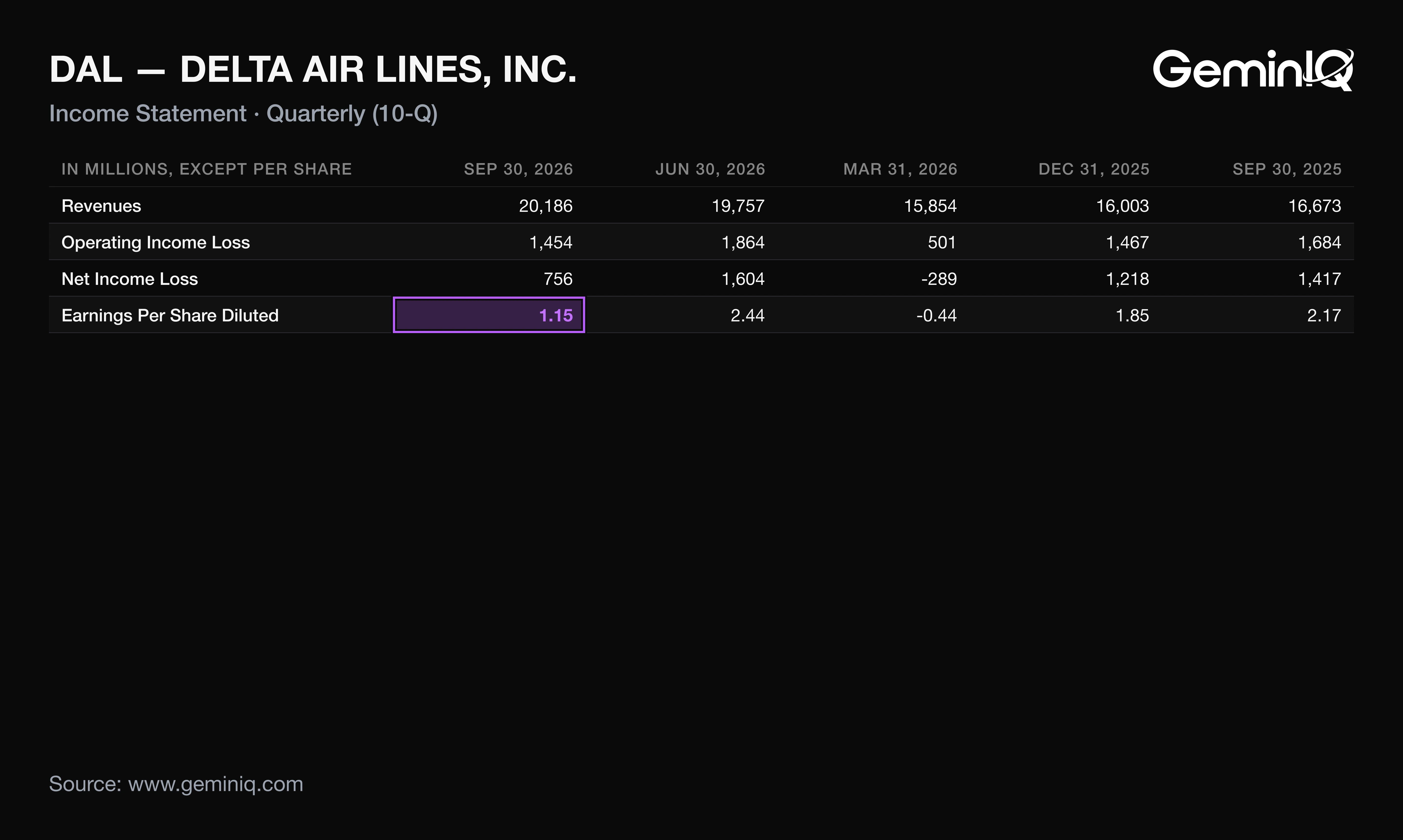
Delta's Q3 2026 diluted EPS was $1.15, down 47.0% from $2.17 a year earlier, on revenue that rose 21.1% to $20.19 billion. Revenue was the highest of the last 16 quarters and the second-highest of the 66 since 2010, and a quarter like that would be expected to lift earnings. Instead operating income fell 13.7%, and the 7.2% operating margin was the fifth-lowest of the last 16 quarters.
The Data: Operating income was $1.45 billion, against $1.68 billion a year earlier, and net income fell 46.6% to $756 million. Of the $3.5 billion revenue increase, $1.1 billion was third-party refinery sales, which carry a matching expense line; the refinery itself posted a $33 million operating loss.
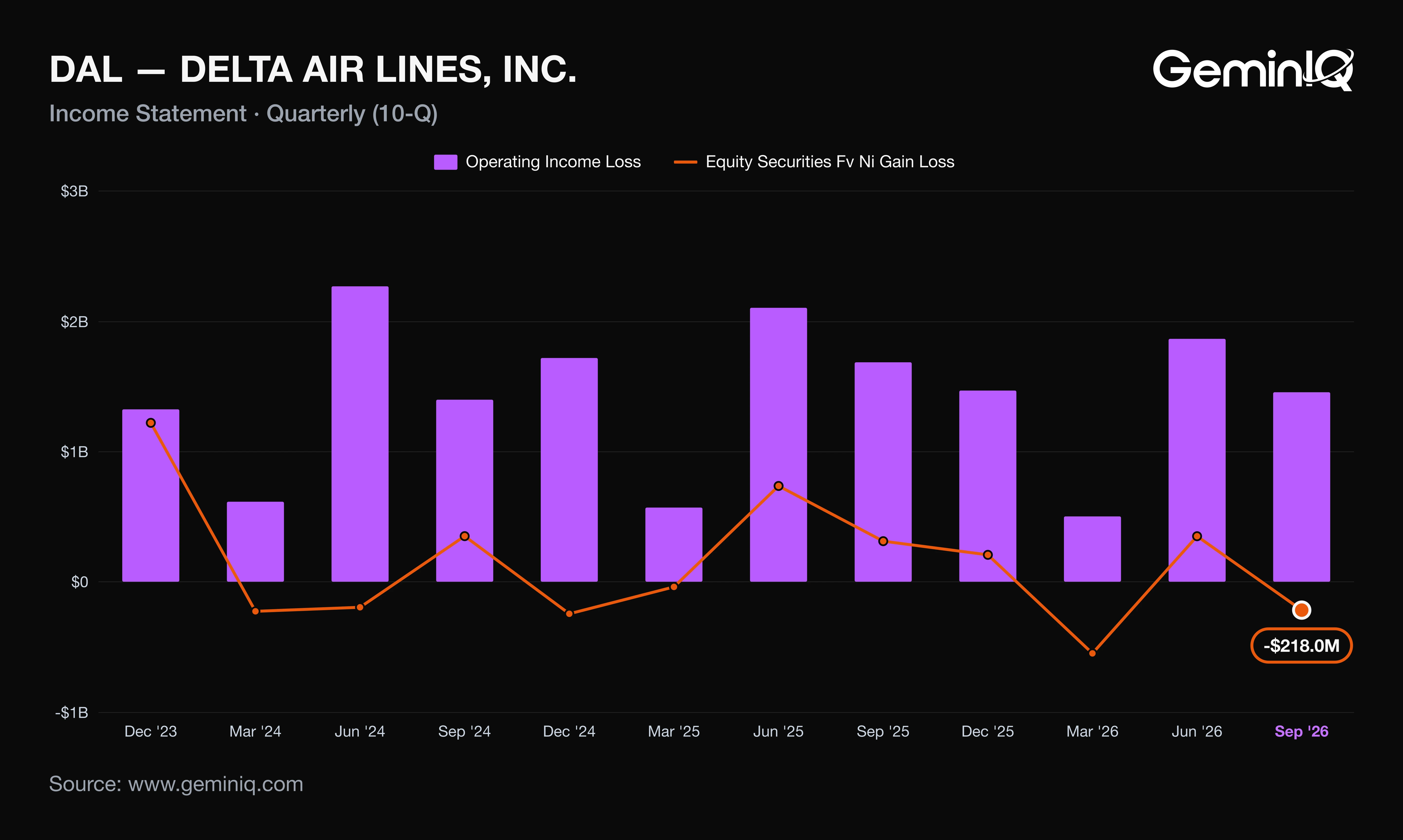
Why: Pre-tax income fell $703 million. Operating income accounts for $230 million of that and non-operating items for $473 million, so two-thirds of the decline sits below the operating line. The 10-Q attributes the swing to mark-to-market losses on equity investments: a $218 million loss against a $311 million gain a year ago. Net income fell further than pre-tax income (47% against 40%) because tax took about 29.6% of pre-tax income against 20.3% (derived), well above the 23% to 25% annual rate the filing projects excluding those marks.
What Delta's Q3 2026 10-Q Shows Beyond the Press Release
The release led with adjusted EPS of $1.72, up 1% from $1.70, and the 10-Q carries GAAP diluted EPS of $1.15, down 47%. Delta says its adjusted figures exclude primarily refinery sales, investment gains and losses, and Monroe hedge results.
The Data: GAAP pre-tax income was $1,074 million against $1,497 million adjusted, so this year's adjustments added $423 million. A year ago GAAP pre-tax income was $1,777 million against $1,477 million adjusted, so the adjustments took away $300 million. The 10-Q itemizes the pieces: $208 million of hedge mark-to-market in fuel expense and the $218 million investment loss.
Why: The exclusions cut both ways. Adjusted operating margin was 9.4%, down from 11.1%, and adjusted operating income fell 2%; adjusted pre-tax income rose 1% only because net interest expense fell $25 million. Delta also guided September-quarter adjusted EPS of $2.00 to $2.50 on an 11% to 13% operating margin in July. Management attributes the shortfall to fuel costs more than $500 million above that guidance and to non-fuel unit costs up 7.3%. The filing supports the cost half: salaries and related costs rose 9% on flat capacity after 4% base pay increases.
Delta Q3 2026 Free Cash Flow, Debt and Dividends
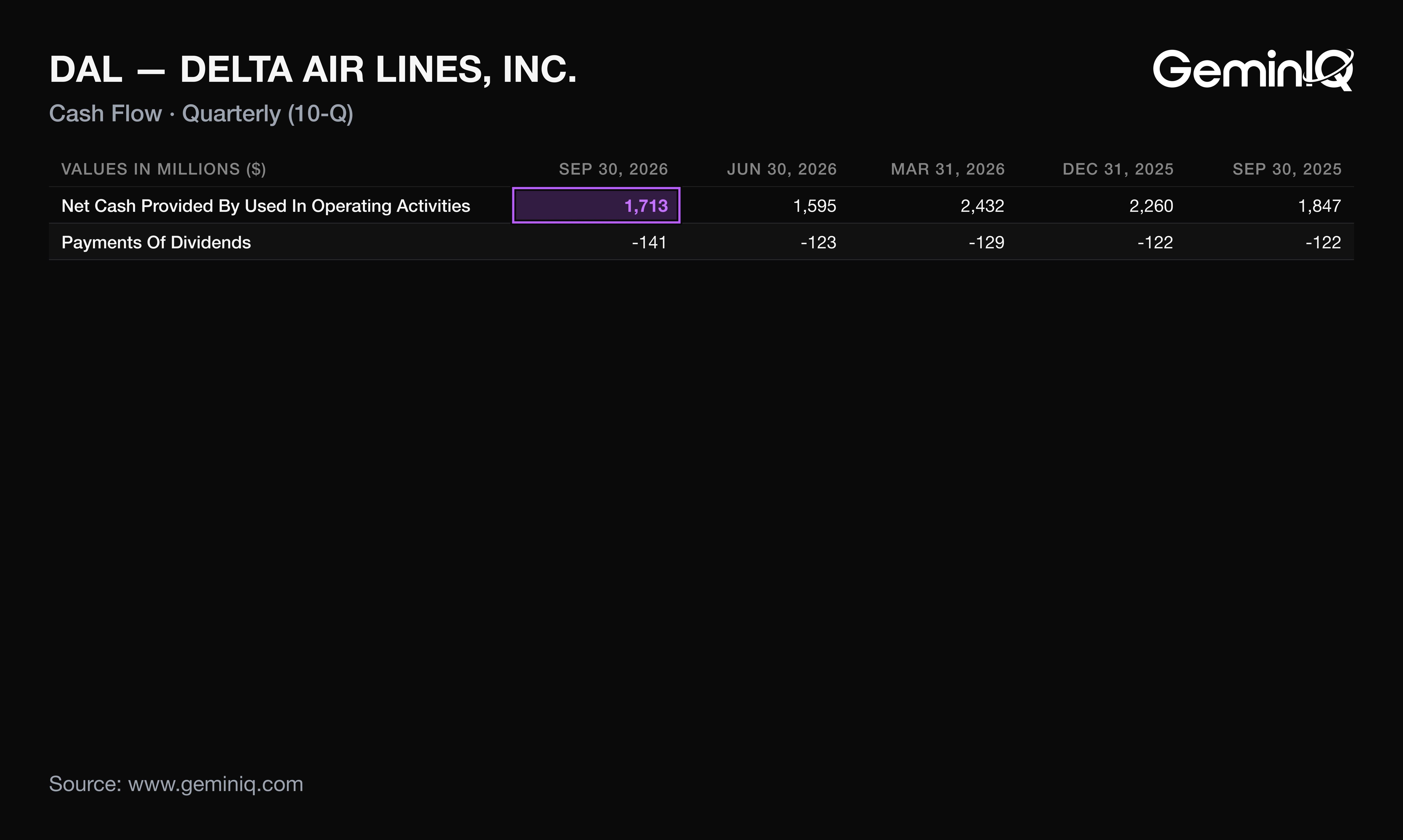
Delta reported free cash flow of $463 million for Q3 2026, down 44% from $833 million a year earlier on the company's own definition in the 8-K, while operating cash flow was $1.71 billion, down 7.3%. Cash held up far better than earnings: operating cash flow was 2.3 times net income, against 1.3 times a year ago (derived).
The Data: Operating cash flow of $1.71 billion exceeded net income by $957 million. The quarter's $673 million of depreciation and the $218 million non-cash investment loss cover about $891 million of that gap. Capital expenditure was $1.41 billion. Total debt was $12.1 billion against $13.3 billion at year-end, while current maturities rose to $2.98 billion from $1.37 billion.
Why: Mark-to-market losses cut net income without touching cash, which is how operating cash flow fell 7.3% while EPS fell 47%. Dividends of $141 million, up 15.6%, took about 30% of the quarter's free cash flow (derived), and no shares have been repurchased under the $1.0 billion program.
Delta's 2026 Guidance After Q3
In its October 9 8-K, Delta guided December-quarter EPS of $1.15 to $1.65 and full-year EPS of $5.10 to $5.60, after adjusted September-quarter EPS of $1.72 came in below the July range of $2.00 to $2.50. Adjusted operating margin of 9.4% likewise landed under the 11% to 13% the prior release set.
The Data: The company guided December-quarter revenue growth of about 20%, up from 16% adjusted in September, on an operating margin of 7% to 9%, whose top end sits below September's 9.4%. The guide assumes fuel near $4.25 per gallon including a $0.40 refinery benefit, against $3.61 adjusted in September. Full-year free cash flow of about $2.5 billion against $1.9 billion year to date implies roughly $0.6 billion in the fourth quarter (derived).
Why: Revenue growth speeds up while the margin range falls because fuel absorbs the increment: the CEO says Delta expects to absorb a $6 billion fuel cost increase this year and still earn roughly $4.5 billion pre-tax.
How DAL Stock Has Moved After Past Earnings Reports
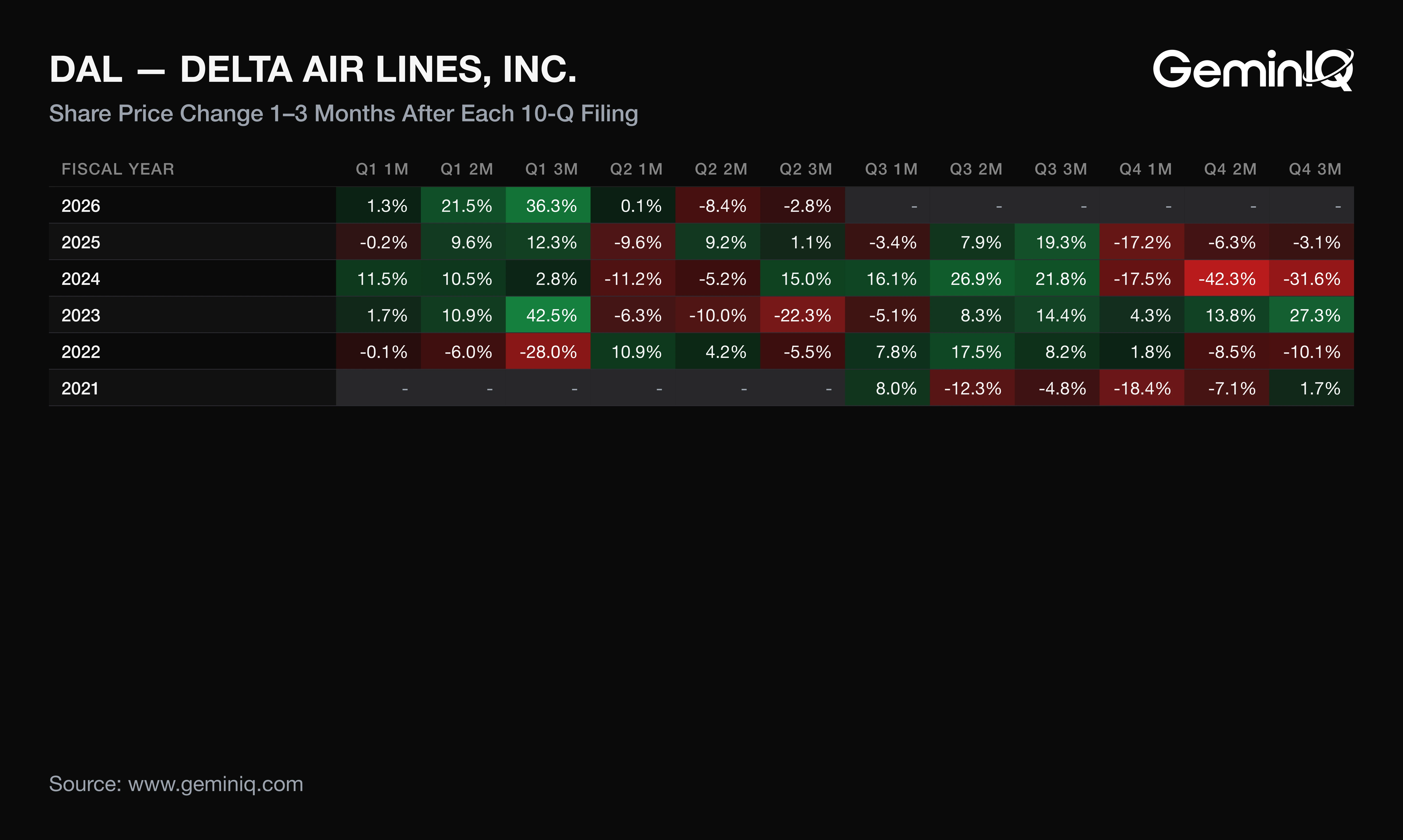
Delta's stock has historically slipped in the first month after most of its 10-Q filings and recovered by month three.
The Data: Across its last 12 filings (October 2023 to July 2026), DAL's median one-month return was -1.8%, positive after 5 of 12, while the median three-month return was +13.4%, positive after 9 of 12. Past Q3 filings were followed by one-month returns of -5.1%, +16.1% and -3.4%.
Why: The recovery arrives in months two and three, which is how a -1.8% median becomes +13.4%. These figures describe how Delta's stock moved after its past filings; they are a historical association, not a forecast. The GeminIQ Earnings Reaction Heat Map shows the full grid, and this filing's window has not yet elapsed.
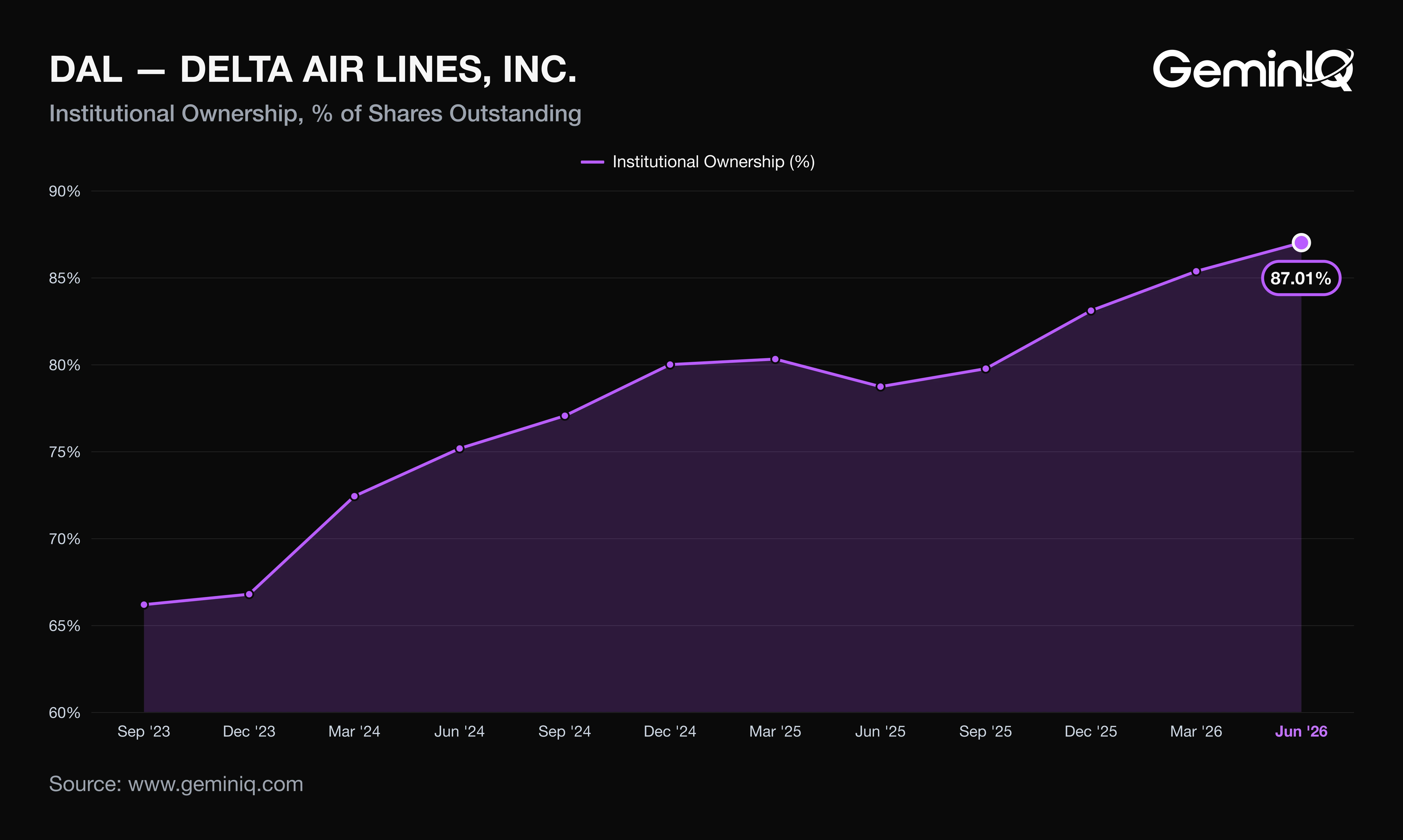
Institutions held 87.01% of Delta at the June 30, 2026 SEC Form 13F quarter end, up from 78.73% a year earlier and the highest of the last 16 quarters. In SEC Form 4 filings from May 2025 to May 2026, insiders made 32 sales totaling $98.8 million and no purchases, against $30.3 million of sales the year before; Glen Hauenstein accounted for $34.4 million. The insider data ends at filings through May 27, 2026, so it does not cover trades after the quarter's print.
A company whose adjusted and GAAP earnings split by the sign of one non-operating line is best read from the cash flow statement outward, because that line is the one that never reaches it.
Frequently Asked Questions
When does Delta report earnings?
Delta reported its Q3 FY2026 results on October 9, 2026 and filed the 10-Q the same day. Last year it filed its Q3 10-Q on October 9, 2025 and its fourth-quarter results on February 11, 2026. That is a pattern from the filing record, not a forecast of the next date.
Is Delta doing well financially?
Delta's trailing operating cash flow was $8.00 billion, in line with $7.98 billion a year earlier, and its Net Debt to EBITDA was 1.14x. Profitability weakened: GeminIQ's pre-calculated Net Profit Margin was 4.58% on a trailing basis, down from 7.36%, and Return on Invested Capital was 12.41%, down from 16.16%.
Does Delta pay a dividend?
Yes. Delta paid $141 million, or $0.2150 per share, on July 30, 2026, and $393 million over the first nine months. On September 24, 2026 the board approved another $0.2150 per share, payable November 5 to holders of record on October 15. Trailing dividends paid were $515 million, up 24.4%.
Where can I verify Delta's Q3 2026 figures?
The figures come from Delta's Q3 2026 Form 10-Q and its October 9, 2026 earnings release on SEC EDGAR. Adjusted and guidance figures appear only in the release.
Wall Street's data. Main Street's price.
Institutional terminals charge thousands a year for as-filed accuracy. GeminIQ gives you the same thing for a fraction of the cost: financials built directly from raw SEC EDGAR filings, not third-party APIs, with full XBRL traceability back to the original 10-K or 10-Q. No normalized guesswork, just calculated metrics, charts, screeners, and watchlists built on numbers exactly as the company reported them. Start researching now at GeminIQ.com.
All financial figures cited in this article reference DELTA AIR LINES, INC.'s Q3 2026 10-Q (filed October 9, 2026, period ending September 30, 2026), with guidance and management commentary drawn from the company's Form 8-K earnings release (filed October 9, 2026). All SEC filings are publicly available at SEC EDGAR and SEC EDGAR.
Disclaimer: The content in this blog is for educational and entertainment purposes only and does not constitute financial, legal, or tax advice. Investing involves risk, including the loss of principal. The views expressed are my own and not intended as financial advice or a guarantee of future performance.