
Ford (F) Q3 2026 Earnings: EPS Down 17%, Taxes Up $727M

By Chad Hartman
Published · Last updated
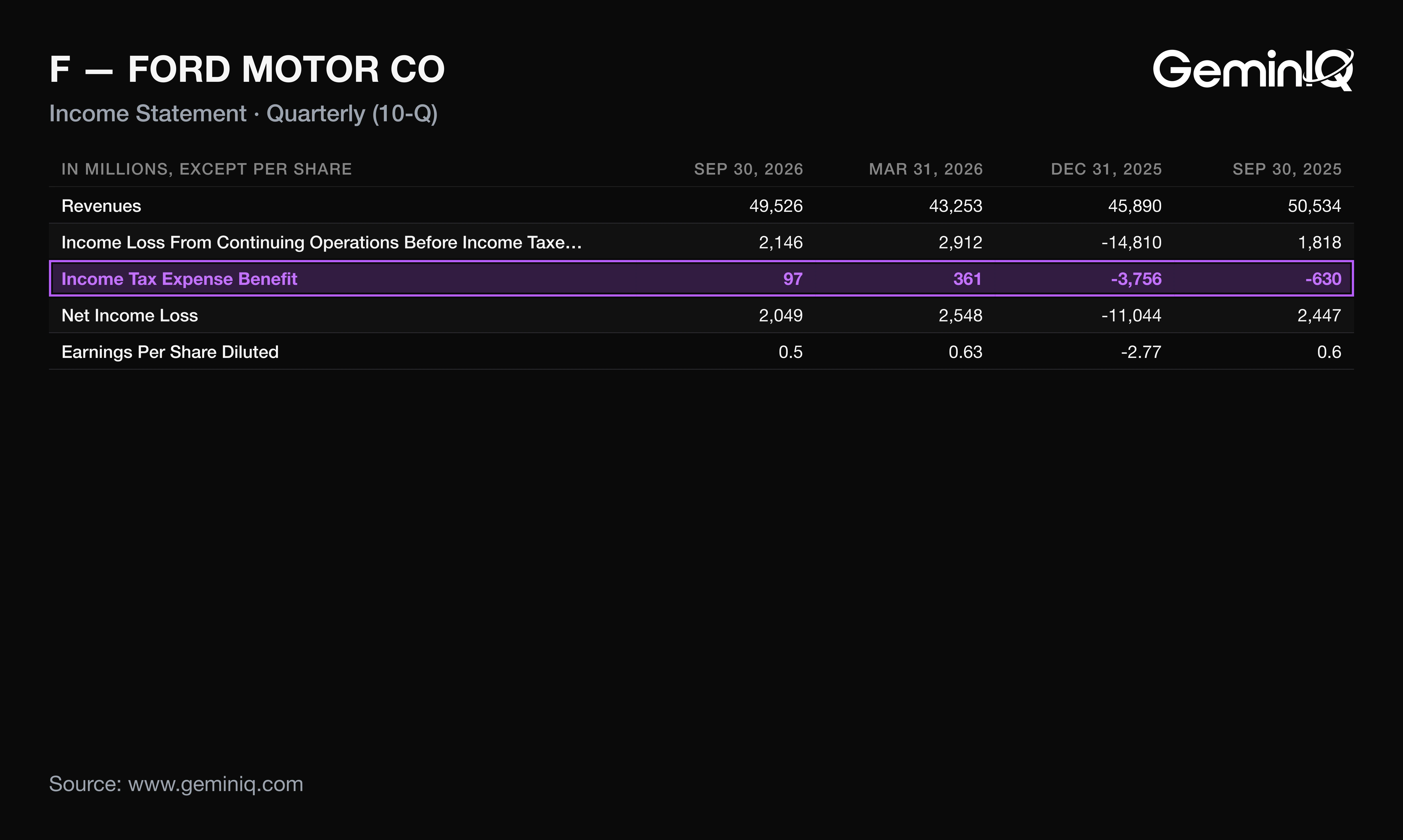
Ford (F) reported Q3 2026 revenue of $49.53 billion, down 2.0% from a year earlier, and diluted EPS of $0.50, down 16.7%, for the quarter ended September 30, 2026. Pretax income rose 18% in the same quarter, so the entire EPS decline sits below that line: income taxes went from a $630 million benefit to a $97 million provision. Ford released the results on October 28, 2026 and filed its 10-Q on October 29, 2026. The release led with adjusted EBIT up $72 million, a gain that came from Ford Credit rather than from the vehicle segments.
| Field | Value |
|---|---|
| Company | Ford ($F) |
| Quarter | Q3 FY2026, period ended September 30, 2026 |
| Earnings release | October 28, 2026 (Form 8-K) |
| 10-Q filed | October 29, 2026 |
| Revenue | $49.53 Billion (-2.0% YoY) |
| Diluted EPS | $0.50 (-16.7% YoY) |
| Operating margin | 2.9% (-0.1 pts YoY) |
| Operating cash flow (TTM) | $5.43 Billion in Q3 2026 (TTM not shown; filed cash-flow rows are year-to-date) |
| Income tax (Q3 2026 vs Q3 2025) | $97M provision vs $630M benefit |
Ford Q3 2026 Revenue, EPS and Margins
Ford's Q3 2026 diluted EPS was $0.50, down from $0.60, on revenue of $49.53 billion. Operating income fell 6.7%. Pretax income rose 18%. The quarter's EPS decline is a tax story.
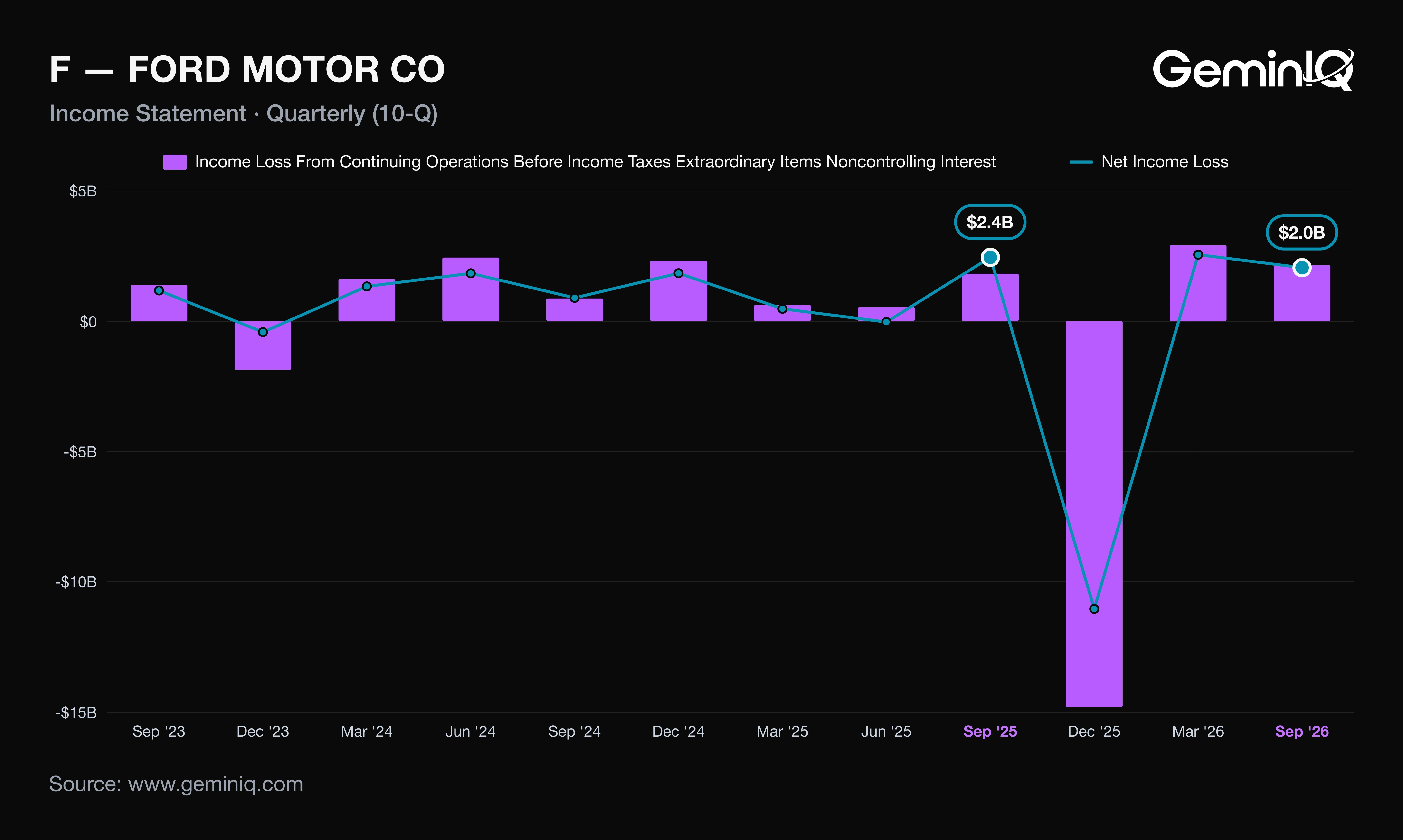
The Data: Operating income was $1.45 billion against $1.56 billion a year earlier, a margin of 2.9% against 3.1%. Pretax income rose to $2.15 billion from $1.82 billion, lifted by other income of $922 million (from $560 million) and equity income of $155 million (from $21 million). Income taxes moved from a $630 million benefit to a $97 million provision, a $727 million swing, and net income fell $398 million.
Why: Pretax income per diluted share rose to $0.53 from $0.45 (derived), while EPS fell from $0.60 to $0.50. The 10-Q puts the net income decline down to "higher taxes (including lower benefits from tax special items)," and its effective tax rate was 4.5%. Year-ago tax carried $1,074 million of tax special items, so $0.60 was flattered too. At the 10-Q's 13.0% adjusted tax rate, EPS would have been about $0.46 (derived). Operating margin ranked 26th-lowest of the 69 quarters since mid-2009. Ford's profit grew where it is taxed least and shrank where it is operated.
What Ford's Q3 2026 10-Q Shows Beyond the Press Release
Ford's release led with Q3 2026 adjusted EBIT of $2.7 billion, up $72 million from $2.6 billion, and a 5.4% margin. The 10-Q's segment table shows that the entire gain came from Ford Credit.
The Data: Ford Credit's EBT rose $172 million to $803 million. Ford Blue EBIT fell $148 million to $1,392 million and Ford Pro fell $320 million to $1,665 million, a combined $468 million drop. Ford Model e's loss narrowed $352 million to $1,058 million on revenue down 31%. The 10-Q's cash table puts adjusted EBIT excluding Ford Credit at $1.9 billion, against $2.0 billion a year earlier.
Why: Management attributes the Pro decline to commodity prices, the Super Duty Oakville launch and temporary Novelis aluminum sourcing costs. The cost factor supports that: it was negative $462 million at Ford Pro and negative $209 million at Ford Blue, the largest drag in each. At Ford Credit, the 10-Q credits "net favorable items included in Other," chiefly favorable derivative valuation and the absence of a U.K. commissions charge, which added $194 million. Ford Pro's 9.4% EBIT margin compares with 11.4% a year earlier. A $72 million company gain built on a $172 million finance-arm gain leaves the vehicle businesses lower.
Ford Q3 2026 Cash Flow, Debt and Share Count
Ford's 10-Q reports Q3 2026 operating cash flow of $5.4 billion, down $2.0 billion from $7.4 billion a year earlier. The cash cost of the first nine months shows up on the balance sheet, not in the share count.
The Data: Nine-month operating cash flow was $11.1 billion against $17.4 billion, and capital spending was $7.04 billion against $6.03 billion. The company reported adjusted free cash flow of $4.7 billion for the quarter (8-K), up from $4.3 billion. Company cash was $25.3 billion, down from $28.7 billion at December 31, 2025, while Company debt excluding Ford Credit rose to $23.7 billion from $21.9 billion. Cash net of debt fell to $2.9 billion from $7.7 billion. Diluted shares were 4,076 million, up 0.7% and the highest of the last 16 quarters.
Why: Accounts payable and accrued liabilities added $3.9 billion to nine-month operating cash flow, against $10.6 billion a year earlier. The 10-Q notes that Ford pays suppliers on terms of about 45 days, so lower volume shrinks that inflow. Ford's convertible notes were settled in March 2026 with 6.6 million treasury shares that were later repurchased, so repurchases offset dilution and did not reduce the count.
Ford's 2026 Guidance After Q3
Ford guided full-year 2026 adjusted EBIT of $10.5 billion to $11 billion in the October 28 8-K, raising the low end from $10 billion. The guide implies a lower fourth quarter than the third.
The Data: Nine-month adjusted EBIT was $8.65 billion, so the range implies fourth-quarter adjusted EBIT of $1.85 billion to $2.35 billion (derived), against $2.66 billion in Q3 and a nine-month quarterly average of $2.88 billion. Ford kept adjusted free cash flow at $6 billion to $7 billion, which on $4.9 billion through nine months implies $1.1 billion to $2.1 billion in Q4.
Why: The July 28 8-K had already raised adjusted EBIT guidance to $10 billion to $11 billion. Ford says its guide assumes commodity costs up nearly $2.5 billion year over year and $1 billion of material and warranty savings. The raise of $0.5 billion at the low end is small beside a quarter that delivered $2.66 billion.
How F Stock Has Moved After Past Earnings Reports
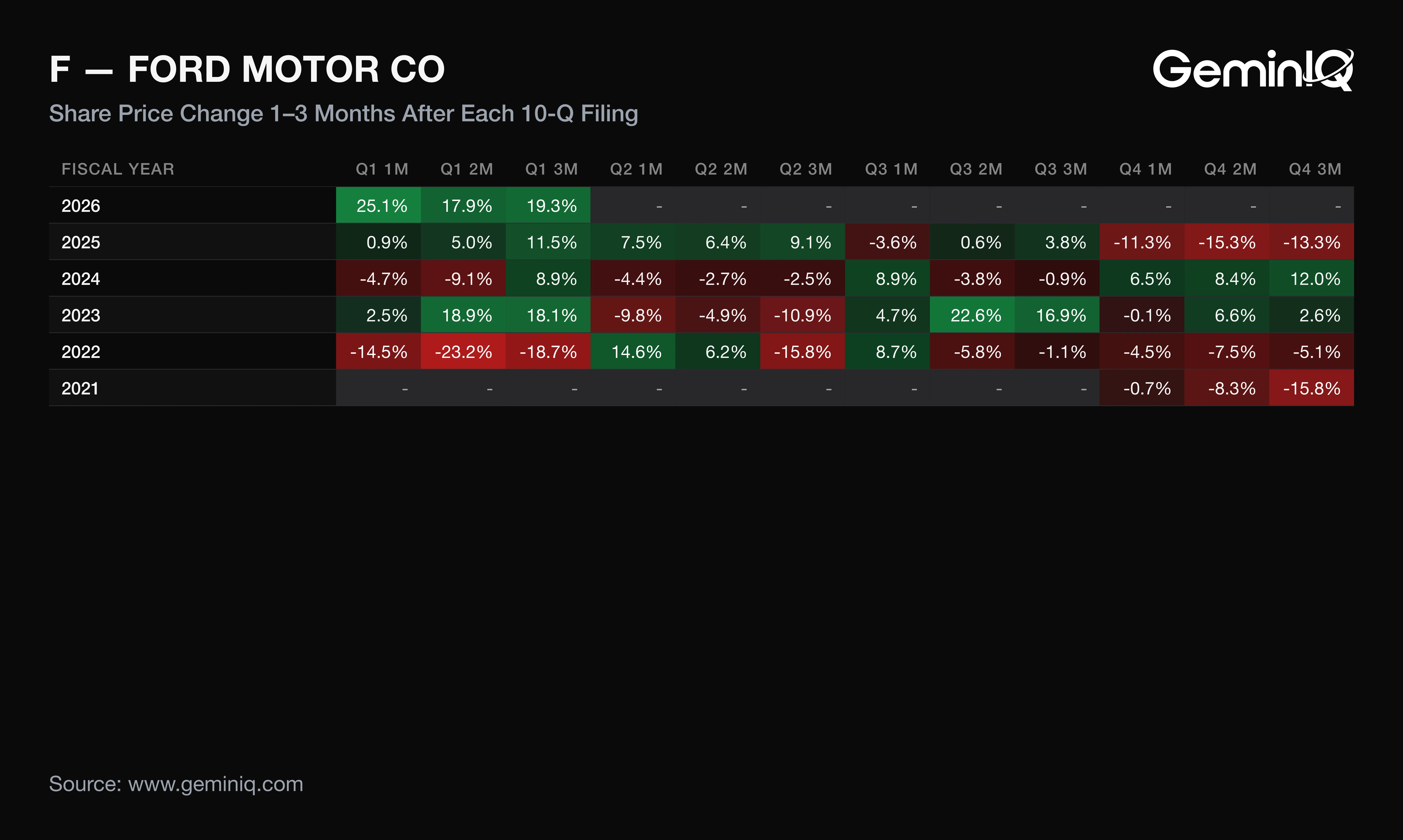
Across the last 12 Ford filings with a completed one-month window (filed July 2023 to April 2026), the median one-month return was +0.4%, positive after 6 of 12. These figures describe how Ford's stock moved after its past filings; they are a historical association, not a forecast.
The Data: The three-month median was +6.3%, positive after 8 of 12. The one-month range ran from -11.3% after the FY2025 Q4 filing on February 11, 2026 to +25.1% after the FY2026 Q1 filing on April 30, 2026. Past Q3 filings were followed by one-month returns of +4.7%, +8.9% and -3.6%. This filing's window has not elapsed. The Earnings Reaction Heat Map shows each cell.
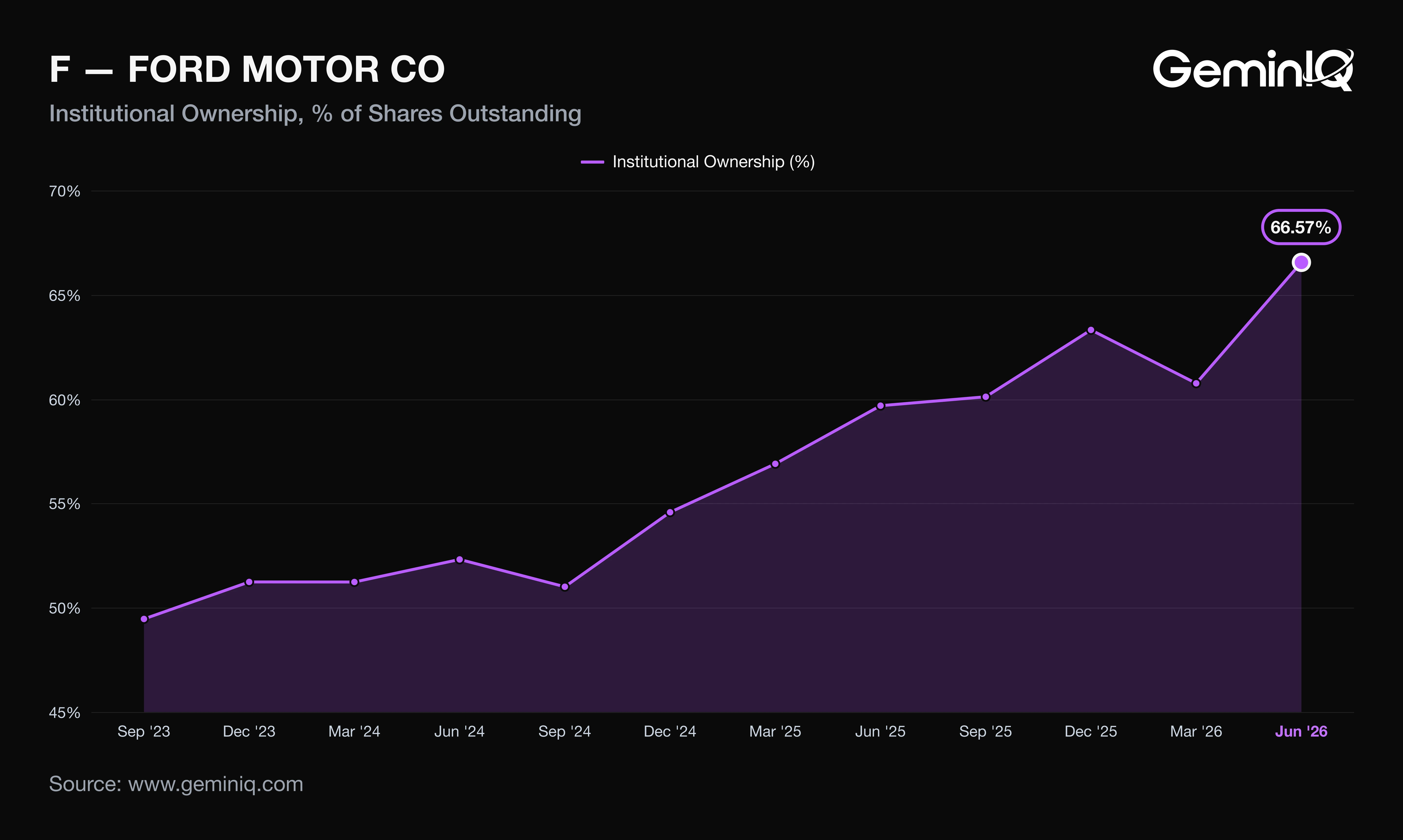
Why: A median near zero with a 36-point spread means the direction after a Ford filing has historically been close to even, with the size set by the outliers. GeminIQ's 13F data shows institutions held 66.57% at June 30, 2026, up 6.87 points in a year and the highest of the last 16 quarters. In the 12 months of Form 4 filings through June 23, 2026, insiders filed 3 purchases ($2.2 million) and 2 sales ($675,000), against none in the prior 12 months; that record ends before the release.
Any quarter where pretax income rises while EPS falls belongs to the tax line, and the next filing's tax rate decides whether the gap persists.
Frequently Asked Questions
When does Ford report earnings?
Ford reported Q3 2026 results in a Form 8-K on October 28, 2026 and filed its 10-Q on October 29, 2026. Last year it filed its fourth-quarter results on February 11, 2026, and its Q3 2025 10-Q on October 24, 2025. Those dates are a pattern in the filing record, not a forecast.
Is Ford doing well financially?
Ford was profitable in Q3 2026, with net income of $2.05 billion and a 4.1% net margin, but not over the trailing twelve months. GeminIQ's pre-calculated Net Profit Margin (TTM) was -2.11%, against 2.49% a year earlier, after a $1.3 billion net loss in Q2 2026 that included a $3.6 billion largely non-cash charge on the BlueOval SK disposition (8-K).
Does Ford pay a dividend?
Yes. Ford declared a fourth-quarter regular dividend of 15 cents per share, payable December 1 to shareholders of record on November 10, the same 15 cents it declared for Q3. The 10-Q says Ford generally targets shareholder distributions of 40% to 50% of adjusted free cash flow.
What was Ford's free cash flow in Q3 2026?
Ford's adjusted free cash flow was $4.7 billion in Q3 2026 (8-K), a company-defined measure. Operating cash flow of $5.4 billion less roughly $2.3 billion of capital spending leaves about $3.1 billion on a plain GAAP basis (derived).
Wall Street's data. Main Street's price.
Institutional terminals charge thousands a year for as-filed accuracy. GeminIQ gives you the same thing for a fraction of the cost: financials built directly from raw SEC EDGAR filings, not third-party APIs, with full XBRL traceability back to the original 10-K or 10-Q. No normalized guesswork, just calculated metrics, charts, screeners, and watchlists built on numbers exactly as the company reported them. Start researching now at GeminIQ.com.
All financial figures cited in this article reference Ford Motor Company's Q3 2026 10-Q (filed October 29, 2026, period ending September 30, 2026), with guidance and management commentary drawn from the company's Form 8-K earnings release (filed October 28, 2026). All SEC filings are publicly available at SEC EDGAR and SEC EDGAR.
Disclaimer: The content in this blog is for educational and entertainment purposes only and does not constitute financial, legal, or tax advice. Investing involves risk, including the loss of principal. The views expressed are my own and not intended as financial advice or a guarantee of future performance.