Lilly (LLY) Q3 2026 Earnings: EPS Up 16%, IPR&D Charge $4.57

By Chad Hartman
Published · Last updated
Eli Lilly (LLY) reported Q3 FY2026 revenue of $24.40 billion, up 38.6%, and diluted EPS of $7.22, up 16.3%, for the quarter ended September 30, 2026; the earnings release and the 10-Q both came out October 29, 2026. Revenue grew more than twice as fast as EPS because acquired in-process R&D charges reached $4.18 billion, or $4.57 a share, pulling operating margin down 6.6 points to 34.5% in a quarter when gross margin rose. The 10-Q shows the charge is the largest piece of a nine-month deal-making pattern, and that pattern also sets the terms of the new guidance.
| Field | Value |
|---|---|
| Company | Eli Lilly ($LLY) |
| Quarter | Q3 FY2026, period ended September 30, 2026 |
| Earnings release | October 29, 2026 (Form 8-K) |
| 10-Q filed | October 29, 2026 |
| Revenue | $24.40 Billion (+38.6% YoY) |
| Diluted EPS | $7.22 (+16.3% YoY) |
| Operating margin | 34.5% (-6.6 pts YoY) |
| Operating cash flow (TTM) | $30.64 Billion |
| Acquired IPR&D charge per share (8-K) | $4.57 (vs $0.71 in Q3 2025) |
Lilly Q3 2026 Revenue, EPS and Operating Margin
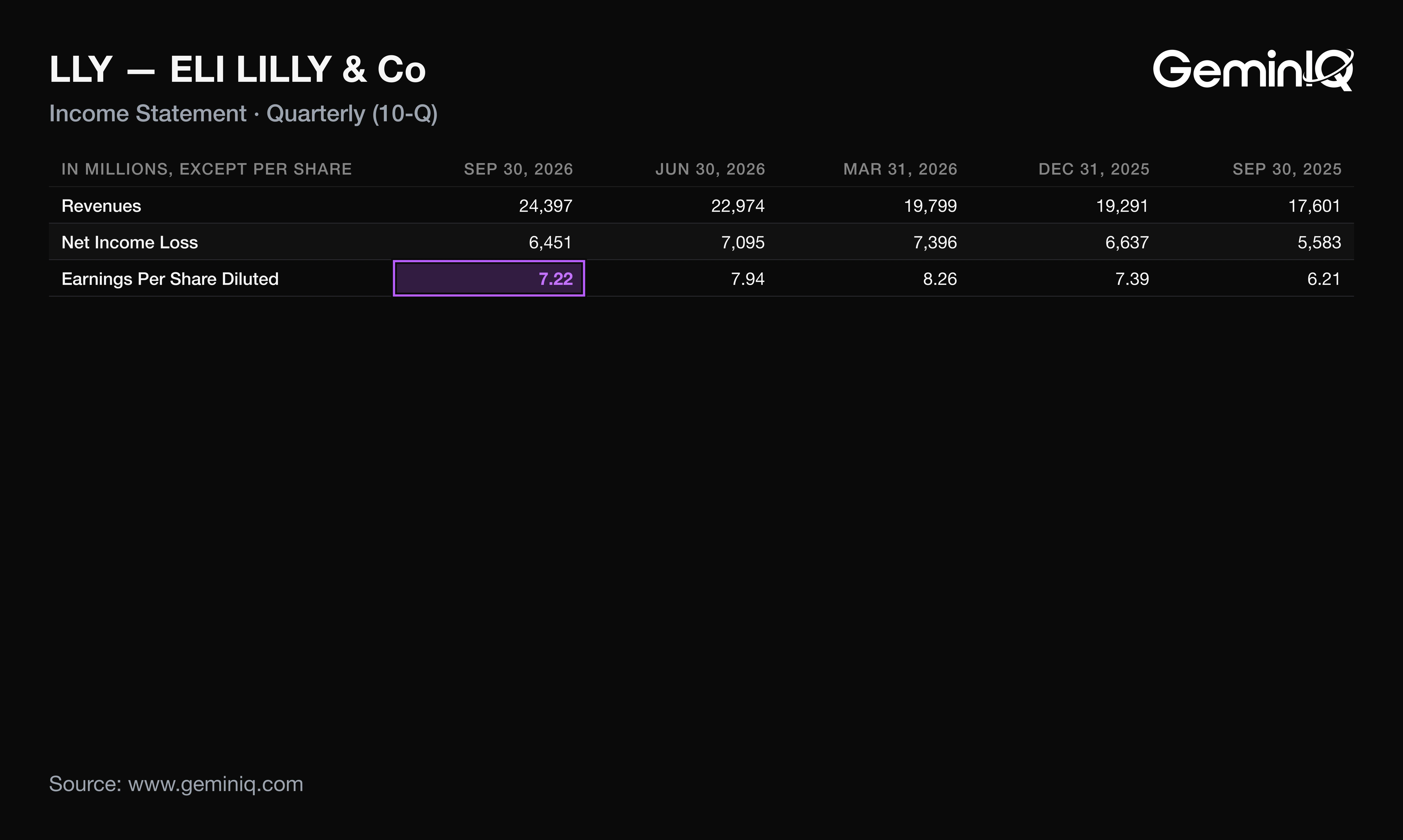
Lilly's Q3 2026 revenue was $24.40 billion, up 38.6% from $17.60 billion a year earlier and the highest of the last 16 quarters. Diluted EPS rose only 16.3% to $7.22 because costs below gross profit absorbed most of the gain.
A reader who saw 39% revenue growth would expect earnings to track it, especially with gross margin widening to 83.9% from 82.9%. Instead operating income rose 16.2% year over year and fell 9.1% from the second quarter.
The Data: Gross profit rose 40.2% to $20.46 billion. Research and development rose 23% to $4.25 billion and marketing, selling and administrative expense rose 14% to $3.13 billion, both slower than revenue. Acquired IPR&D jumped to $4.18 billion from $656 million. Operating margin fell to 34.5%, the seventh highest of the last 16 quarters, against 41.1% a year earlier.
Why: The release states that EPS included $4.57 of acquired IPR&D charges, against $0.71 in Q3 2025. Adding those back gives $11.79 against $6.92, growth of about 70% (derived from the release's figures).
Revenue quality needs one caveat. The 10-Q attributes growth to a 53% volume gain partly offset by 15% lower realized prices, and the release says about $900 million of Q3 revenue came from $410 million of Jardiance milestones and rebate-estimate adjustments. Removing that, and the roughly $380 million of milestone and divestiture revenue in the year-ago quarter, leaves growth near 36% (derived), still more than double the EPS rate. A 16% EPS figure measures how much dealmaking Lilly booked in the quarter as much as how much it earned.
What Lilly's Q3 2026 10-Q Shows Beyond the Press Release
Lilly's 10-Q puts nine-month acquired IPR&D at $7.54 billion, 3.2 times the $2.38 billion of the same period in 2025. The release presents Q3's $4.57 a share as a quarter's items; the filing shows Q3 alone exceeded the $3.36 billion of the first half combined (derived).
The Data: The 10-Q ties the Q3 charge primarily to the acquisitions of AtaiBeckley and Curevo, and the nine-month charge to those two plus Orna and Ajax. Lilly paid $18.2 billion for business development in the nine months, and in October acquired Merida for up to $2.9 billion. The effective tax rate was 23.3%, against 22.8% a year earlier.
Why: Lilly books these asset acquisitions as income-statement charges the quarter they close, and the MD&A attributes the higher tax rate to the "unfavorable tax impact of nondeductible acquired IPR&D charges." Each deal therefore lands in EPS at full cost and with no tax shield, which is why $4.18 billion of charges removed $4.57 a share from a $7.22 result. The release's own guidance footnote excludes IPR&D incurred after September 30, so the Merida deal sits outside the guided EPS range.
Lilly Q3 2026 Operating Cash Flow, Debt and Capital Returns
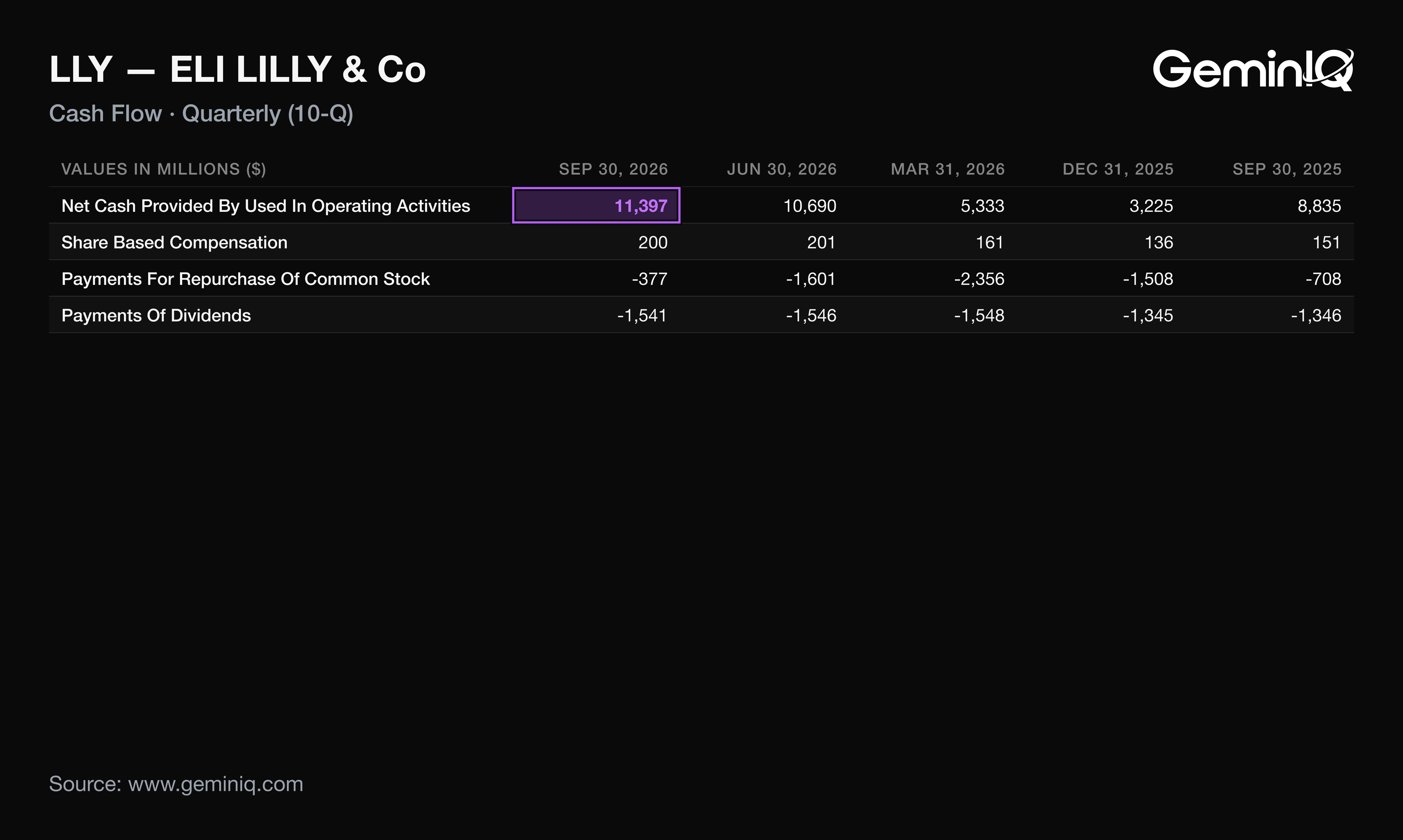
Lilly's Q3 2026 operating cash flow was $11.40 billion, up 29.0% from $8.84 billion and the highest of the last 16 quarters. Net income was $6.45 billion, so cash from operations ran 1.77 times earnings (derived).
The Data: The 10-Q's segment note shows $3.64 billion of expenditures for long-lived assets in the quarter against $2.32 billion a year earlier, leaving about $7.76 billion after them (derived; the figure includes software). Total debt reached $49.5 billion, up $7.0 billion from December 31, 2025, and interest expense was $378 million against $180 million. GeminIQ's pre-calculated Net Debt to EBITDA was 1.21x, down from 1.34x.
Why: The charge depresses net income without touching operating cash flow, which is why the two diverged, and the deals are financed by borrowing: Lilly issued $9.0 billion of long-term debt in May. Buybacks were small beside that: $377 million repurchased in Q3, 3.3% of operating cash flow (derived), though diluted shares of 893.4 million were the lowest of the last 16 quarters.
Interest expense doubling while leverage fell means EBITDA is growing faster than the debt, for now.
Lilly's 2026 Guidance After Q3
Lilly guided full-year 2026 revenue to $91 to $92 billion in the October 29 release, up from $85 to $87 billion, a $5.5 billion increase at the midpoint, while its EPS range moved down to $35.00 to $36.00 from $35.50 to $36.50.
The Data: Nine-month revenue was $67.17 billion, so the guided range implies fourth-quarter revenue of $23.83 to $24.83 billion, a midpoint of $24.33 billion against Q3's $24.40 billion (derived).
Why: The company states that underlying EPS guidance rose $4.07 at the midpoint and Q3's $4.57 of IPR&D charges more than offset it. The first three quarters, it adds, included sales-based milestones and rebate adjustments, and no further Jardiance milestones remain. Removing Q3's roughly $900 million of benefits puts underlying Q3 revenue near $23.5 billion, so the Q4 midpoint implies about 3.5% sequential growth (derived). In August the company raised the same revenue range from $82 to $85 billion to $85 to $87 billion, so this is its second consecutive raise.
How LLY Stock Has Moved After Past Earnings Reports
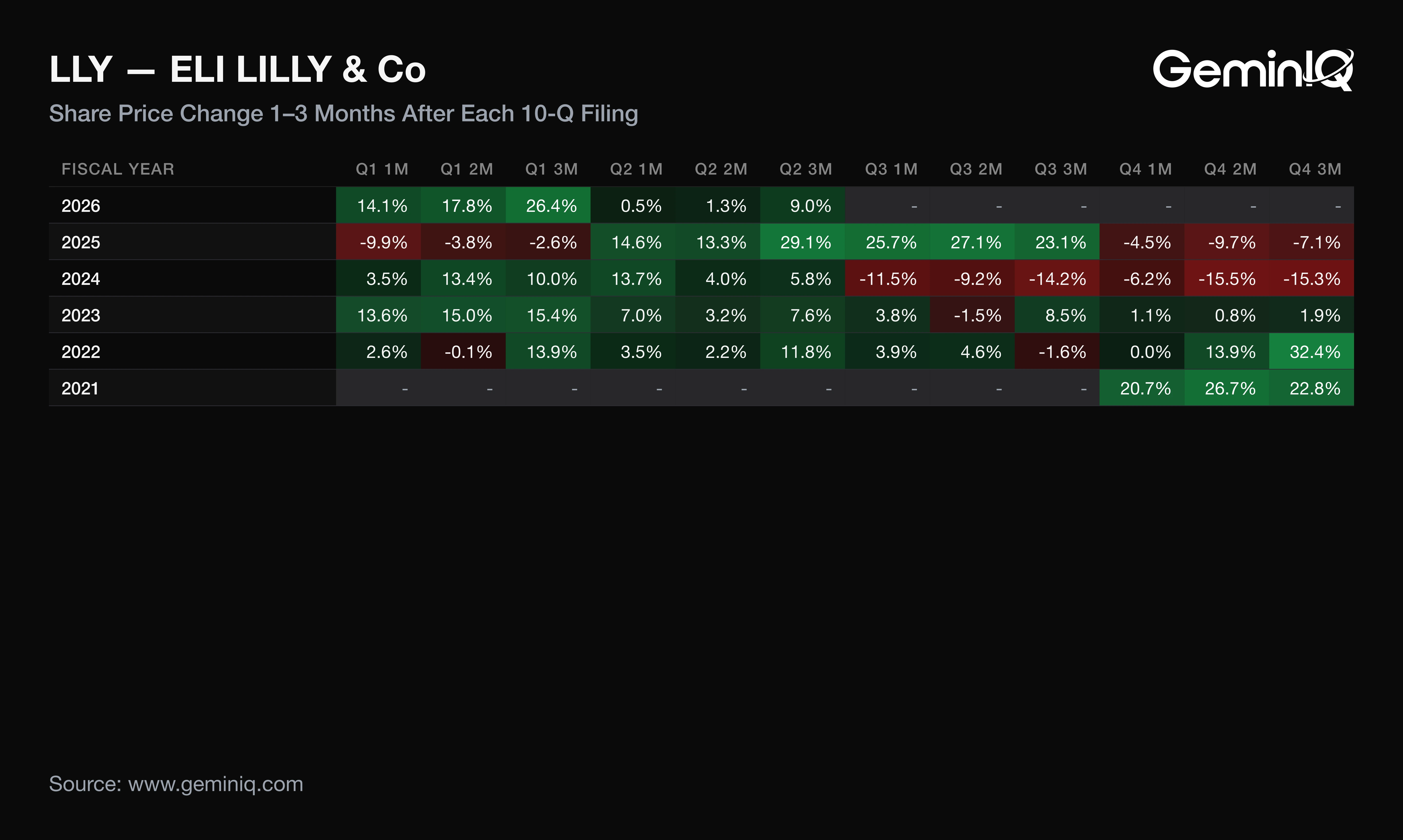
Across Lilly's last 12 10-Q filings with a completed one-month window, filed November 2023 through August 2026, the median one-month return was +2.3%, positive after 8 of 12. These figures describe how Lilly's stock moved after its past filings; they are a historical association, not a forecast.
The Data: The one-month range ran from -11.5% (FY2024 Q3, filed October 30, 2024) to +25.7% (FY2025 Q3, filed October 30, 2025). The past three Q3 filings were followed by +3.8%, -11.5% and +25.7% at one month. This filing's window has not elapsed, so its cells are blank in the Earnings Reaction Heat Map.
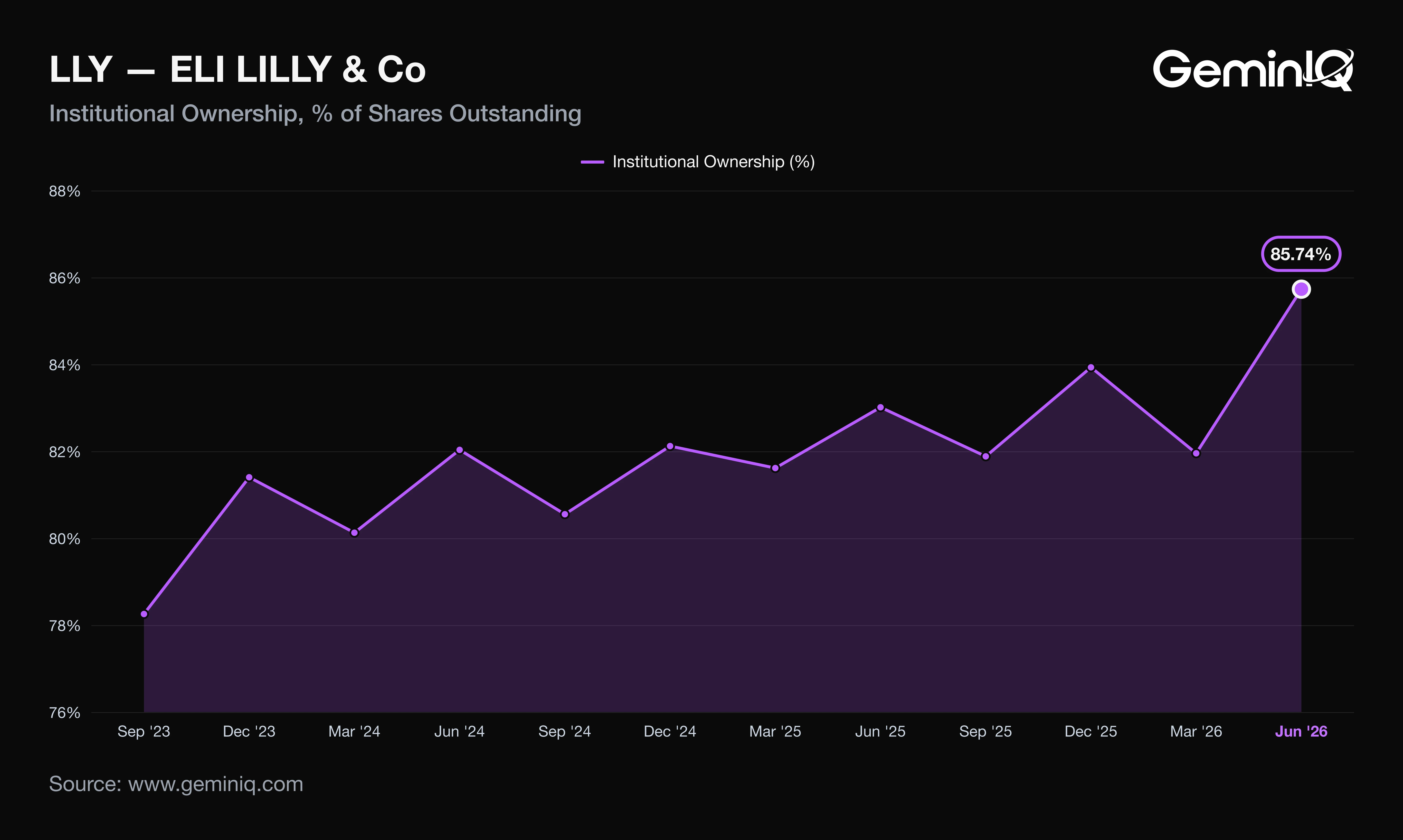
Why: Ownership is the steadier reference: 13F filers held 85.74% of shares at June 30, 2026, up from 83.02% a year earlier and the second highest of the last 16 quarters. The September 30 figure has not been filed.
When a company expenses its acquisitions through the income statement, the gap between revenue growth and EPS growth measures the deal calendar before it measures the business.
Frequently Asked Questions
When does Eli Lilly report earnings?
Eli Lilly reported Q3 2026 results and filed its 10-Q on October 29, 2026. Last year it filed its fourth-quarter FY2025 results on February 12, 2026, which is a pattern from the filing record, not a forecast of the next date.
Does Eli Lilly pay a dividend?
Yes. Eli Lilly paid $1.54 billion of dividends in Q3 2026 and $5.98 billion over the trailing twelve months, up 14.8%. It declared a $1.73 per share dividend for the fourth quarter, payable December 10, 2026 to holders of record on November 13, 2026.
Is Eli Lilly doing well financially?
Eli Lilly's trailing net profit margin was 31.90% at Q3 2026, against 30.99% a year earlier, per GeminIQ's pre-calculated Net Profit Margin. Return on invested capital was 38.21% and the current ratio was 1.39x, down from 1.55x, while total debt rose to $49.5 billion.
What is Eli Lilly's current revenue?
Eli Lilly's Q3 2026 revenue was $24.40 billion and nine-month revenue was $67.17 billion, up 46%. Mounjaro contributed $10.72 billion and Zepbound $5.35 billion in the quarter, and Mounjaro, Zepbound and Foundayo made up 66% of nine-month revenue.
Wall Street's data. Main Street's price.
Institutional terminals charge thousands a year for as-filed accuracy. GeminIQ gives you the same thing for a fraction of the cost: financials built directly from raw SEC EDGAR filings, not third-party APIs, with full XBRL traceability back to the original 10-K or 10-Q. No normalized guesswork, just calculated metrics, charts, screeners, and watchlists built on numbers exactly as the company reported them. Start researching now at GeminIQ.com.
All financial figures cited in this article reference ELI LILLY AND COMPANY's Q3 2026 10-Q (filed October 29, 2026, period ending September 30, 2026), with guidance and management commentary drawn from the company's Form 8-K earnings release (filed October 29, 2026). All SEC filings are publicly available at SEC EDGAR and SEC EDGAR.
Disclaimer: The content in this blog is for educational and entertainment purposes only and does not constitute financial, legal, or tax advice. Investing involves risk, including the loss of principal. The views expressed are my own and not intended as financial advice or a guarantee of future performance.