
Roku (ROKU) Q3 2026 Earnings: EPS $1.20, S&M Down 21%

By Chad Hartman
Published · Last updated
Roku (ROKU) reported Q3 FY2026 revenue of $1.50 billion, up 24.1% from a year earlier, and diluted EPS of $1.20, up 650% from $0.16, for the quarter ended September 30, 2026. Its 8-K shareholder letter and its 10-Q were both filed November 2, 2026. Total gross profit fell 3.7% from Q2 while operating income rose 12.3%, so the margin record came from the expense lines, not from the gross profit the letter led with. Sales and marketing expense fell 21% to $190.9 million, and the 10-Q says part of that drop was a one-time credit.
| Field | Value |
|---|---|
| Company | Roku ($ROKU) |
| Quarter | Q3 FY2026, period ended September 30, 2026 |
| Earnings release | November 2, 2026 (Form 8-K) |
| 10-Q filed | November 2, 2026 |
| Revenue | $1.50 Billion (+24.1% YoY) |
| Diluted EPS | $1.20 (+650.0% YoY) |
| Operating margin | 10.9% (+10.1 pts YoY) |
| Operating cash flow (TTM) | $810.87 Million |
| Sales and marketing expense | $190.9 Million (−21.1% YoY) |
Roku Q3 2026 Revenue, EPS and Margins
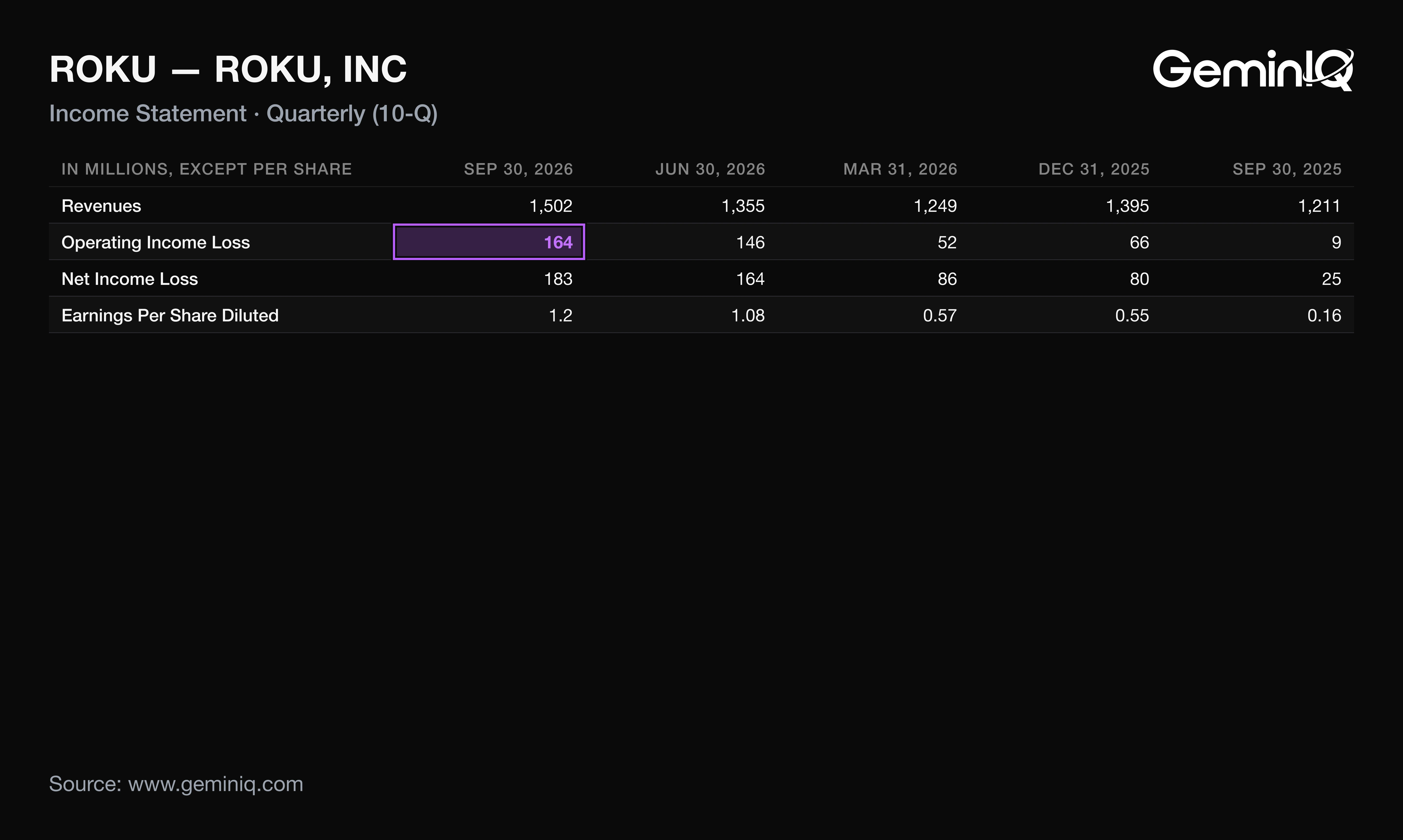
Roku's Q3 2026 operating income was $164.1 million against $9.5 million a year earlier, the highest of the last 16 quarters. The headline is a revenue story; the earnings gain is an expense story.
Revenue added $291.4 million. Gross profit added only $123.6 million, and operating expenses fell $31.0 million. That cut supplied about 20% of the $154.6 million operating-income gain. Operating income accounted for roughly 97% of the $158.5 million rise in net income (derived), so nothing below the operating line did much.
The Data: Gross margin was 43.2% against 49.7% in Q2, the fourth-lowest of the last 16 quarters. Operating margin was 10.9%, the highest of the same 16 quarters. Diluted shares were 152.64 million, up 0.7%, so share count explains almost none of the EPS change.
Why: Gross profit slipped from Q2 because Devices swung to a $48.6 million gross loss from a $26.9 million gain; the letter attributes the −25.1% Devices margin to elevated memory costs. Advertising held a 63.2% margin, up 4.7 points year over year. The operating line rose anyway because sales and marketing dropped $51.2 million. Operating margin is the highest in the 16-quarter window, and it rests on the cost line rather than the margin line.
What Roku's Q3 2026 10-Q Shows Beyond the Shareholder Letter
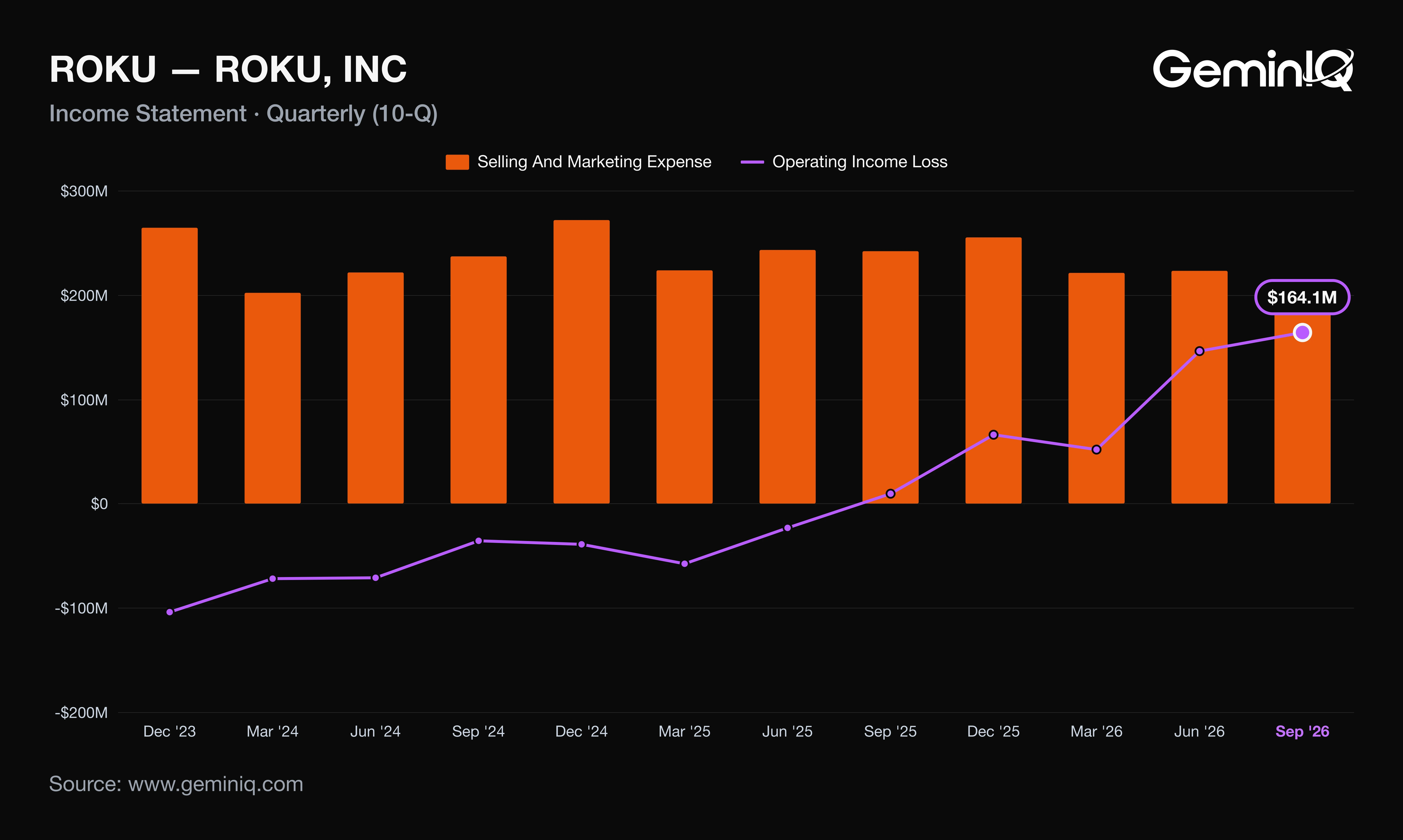
Roku's Q3 2026 sales and marketing expense was $190.9 million, down 21.1% from $242.1 million, and the 10-Q breaks the drop into parts the letter does not. Marketing expense fell $42.1 million, and a $19.2 million credit from the buyout of previously impaired corporate-office floors also reduced the line, partly offset by $9.5 million of higher personnel expense.
The Data: Strip the credit and sales and marketing would have been about $210.1 million, down roughly 13% (derived). General and administrative expense rose $15.6 million, of which $13.4 million was merger-related costs for the pending Fox transaction. The credit and the merger costs roughly offset, a net $5.8 million, so neither distorts operating income much on its own.
Why: The $42.1 million marketing decline is the larger piece, and its timing matters. The letter says distribution costs for Roku TV model sales, "a significant component" of sales and marketing, are expected to be weighted toward Q4 2026. The company attributes that to higher Roku TV unit volume from TCL and Hisense. Operating margin in a quarter with light distribution cost is therefore a timing result until Q4 reports. Roku gave no outlook for Q4: with the Fox transaction pending, the letter says there is no earnings call and no financial outlook, and states only that Roku is on track for the second-half forecast in its proxy statement.
Roku Q3 2026 Free Cash Flow, Buybacks and Tax
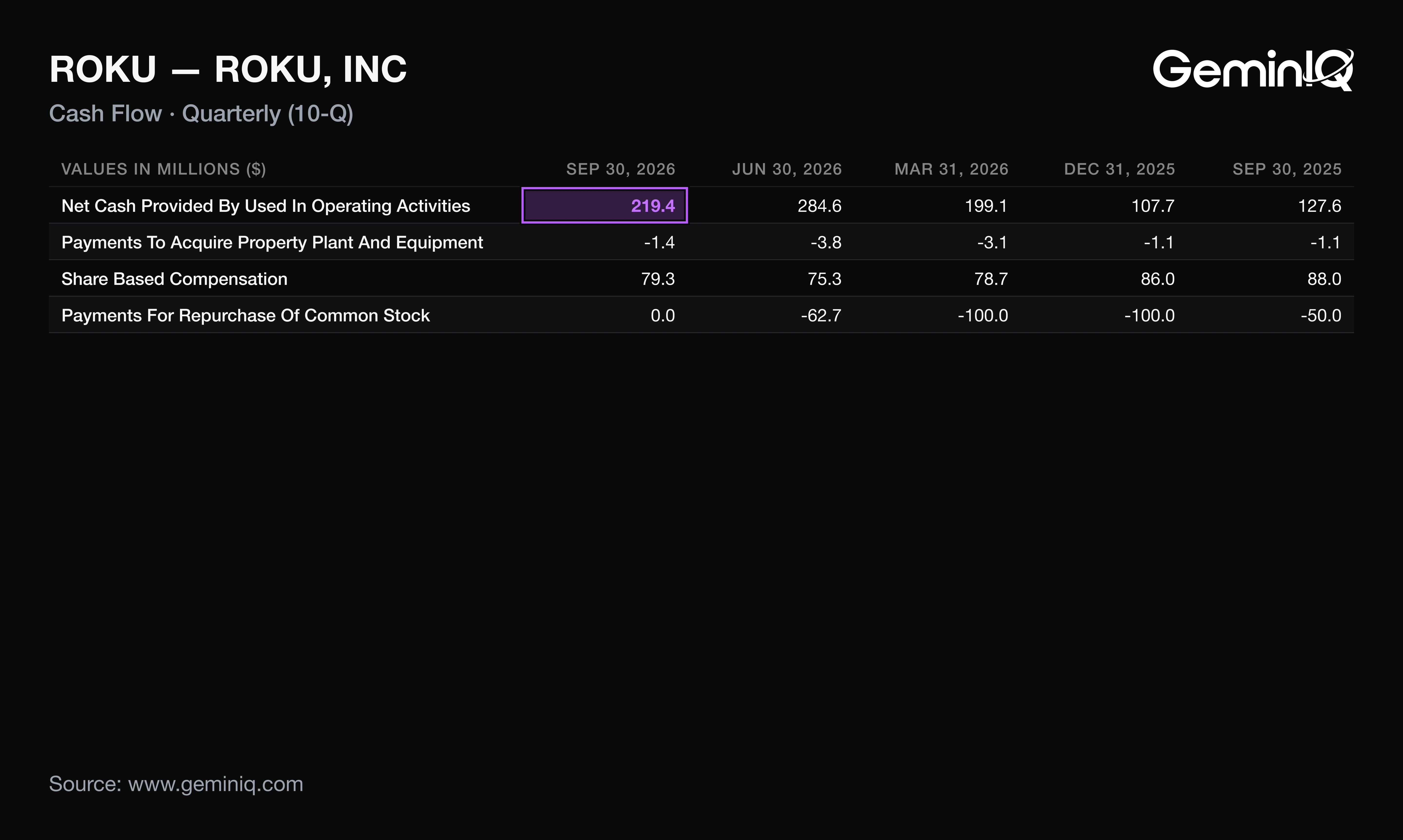
Roku's Q3 2026 operating cash flow was $219.4 million, up 72.0% from a year earlier but down 22.9% from Q2's $284.6 million, which still ranks third highest of the last 16 quarters. Cash conversion was strong, at 120% of the $183.3 million net income.
The Data: GeminIQ's pre-calculated Free Cash Flow for the trailing twelve months was $801.5 million, against $795.7 million in the company's non-GAAP figure, which also subtracts exchange-rate effects. Capital expenditure was only $1.4 million. Cash and equivalents were $2.52 billion with no borrowing on the $300 million credit facility. Roku repurchased 1.55 million shares for $162.7 million in the first half, then suspended the program when it signed the Fox merger agreement. Diluted shares nonetheless reached their highest level of the last 16 quarters.
Why: Buybacks stopped, but stock compensation did not: $79.3 million of it in the quarter, and $167.6 million went to taxes on net-settled awards in the nine months. The tax line is the larger EPS lever. Income tax was $4.0 million on $187.4 million of pretax income, a rate near 2% (derived), because the 10-Q states a full valuation allowance remains against US deferred tax assets. At a 21% rate, EPS would have been about $0.97 instead of $1.20 (illustrative). The 10-Q also says a release of that allowance within twelve months is a "reasonable possibility", which would swing reported net income on a non-cash entry.
How ROKU Stock Has Moved After Past Earnings Reports
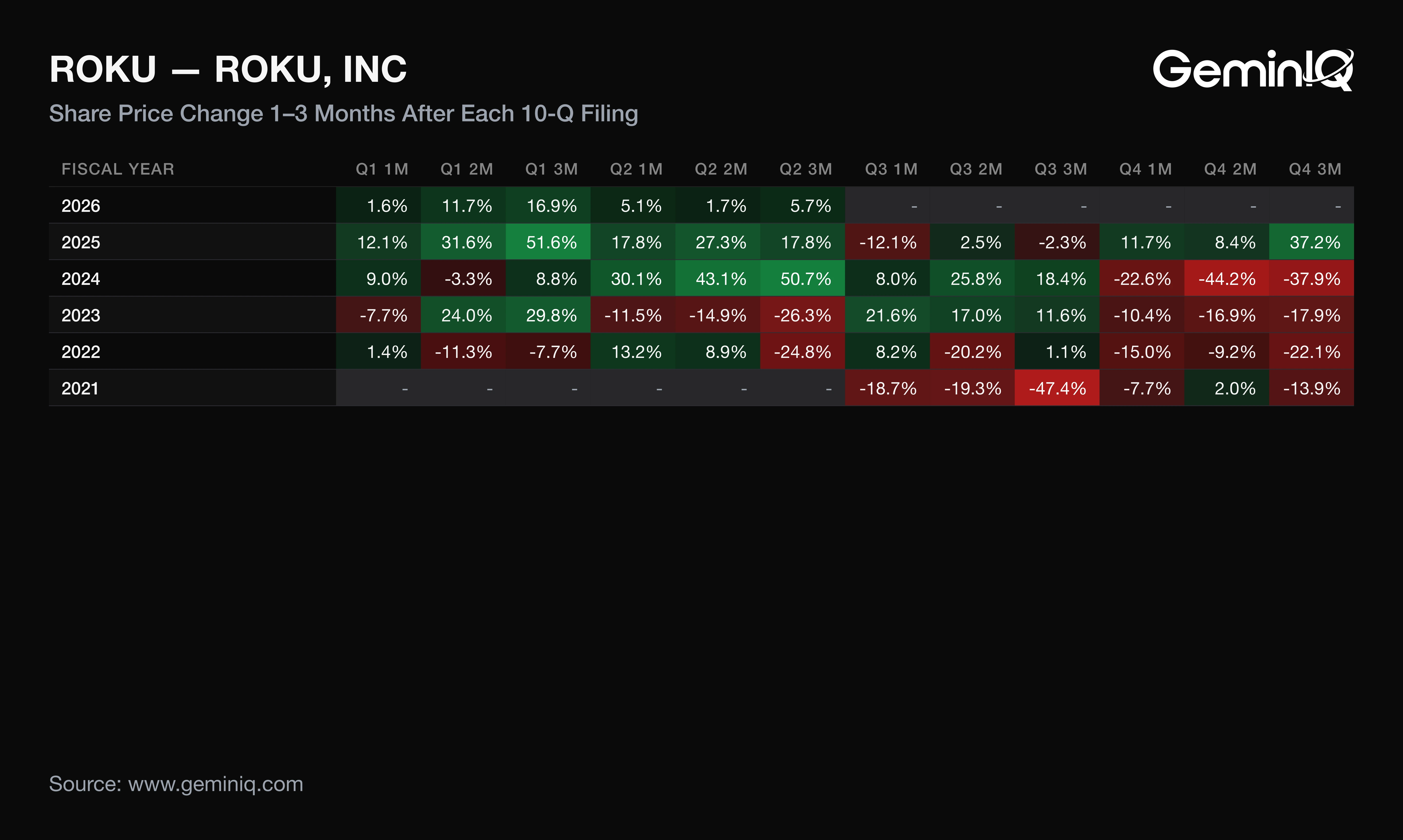
After its last 12 10-Q filings with a completed window, ROKU's one-month return had a median of +8.5% and was positive 9 times, with a range from −22.6% to +30.1%. These figures describe how Roku's stock moved after its past filings; they are a historical association, not a forecast. The latest filing has no return yet because its window has not elapsed.
The Data: The three prior Q3 filings were followed by one-month returns of +21.6%, +8.0% and −12.1%. Three-month returns after all 12 filings had a median of +14.2%.
Why: All of that history comes from Roku as an independent company. The 10-Q describes the Fox Merger Agreement dated June 14, 2026, so the stock now trades alongside that transaction, and a standalone reaction record may carry less weight. Insider filings show 78 sales worth $173.7 million and no purchases in the twelve months of filings through September 15, 2026, against $62.8 million in sales the prior twelve months; Charles Collier ($92.3 million) and Anthony Wood ($61.3 million) account for 88% of it. The finding is the near-tripling of sales dollars, not their direction. The GeminIQ Earnings Reaction Heat Map shows each filing.
Any margin record that rests on a cost the company says lands next quarter is borrowing from that quarter.
Frequently Asked Questions
When does Roku report earnings?
Roku reported Q3 2026 results on November 2, 2026 and filed the 10-Q the same day. Last year it reported Q3 on October 31, 2025, and filed its fourth-quarter results on February 13, 2026. That is a filing-record pattern, not a forecast of the next date.
Does Roku pay a dividend?
No. Roku's cash flow statement shows $0 of dividends paid in Q3 2026 and in the trailing twelve months. Its capital return has been share repurchases, which it suspended in Q2 2026 when it signed the Fox merger agreement.
Is Roku doing well financially?
Roku's trailing-twelve-month net profit margin was 9.34% against −0.61% a year earlier, per GeminIQ's Net Profit Margin. Its Current Ratio was 2.70x, and it had no borrowings at September 30, 2026.
How has ROKU stock reacted after past Q3 reports?
One month after the Q3 filings of FY2023, FY2024 and FY2025, ROKU returned +21.6%, +8.0% and −12.1%. Three months after, it returned +11.6%, +18.4% and −2.3%. These are historical associations over three observations.
Wall Street's data. Main Street's price.
Institutional terminals charge thousands a year for as-filed accuracy. GeminIQ gives you the same thing for a fraction of the cost: financials built directly from raw SEC EDGAR filings, not third-party APIs, with full XBRL traceability back to the original 10-K or 10-Q. No normalized guesswork, just calculated metrics, charts, screeners, and watchlists built on numbers exactly as the company reported them. Start researching now at GeminIQ.com.
All financial figures cited in this article reference Roku, Inc.'s Q3 2026 10-Q (filed November 2, 2026, period ending September 30, 2026), with guidance and management commentary drawn from the company's Form 8-K earnings release (filed November 2, 2026). All SEC filings are publicly available at SEC EDGAR and SEC EDGAR.
Disclaimer: The content in this blog is for educational and entertainment purposes only and does not constitute financial, legal, or tax advice. Investing involves risk, including the loss of principal. The views expressed are my own and not intended as financial advice or a guarantee of future performance.