
GameStop 10-K Analysis (2026): The Profit Isn't From Games

By Chad Hartman
Published · Last updated
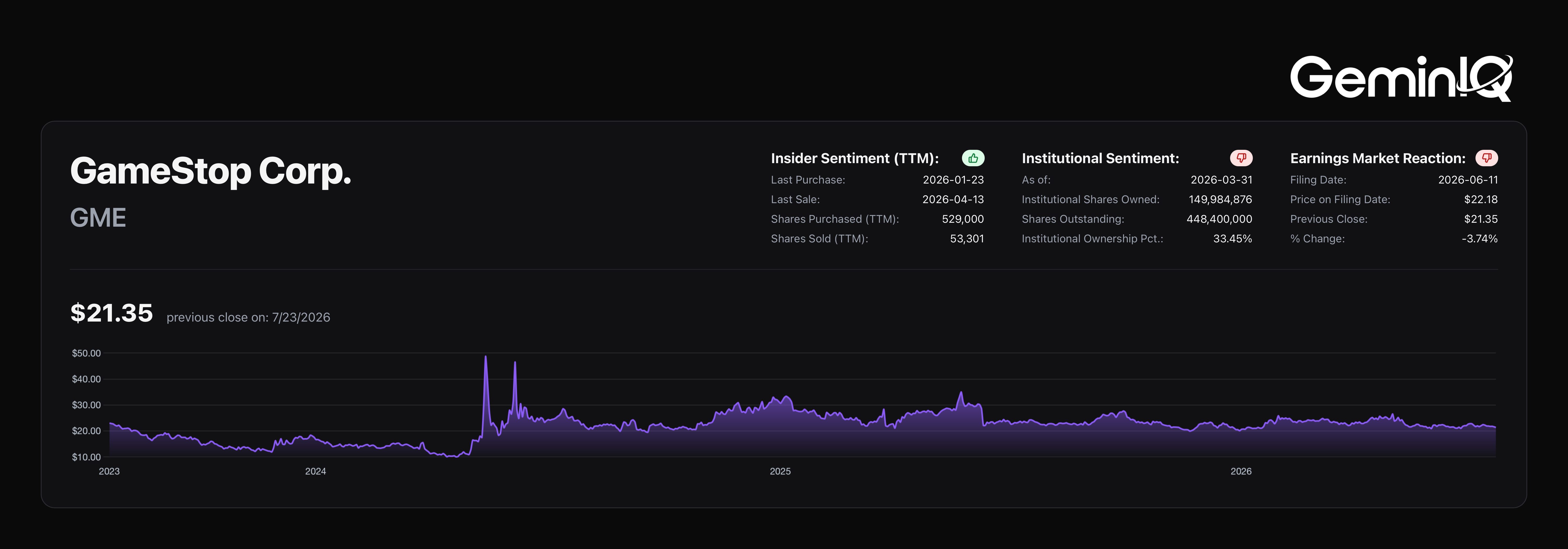
GameStop Corp. ($GME) filed its FY2025 10-K on March 24, 2026, covering the fiscal year ended January 31, 2026. Net income was $418.4 Million, the highest in a decade. The headline reads like a turnaround. The income statement tells a two-part story: the retail business did turn a genuine $232.1 Million operating profit, its first positive operating year since fiscal 2016, but $271.5 Million of the bottom line is interest income earned on a $6.30 Billion cash pile. Take the interest income away and the picture is smaller and more interesting than the net income figure suggests.
| Field | Value |
|---|---|
| Ticker | $GME |
| Filing | FY2025 10-K |
| Filed | March 24, 2026 |
| Period End | January 31, 2026 |
| Net Income (FY2025) | $418.4 Million |
| Operating Income (FY2025) | $232.1 Million |
| Interest Income, Net | $271.5 Million |
| Cash And Marketable Securities | $9.01 Billion |
Two Income Engines, Only One of Them Retail
The net income figure combines two very different sources of profit, and separating them is the whole analysis.
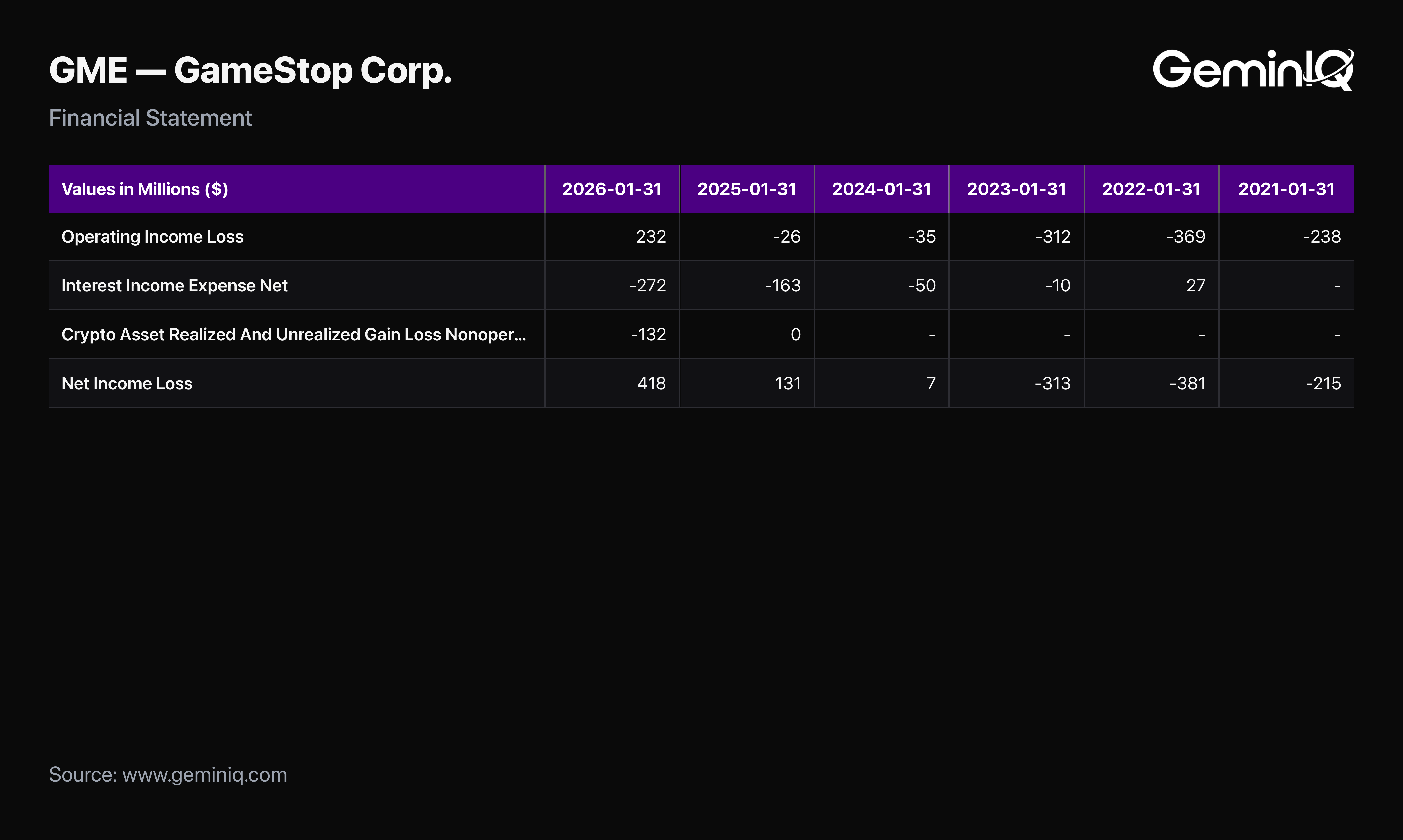
The Data: GameStop's Operating Income (Loss) was $232.1 Million in FY2025, a swing from -$26.2 Million the prior year and the first positive operating result since fiscal 2016. Below the operating line, Interest Income, Net contributed $271.5 Million, up from $163.4 Million. A new item, Loss On Digital Assets And Related Receivables, cost $131.6 Million. Income Before Income Taxes came to $384.0 Million, and an income tax benefit of $34.4 Million lifted Net Income to $418.4 Million.
The arithmetic worth holding onto: the retail operation produced $232.1 Million of operating profit, while the cash pile produced $271.5 Million of interest. More of GameStop's pretax income came from its treasury than from selling anything.
The GeminIQ Edge: A single net income figure collapses an operating business and an interest-bearing treasury into one number. Reading Operating Income and Interest Income, Net as separate lines from the Financial Statements is what reveals that the larger contributor isn't the stores.
The Operating Turnaround Is Real, and It Came From Cost-Cutting
The operating profit deserves credit on its own terms, but the source of it matters for whether it holds.
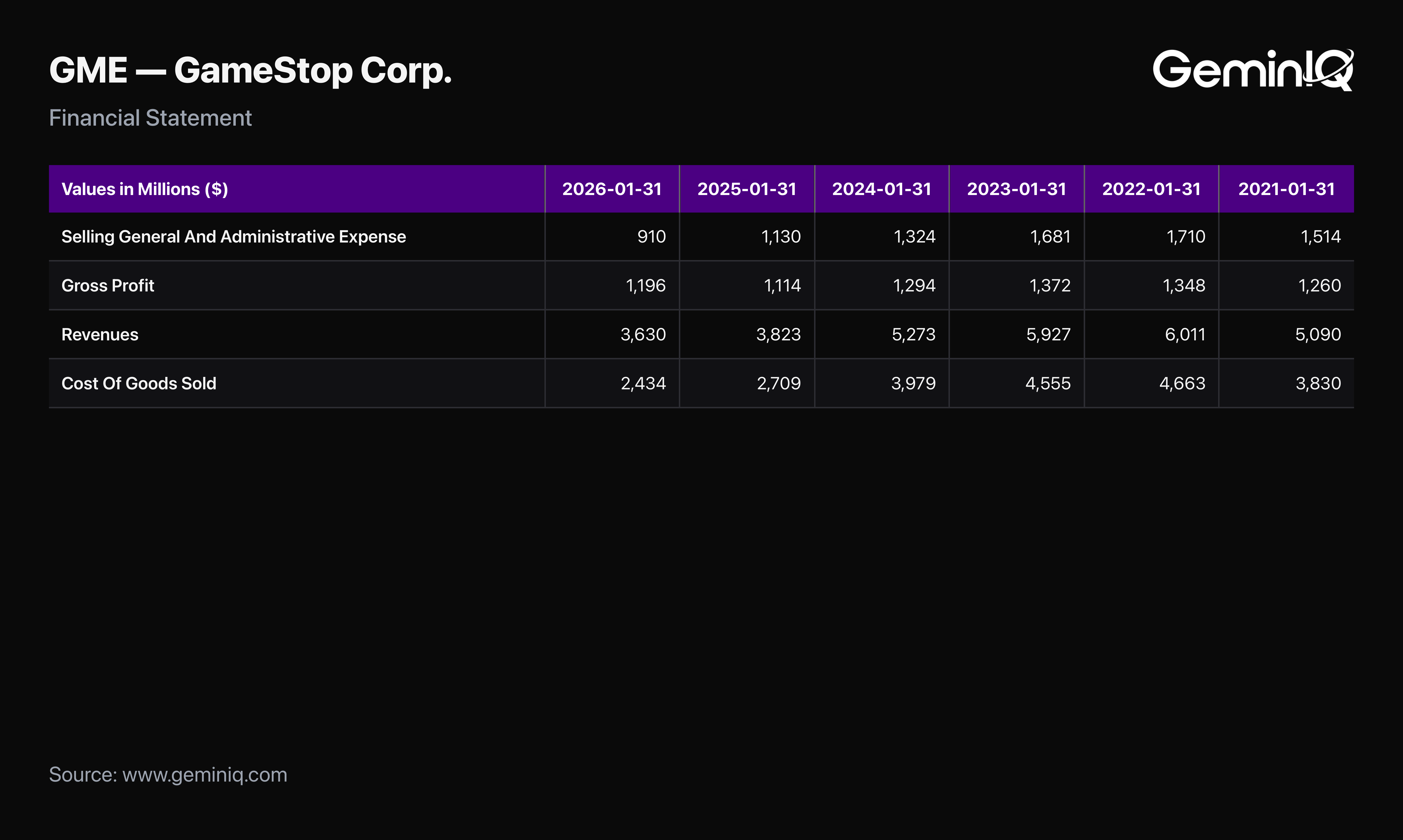
The Data: GameStop's Net Sales fell to $3.63 Billion from $3.82 Billion, a decline of 5.0% and the continuation of a long revenue slide from $9.55 Billion a decade ago. Gross Profit rose to $1.20 Billion from $1.11 Billion, lifting GeminIQ's Gross Profit Margin to 32.95% from 29.14%. The operating swing came from below the gross line: Selling, General, And Administrative Expenses fell to $910.2 Million from $1,130.4 Million, a reduction of $220.2 Million or 19.5%.
The turnaround, in other words, is a margin-and-cost story rather than a growth story. Revenue is still falling. GeminIQ's Operating Profit Margin reached 6.39%, its best since fiscal 2015, achieved by cutting operating expenses faster than sales declined.
The GeminIQ Edge: An operating profit built on a 19.5% SG&A cut against falling revenue is real but structurally limited. Cost reduction has a floor, and revenue is still contracting. The trend that matters next is whether the top line can stabilize now that the easy cost cuts have been taken.
The Balance Sheet Nobody From 2021 Would Recognize
The cash pile that generated most of the profit did not come from operations, and the financing behind it reshaped the balance sheet.
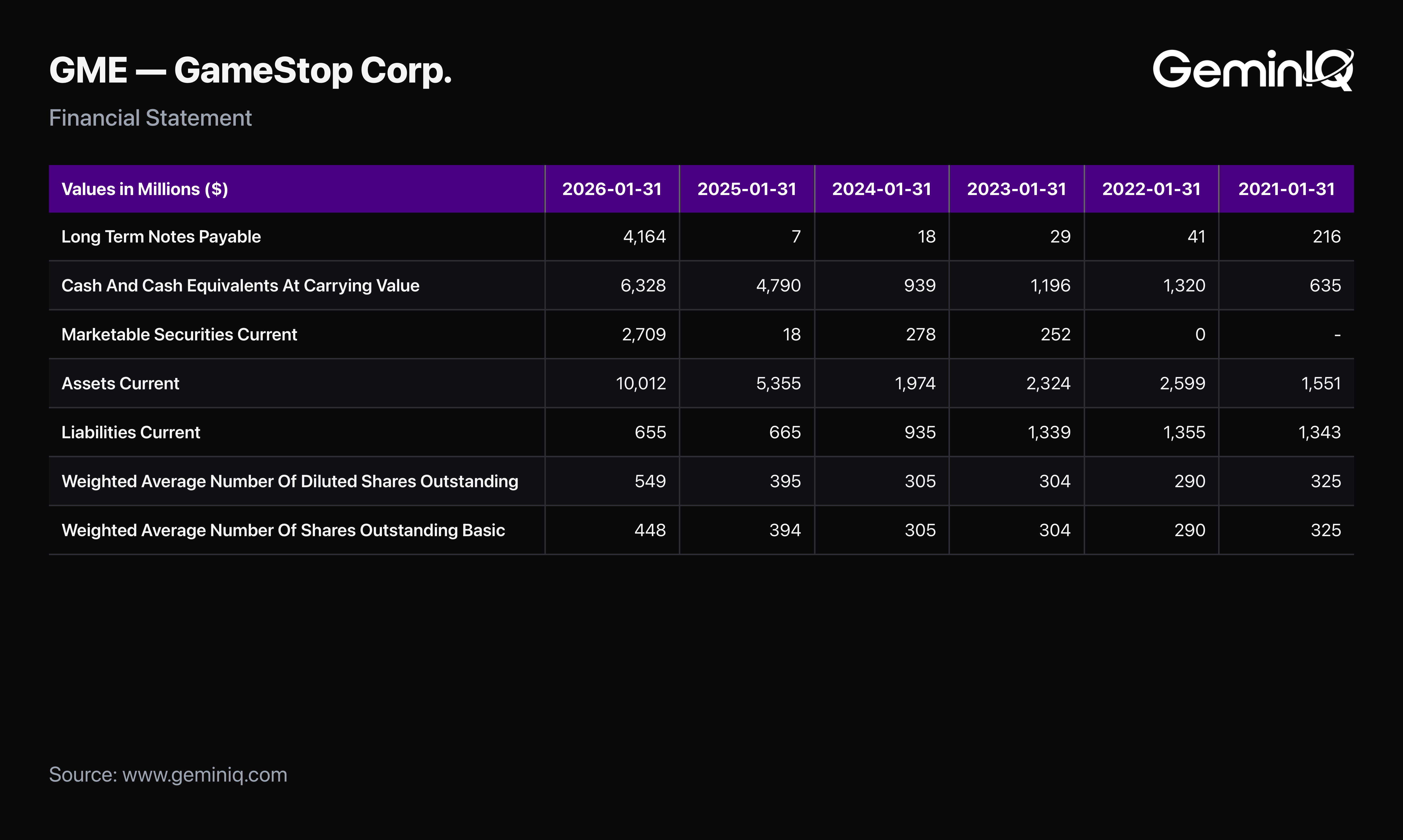
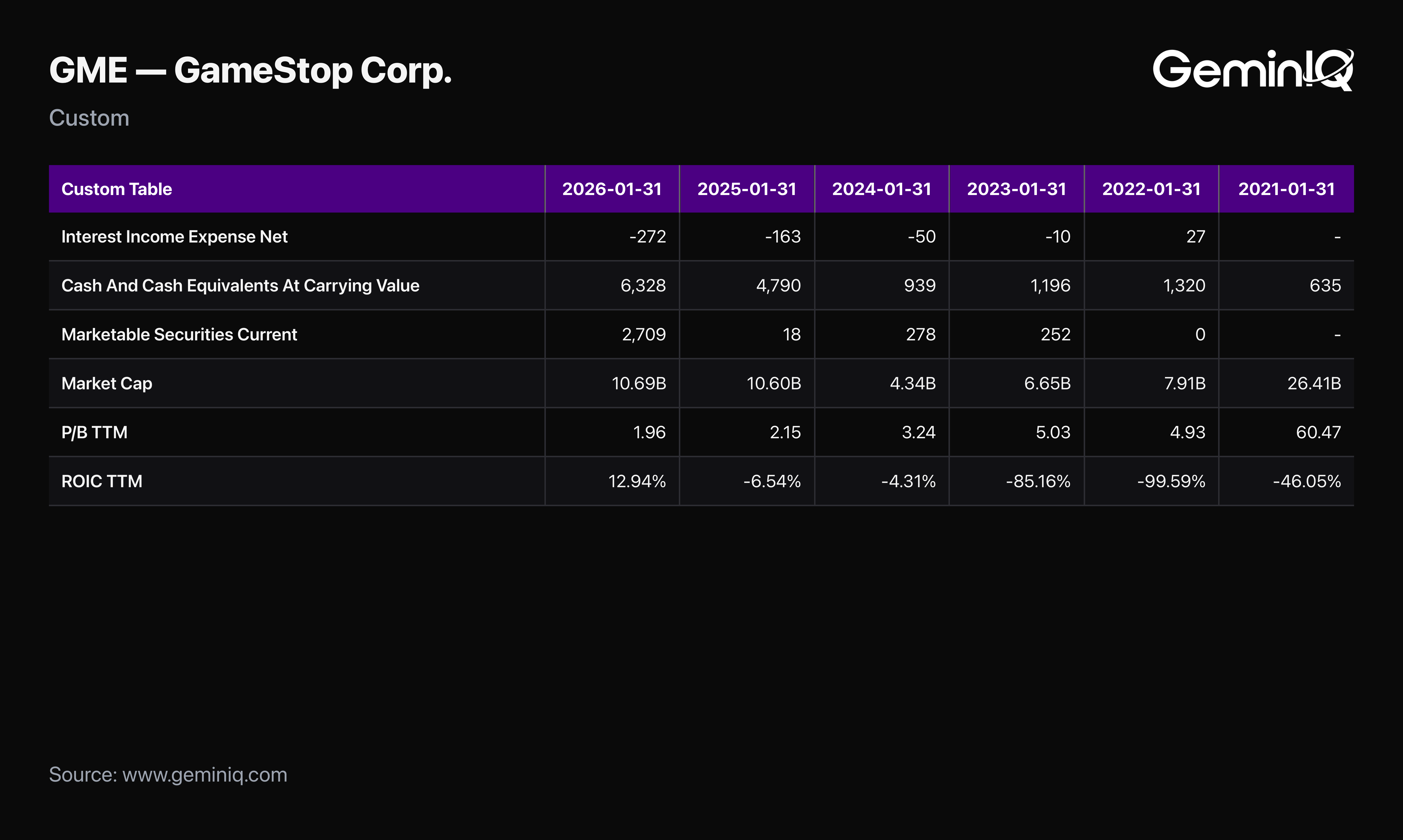
The Data: GameStop ended FY2025 with $6.30 Billion in Cash And Cash Equivalents and a further $2.71 Billion in Marketable Securities, for roughly $9.01 Billion in cash and equivalents against a total asset base of $10.39 Billion. Against that, Long-Term Debt, filed as Long Term Notes Payable, stood at $4.16 Billion, up from $6.6 Million a year earlier. That debt is the convertible notes the company issued to build the cash position, and it is why GeminIQ's Net Debt reads -$2.16 Billion, a net cash position, even with $4.16 Billion of gross debt on the books.
The share count moved alongside the debt. Weighted Average Number Of Diluted Shares Outstanding rose to 549.1 Million from 394.7 Million, an increase of 39.1%, reflecting both equity issuance and the dilutive effect of the convertible notes. Basic shares rose to 447.6 Million from 394.1 Million. The Current Ratio sits at 15.3, a number that reflects a company that is mostly a pile of cash with a retailer attached.
The GeminIQ Edge: A net cash position of -$2.16 Billion sitting on top of $4.16 Billion of gross convertible debt is the kind of structure a summary balance sheet flattens into "net cash, no concern." Reading gross debt and the diluted share count as their own lines shows the cost of assembling that cash: $4.16 Billion borrowed and a diluted share base 39.1% larger than a year ago.
What the Interest Income Depends On
Because interest income carried more of the bottom line than the retail business did, it is worth asking how durable it is.
The Data: The $271.5 Million in Interest Income, Net is a function of two things GameStop does not fully control: the size of the cash pile and prevailing short-term rates. On roughly $9.01 Billion of cash and marketable securities, that income implies a blended yield in the low-single-digit percent range. GeminIQ's Return on Invested Capital reads 12.94%, a swing from -6.54% a year earlier, though that figure is heavily influenced by the treasury income and the way invested capital treats the cash and debt.
Against the cash, the market assigns a premium. Market capitalization stands at $10.69 Billion, of which the $9.01 Billion in cash and securities is roughly 84%. The Price to Book ratio is 1.96 against book value of $5.44 Billion.
The GeminIQ Edge: Interest income is real income, and at current rates it is substantial. It is also the least controllable line on the statement, moving with rates GameStop does not set and a cash balance funded by convertible debt. A valuation that capitalizes $271.5 Million of interest income at an operating-business multiple is making an assumption the filing cannot support on its own.
Smart Money and the Insider Record
What are the people actually running the company doing with their own money?
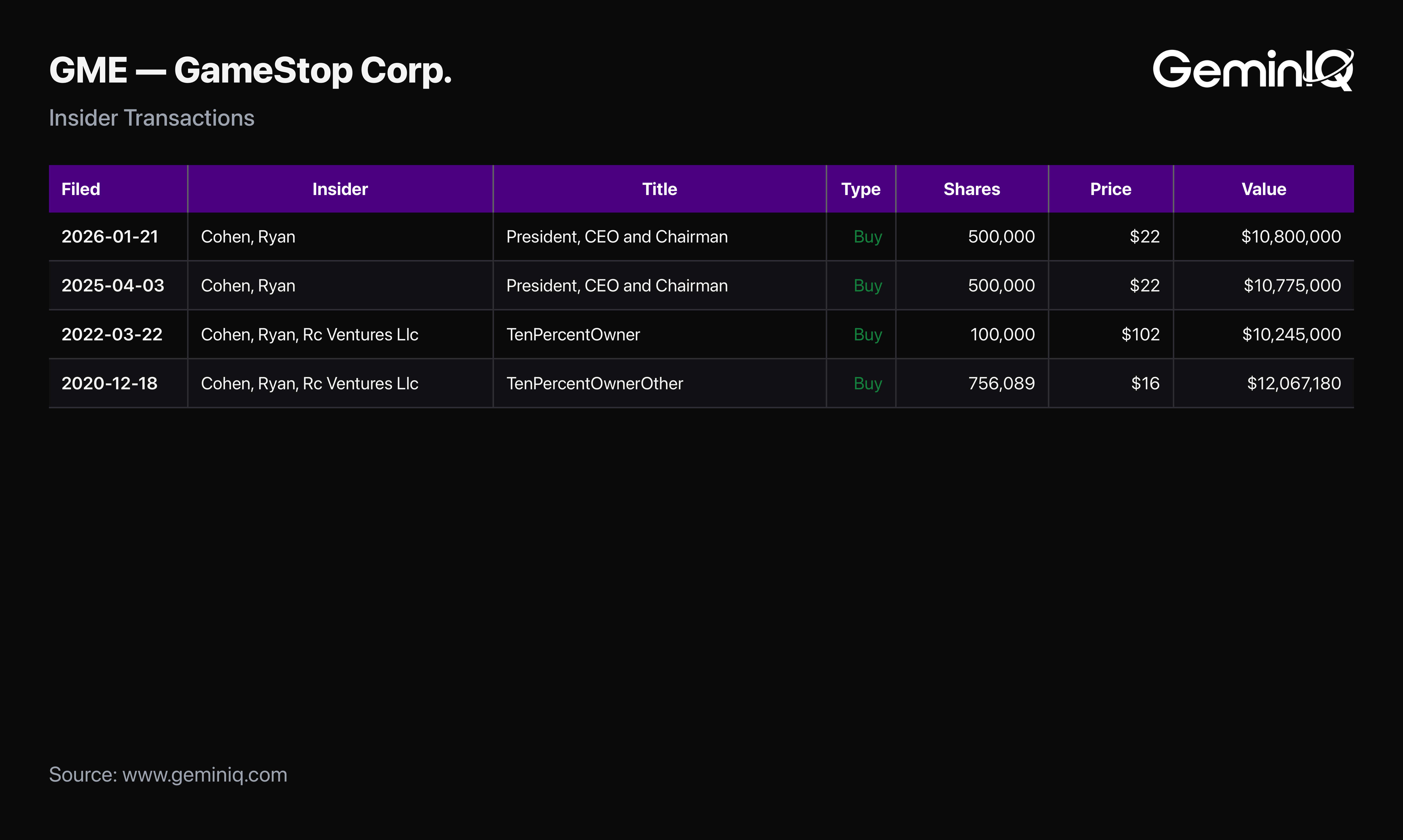
The Data: Unlike most large-cap records, GameStop's insiders have been buying. Since January 1, 2025, GeminIQ's Insider Transactions records 9 purchase filings totaling $33.26 Million against 17 sale filings totaling $1.76 Million. The purchases are dominated by the President, CEO and Chairman, who filed three separate buys of 500,000 shares each: at $21.55 on April 3, 2025, $21.12 on January 20, 2026, and $21.60 on January 21, 2026, for roughly $32.1 Million combined. The sales are small director dispositions.
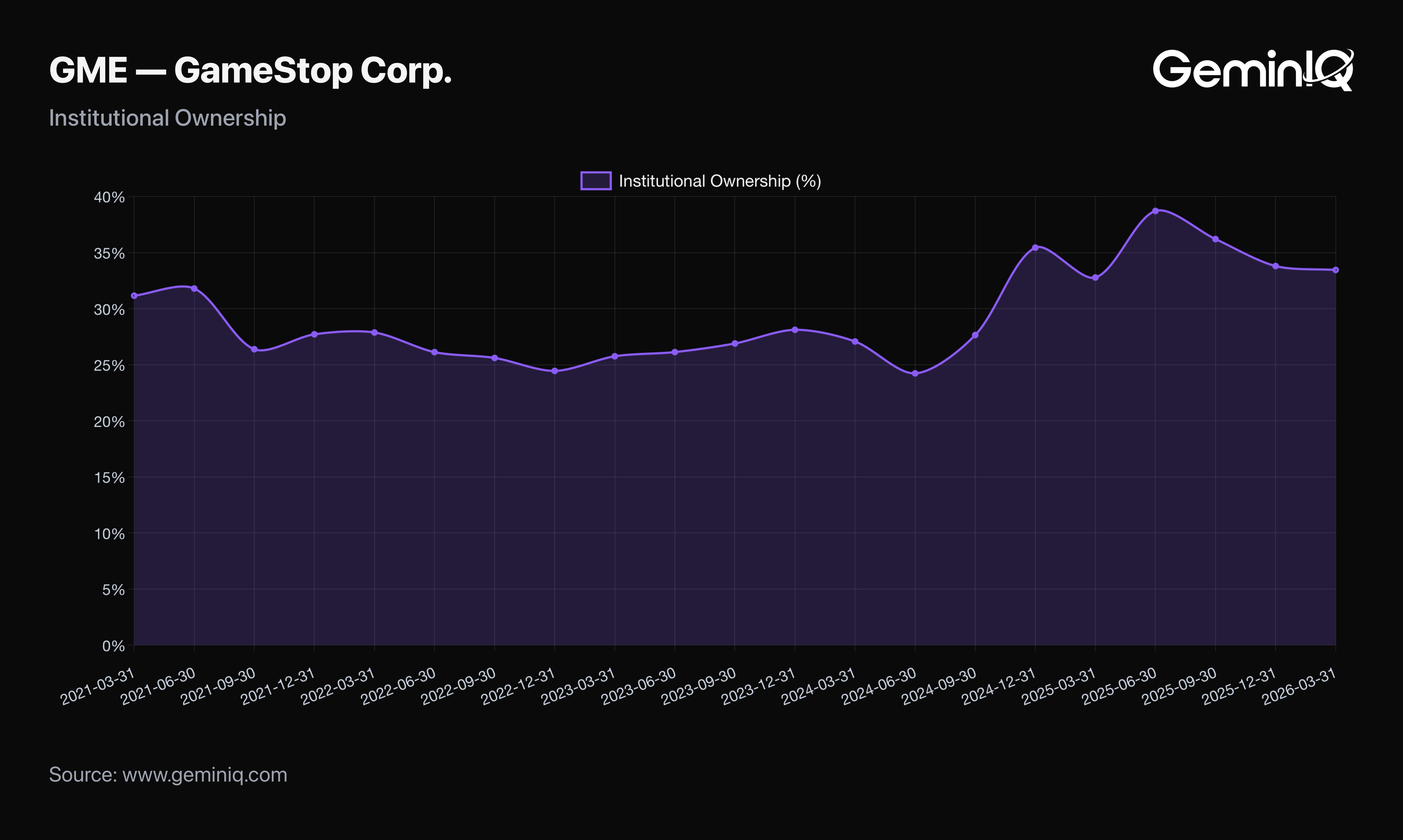
Institutional Ownership has declined steadily, from 38.71% as of the quarter ending June 30, 2025 to 33.45% as of March 31, 2026. Both figures come from quarterly 13F filings and describe positioning as of those quarter-ends rather than current holdings.
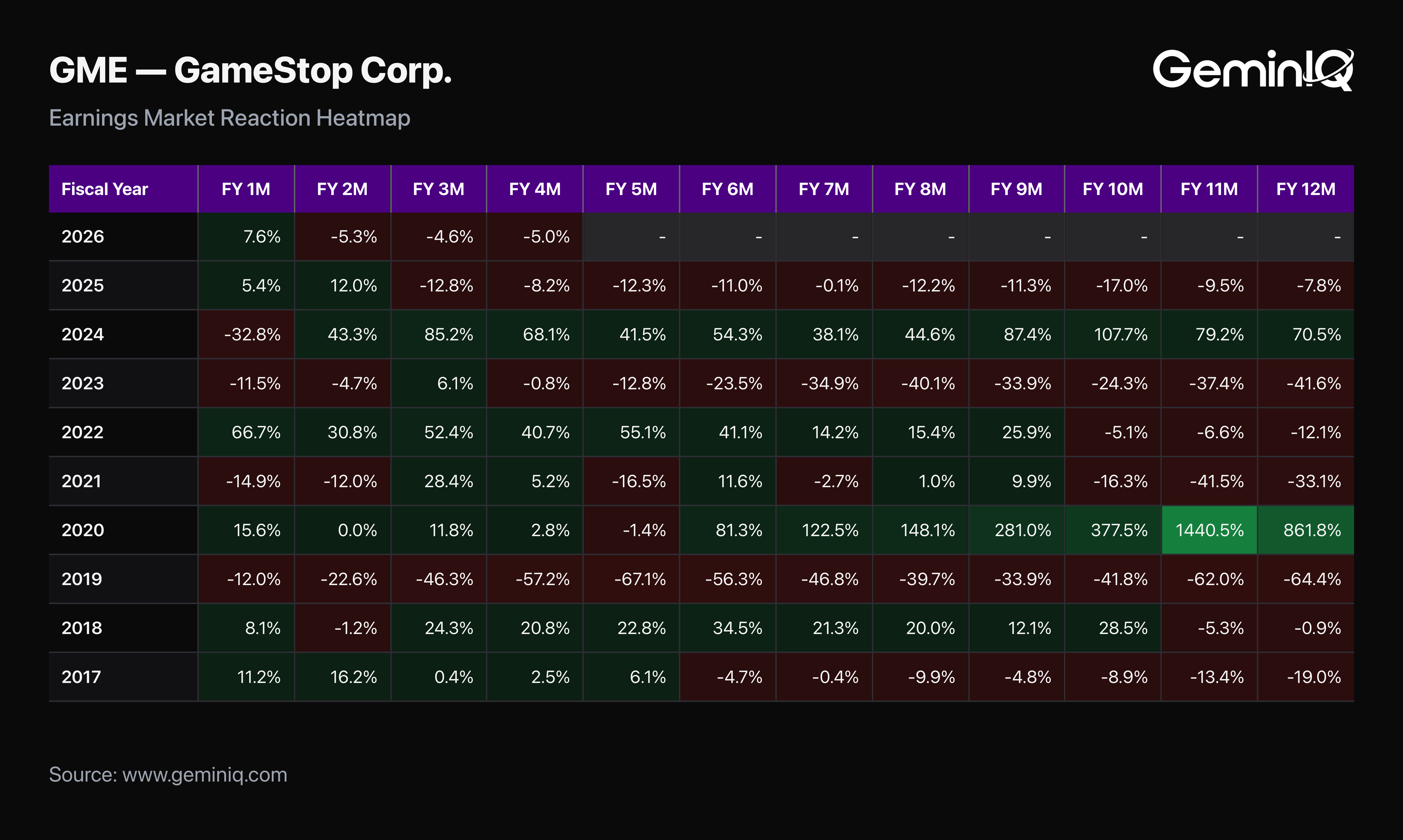
The GeminIQ Edge: A CEO buying 1.5 Million shares of his own company with his own money is a materially different signal than a scheduled director sale, and it is the rare case where the insider record leans clearly one direction. GeminIQ's Earnings Market Reaction Heatmap shows the stock up 7.63% one month after this 10-K was filed, then down 5.35% at two months and 4.56% at three. The full twelve-month window has not yet elapsed.
Frequently Asked Questions
Was GameStop's FY2025 profit from its retail business?
Partly. Operating income was $232.1 Million, a genuine retail operating profit and the first since fiscal 2016. But Interest Income, Net contributed $271.5 Million on top of that, so more of the pretax income came from the cash pile than from operations. Net income was $418.4 Million.
How did GameStop turn an operating profit if sales fell?
By cutting costs faster than revenue declined. Net Sales fell 5.0% to $3.63 Billion, but Selling, General, And Administrative Expenses fell 19.5%, from $1,130.4 Million to $910.2 Million. Gross margin also expanded, to 32.95% from 29.14%.
How much debt does GameStop have now?
$4.16 Billion in Long-Term Notes Payable as of January 31, 2026, up from $6.6 Million a year earlier. These are convertible notes issued to build the cash position. Because cash and securities total roughly $9.01 Billion, Net Debt is still negative at -$2.16 Billion.
How much has GameStop's share count grown?
Weighted average diluted shares rose to 549.1 Million from 394.7 Million, an increase of 39.1%, driven by equity issuance and the dilutive effect of the convertible notes. Basic shares rose to 447.6 Million from 394.1 Million.
How do I separate operating profit from interest income on a filing?
Read the income statement below the operating line. Operating Income (Loss) is the business result; Interest Income, Net and other non-operating lines are separate. When a company holds a large cash balance, the interest line can rival or exceed the operating line, and only reading them separately tells you which engine is actually driving the bottom line.
GameStop's most recent annual filing is a Form 10-K filed March 24, 2026, covering the fiscal year ended January 31, 2026 (FY2025).
Wall Street's data. Main Street's price.
Institutional terminals charge thousands a year for as-filed accuracy. GeminIQ gives you the same thing for a fraction of the cost: financials built directly from raw SEC EDGAR filings, not third-party APIs, with full XBRL traceability back to the original 10-K or 10-Q. No normalized guesswork, just calculated metrics, charts, screeners, and watchlists built on numbers exactly as the company reported them. Start researching now at GeminIQ.com.
All financial figures cited in this article reference GameStop Corp.'s FY2025 10-K (filed March 24, 2026, period ending January 31, 2026). All SEC filings are publicly available at SEC EDGAR.
Disclaimer: The content in this blog is for educational and entertainment purposes only and does not constitute financial, legal, or tax advice. Investing involves risk, including the loss of principal. The views expressed are my own and not intended as financial advice or a guarantee of future performance.