
Institutional Buying Before Big Runs: None Got Ahead of the Move

By Chad Hartman
Published · Last updated
NVIDIA's institutional ownership was at a multi-year low of 52.21% at the quarter ended December 2022 — the quarter before its AI-era climb began. Across Tesla, NVIDIA, and Palantir, none of the three runs shows institutions getting ahead of the move.
Tesla's stock rose more than sixfold in the nine months between March 2020 and December 2020. Over that same stretch, institutional ownership fell from 50.00% to 45.77%, dropping as low as 42.00% at the sharpest point of the move. The people running the world's largest pools of capital did not buy Tesla's 2020 run. They watched their share of the company shrink while it happened.
That's the honest answer to a question investors like to assume works in the smart money's favor: did institutions front-run the biggest stock runs of the last several years, chase them once they were underway, or miss them outright? GeminIQ's Form 13F data can check this directly, quarter by quarter, against the actual price action — for Tesla, NVIDIA, and Palantir, three of the most celebrated multi-year runs of the past decade. The answer is different for each, and only one of the three looks anything like institutions getting ahead of the move.
Every figure below is drawn from each company's own Form 13F institutional ownership data and SEC filing history via GeminIQ, read in the order it was reported. GeminIQ's 13F coverage begins in Q1 2013 across the full universe — a hard floor confirmed while building this piece — so this study is restricted to runs whose pre-run and run-era quarters fall after that date.
| Company | The Run | Institutional Data Window | Outcome Metric |
|---|---|---|---|
| Tesla (TSLA) | 2020 — stock +6x in 9 months | Q2 2013–Q1 2026 | Institutional ownership: 50.00% (Q1 2020) → 45.77% (Q4 2020), with a low of 42.00% (Q3 2020) |
| NVIDIA (NVDA) | 2023–2025 — the AI inflection | Q2 2013–Q1 2026 | Institutional ownership: 52.21% (low, Dec 2022) → 60.66% (Dec 2023) |
| Palantir (PLTR) | 2023–2025 — stock +20x | Q3 2020–Q1 2026 | Institutional ownership: 28.27% → 50.93% through the run |
Tesla Institutional Ownership Fell From 50.00% to 45.77% Through the 2020 Run
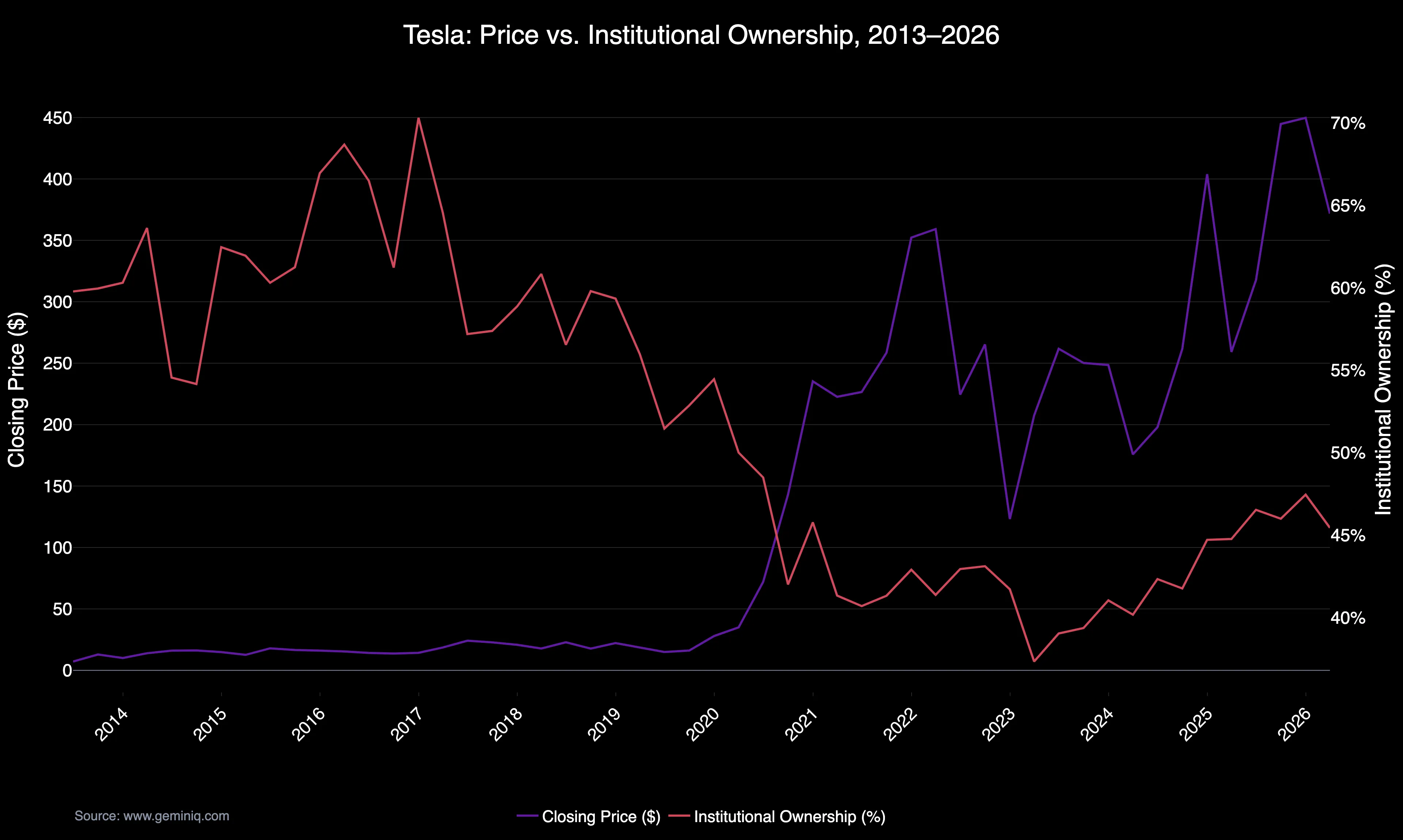
By early 2020, Tesla was already a well-covered, well-owned stock — institutional ownership had run in the low-to-mid 50s for years. Then the stock did something few large-caps ever do.
The Filing Data: Tesla's price rose from $34.93 (Q1 2020) to $71.99 (Q2 2020) to $143.00 (Q3 2020) to $235.22 (Q4 2020) — more than a sixfold increase in nine months. Institutional ownership over those same four quarters: 50.00% → 48.49% → 42.00% → 45.77%. Ownership kept falling through 2021 as the stock climbed further, bottoming near 40.69% even as the price peaked above $359 in early 2022.
The Signal: This is about as clean a "missed it" result as this kind of data produces. Institutional ownership didn't just fail to rise ahead of the move — it fell fastest during the sharpest part of the rally, and it didn't meaningfully recover until 2024–2025, long after the run itself was over.
NVIDIA Institutional Ownership Hit a 52.21% Low the Quarter Before the AI Run
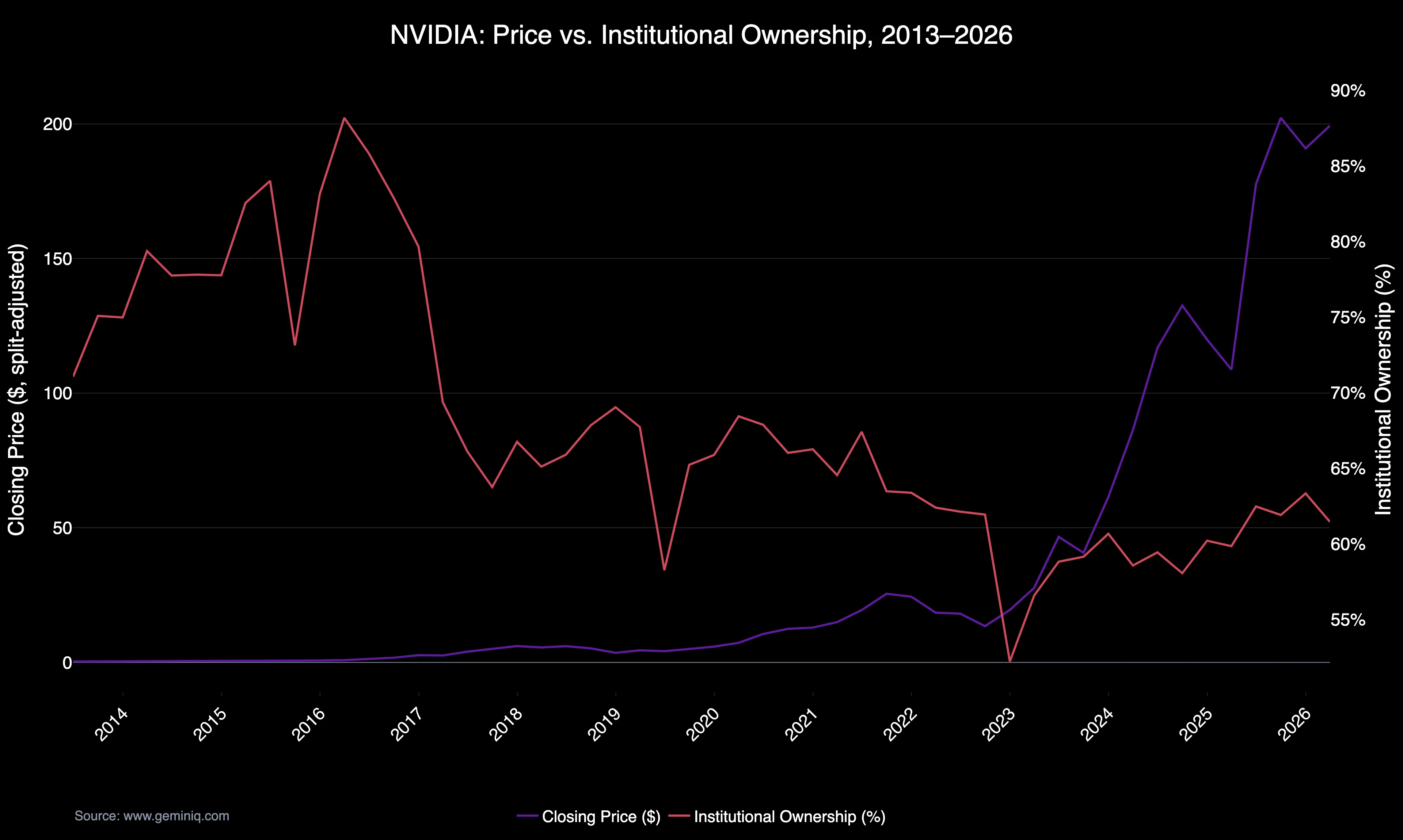
Unlike Tesla, NVIDIA was a stock institutions had owned heavily for a decade. But their conviction wasn't steady — and it hit a low point at almost the worst possible time.
The Filing Data: Institutional ownership fell from a 2016 peak near 88% down to 52.21% by the quarter ended December 2022 — a multi-year low, though that comparison spans a period over which NVIDIA's share count and its index composition both changed materially, so the two endpoints are not measuring an identical shareholder base. The very next quarter, NVIDIA's price began its climb: $27.69 (quarter ended April 2023) to $46.64 (quarter ended July 2023), up 68% in three months, then to $132.55 by the quarter ended October 2024 and $202.23 by the quarter ended October 2025. Institutional ownership recovered alongside the move — 56.57% → 58.81% → 59.14% → 60.66% by the end of 2023 — but as of the most recent filing it still hadn't reclaimed its 2016 highs, even with the stock up more than sevenfold from where the AI run began.
The Signal: NVIDIA's institutional base was at its thinnest right before the single biggest catalyst quarter in the company's history. What followed looks less like front-running and more like a gradual, partial catch-up.
Palantir Institutional Ownership Rose From 28.27% to 50.93% During the Run
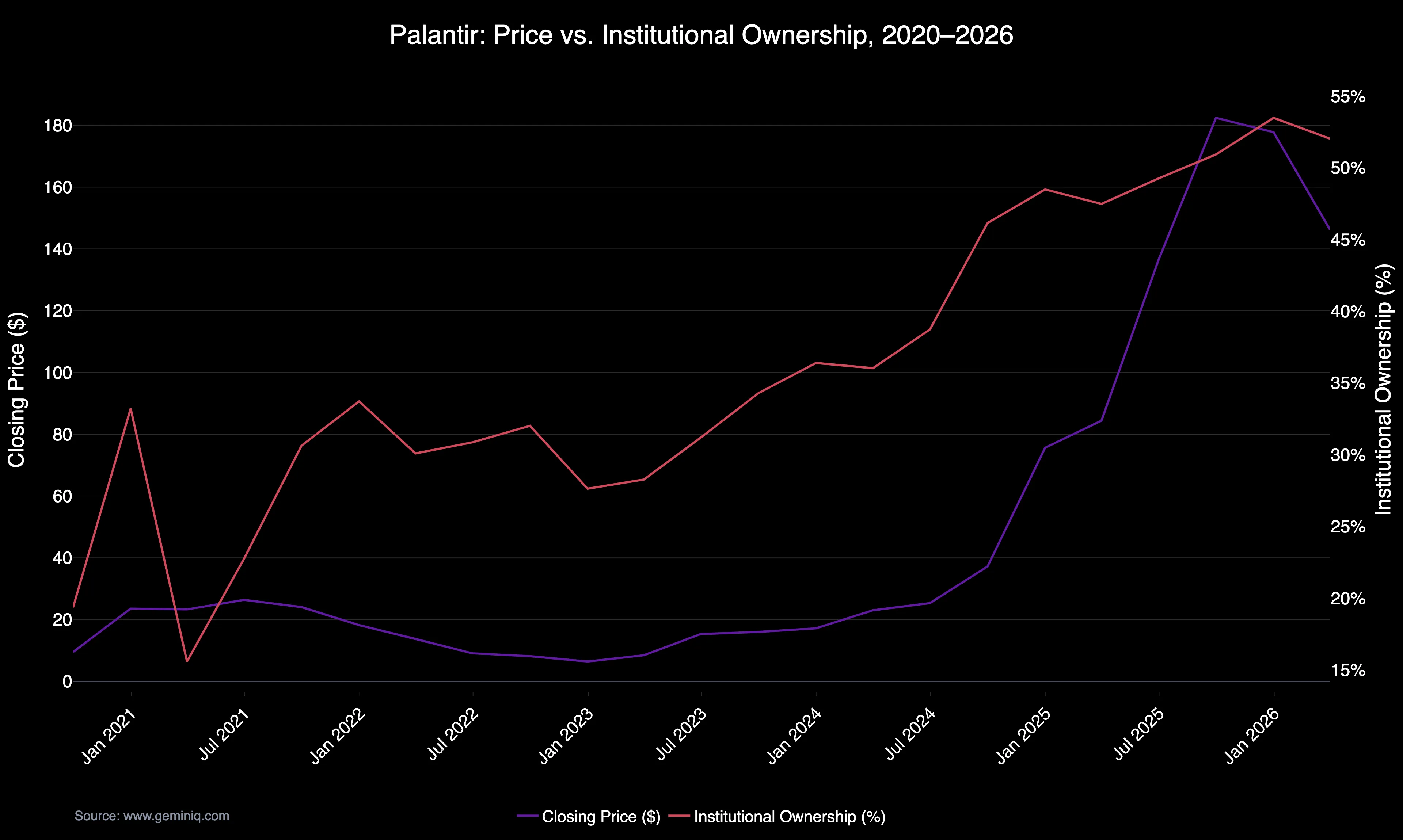
Palantir is the exception on this list — the only one of the three where institutional ownership moved in the same direction as the stock for almost the entire run, not against it or behind it.
The Filing Data: From the quarter ended March 2023 ($8.45) through the quarter ended September 2025 ($182.42), Palantir's stock rose more than twentyfold. Institutional ownership rose alongside it nearly every quarter: 28.27% → 31.20% → 34.29% → 36.39% → 36.03% → 38.73% → 46.15% → 48.49% → 47.48% → 49.25% → 50.93%, up more than 80% over the same stretch.
The Signal: This isn't a front-run — ownership was still climbing as the stock did, not ahead of it. But it's the closest thing on this list to institutions correctly reading a story as it developed and building into it consistently, rather than being caught flat-footed or bailing early.
Did Institutional Ownership Predict Any of These Runs?
None of the three runs in this piece show institutions getting ahead of the move — the pattern that's supposed to justify calling 13F data "smart money." Tesla's ownership share collapsed during the sharpest part of its 2020 rally. NVIDIA's ownership bottomed the quarter before its AI-era climb began, then only partially rebuilt. Only Palantir shows anything like sustained conviction, and even there it's concurrent with the run, not predictive of it.
If there's a single honest takeaway across all three, it's that 13F filings are a quarterly, lagged record of what institutions already did, not a forward indicator of what they're about to do. The same caveat applies to insider Form 4 records: both describe a transaction that has already happened. That's worth remembering every time a headline calls a stock "institutionally favored" right before or right after it moves.
The most extreme institutional-ownership reading in GeminIQ's data isn't in this study at all: at one point aggregated 13F filings reported more GameStop shares than GameStop had issued, which is what happens when lent shares are counted twice.
Check Your Holdings
This same comparison works on anything you hold, and on anything you're screening for. Pull up a position's price history alongside GeminIQ's Institutional Ownership data and look at the relationship over time, not just the current ownership percentage. Rising ownership during a rally can mean conviction is building — or it can mean institutions are the ones paying up after the move, buying the same strength retail already bought. Falling ownership during a rally isn't automatically bearish either, as Tesla's 2020 quarter shows; sometimes it just means the move outran the institutional base entirely. The data is quarterly and lagged, always — treat every reading as a snapshot of last quarter's positioning, not a signal about next quarter's.
Frequently Asked Questions
Did institutions predict any of these three stock runs before they happened?
No. In none of the three cases did institutional ownership rise meaningfully in the quarters immediately before the run began. NVIDIA's ownership was at a multi-year low the quarter before its AI-era climb started; Tesla's was already declining before its 2020 run and kept falling through it.
Did institutions buy NVIDIA before the AI run?
No. NVIDIA's institutional ownership fell from a 2016 peak near 88% to 52.21% by the quarter ended December 2022 — a multi-year low, and the quarter immediately before the price began climbing from $27.69 (quarter ended April 2023) to $46.64 (quarter ended July 2023), up 68% in three months. Ownership then recovered alongside the move — 56.57% → 58.81% → 59.14% → 60.66% by the end of 2023 — and as of the most recent filing still hadn't reclaimed its 2016 highs. That is catch-up, not front-running. The 2016 comparison spans a period over which share count and index composition both changed materially.
Did institutions buy Palantir before the run?
Not before it — alongside it. Palantir's institutional ownership was 28.27% at the quarter ended March 2023, when the stock closed at $8.45, and rose nearly every quarter to 50.93% by the quarter ended September 2025, when it closed at $182.42. Ownership rose more than 80% while the stock rose more than twentyfold. That is the closest case on this list to institutions reading a story as it developed, but it is concurrent with the run, not ahead of it.
Does institutional ownership predict stock returns?
Not in any of the three cases in this study. Tesla's ownership share fell through the sharpest part of its 2020 rally, NVIDIA's bottomed the quarter before its AI-era climb, and Palantir's rose only in step with the move. Form 13F is a quarterly filing disclosing positions as of quarter-end, typically 45 days later, so it is a record of what institutions already did rather than a forward indicator. Three named runs are not a base rate, and this study does not attempt to establish one.
Is falling institutional ownership during a stock's rise always a bad sign?
No — Tesla's case is the clearest illustration of why it can mean the opposite. A falling ownership percentage during a sharp rally can simply mean the stock's price and shareholder base are growing faster than institutional positions are, not that institutions are selling in dollar terms.
How current is GeminIQ's institutional ownership data?
Form 13F filings are quarterly by design and disclose positions as of each quarter's end, typically 45 days after the quarter closes. This data should never be treated as live or real-time positioning.
Why doesn't this study include older, pre-2013 stock runs?
GeminIQ's 13F coverage begins in Q1 2013 across the full universe. A run whose pre-run and run-era quarters fall entirely before that date — a case confirmed and excluded while researching this piece — can't be told with this data.
Wall Street's data. Main Street's price.
Institutional terminals charge thousands a year for as-filed accuracy. GeminIQ gives you the same thing for a fraction of the cost: financials built directly from raw SEC EDGAR filings, not third-party APIs, with full XBRL traceability back to the original 10-K or 10-Q. No normalized guesswork, just calculated metrics, charts, screeners, and watchlists built on numbers exactly as the company reported them. Start researching now at GeminIQ.com.
All institutional ownership and price figures in this article are drawn via GeminIQ from the SEC filing histories of Tesla, Inc., NVIDIA Corporation, and Palantir Technologies Inc., all publicly available on SEC EDGAR. Form 13F data reflects quarter-end positions reported with a standard filing lag and should not be read as live positioning.
Disclaimer: The content in this blog is for educational and entertainment purposes only and does not constitute financial, legal, or tax advice. Investing involves risk, including the loss of principal. The views expressed are my own and not intended as financial advice or a guarantee of future performance.