
Do Stock Buybacks Reduce Share Count? The Announcement vs. Reality

By Chad Hartman
Published · Last updated
A stock buyback, or share repurchase, is when a company uses its cash to buy its own shares, reducing the number of shares held by the public so each remaining share owns a larger slice of earnings. Announcing a buyback is not the same as doing one, though: boards authorize programs far larger than they ever spend, and the share count only falls when the purchases outpace new stock issued to employees.
Intel's board has authorized $110.0 Billion in cumulative stock buybacks since the company's repurchase program began in 1990. As of the most recent 10-Q, $7.24 Billion of that capacity sits completely unused — a sum the board has already given itself permission to spend, sitting idle through a stretch in which Intel posted a trailing-twelve-month operating loss. A board authorization is a press release. Whether it turns into cash actually leaving the company, and whether the diluted share count actually falls as a result, is a separate question that only shows up months or years later in the 10-K and 10-Q — and GeminIQ's as-filed data shows those two questions get very different answers depending on which company is asked.
Do Buybacks Reduce Share Count? The Short Answer
Not always. A buyback reduces the diluted share count only if the company actually spends the money and doesn't reissue shares through equity compensation or a stock offering. A board authorization is a ceiling, not a commitment — Intel has $7.24 Billion approved and unspent, and Boeing's diluted share count is now higher than before its buyback era began.
How This Study Was Built
This study traces four companies — Apple, Boeing, General Electric, and Intel — across their full GeminIQ filing histories, fiscal years 2009 through each company's most recently filed 10-K or 10-Q, filed through 2026. Board-authorized repurchase ceilings, program pause and cancellation dates, and material capital-raising events referenced below are sourced externally from each company's own SEC 8-K filings and investor disclosures, since an authorization limit or a stock offering is a footnote and press-release fact rather than a discrete XBRL tag; every dollar actually spent and every share count figure below is read directly from GeminIQ's as-filed 10-K and 10-Q extraction. No forward-return data is used in this study — the question here is spend versus authorization, not price reaction.
What Full Execution Looks Like: A $90 Billion Program Spent Down in About a Year
Every comparison needs a baseline for what full execution looks like. Apple is the illustration here, not the subject — the subject is execution.
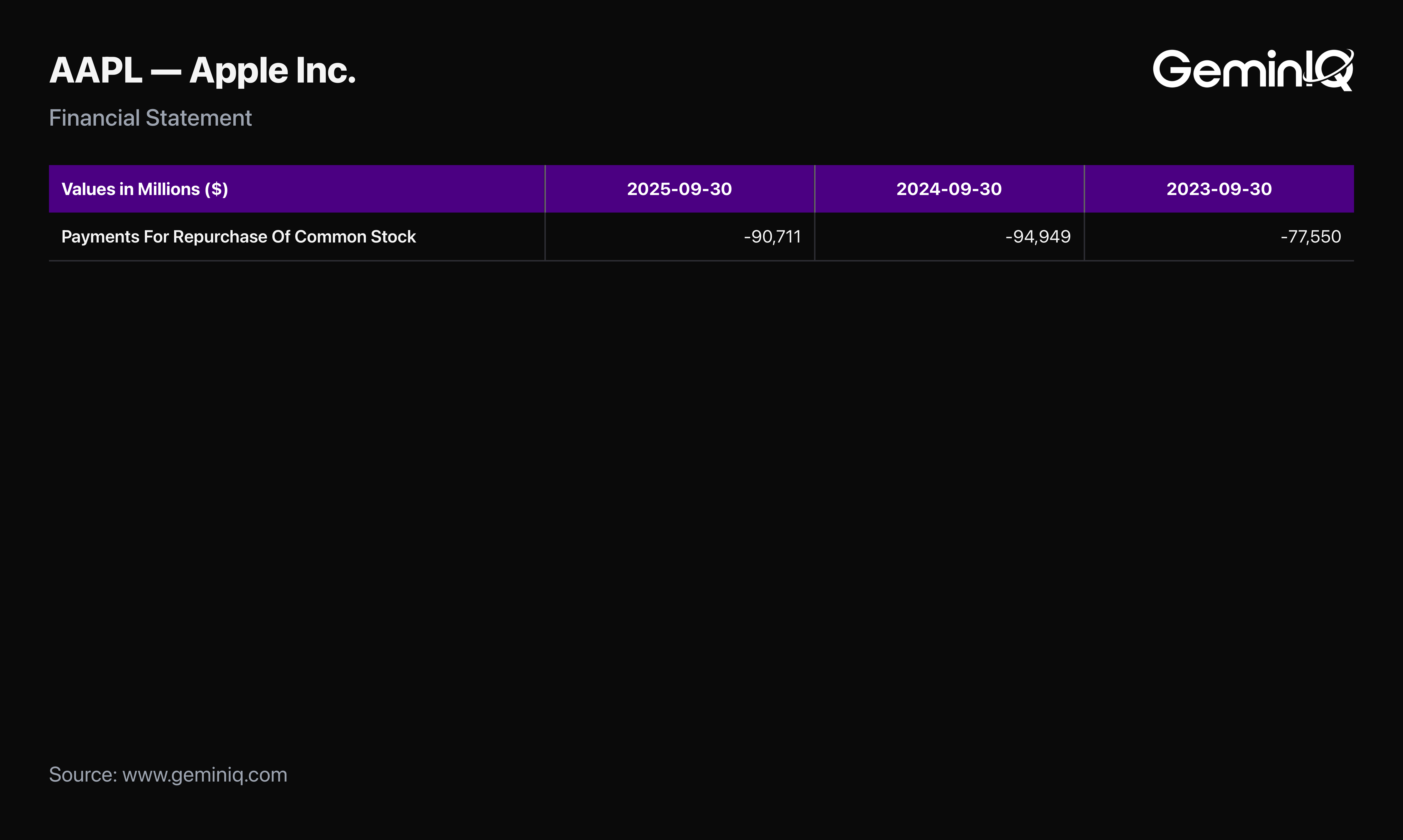
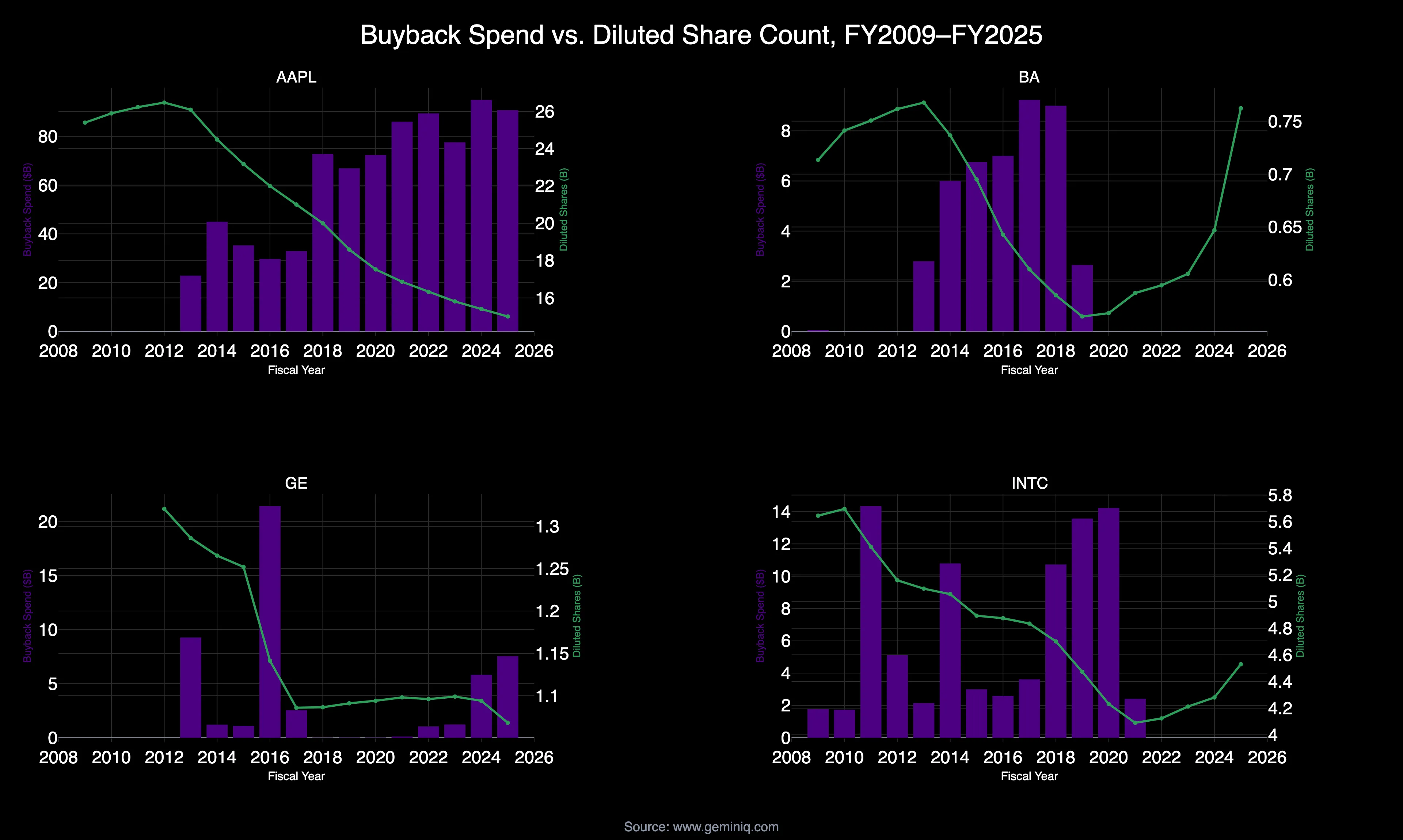
The Filing Data: Apple's board approved a $90 Billion program in May 2023; by the following June, only $4.1 Billion remained unused, and the board authorized a fresh $110 Billion program in May 2024 while the prior one still had capacity left. The cash flow statement matches the authorizations: Payments For Repurchase Of Common Stock runs $94.949 Billion in FY2024 and $90.711 Billion in FY2025. Diluted shares fall in lockstep — 26.087 Billion at the close of FY2013 to 15.005 Billion at the close of FY2025, a decline of 42.5% with no single year of reversal.
The Signal: An authorization spent down to $4.1 Billion inside about a year, replaced before it ran dry, is what zero gap between announcement and reality looks like. It is the standard the other three companies below get measured against — and none of them meet it.
Boeing: $20 Billion Authorized in 2018, Terminated Outright in 2020
Boeing ran one of the most aggressive buyback programs of the last decade — then walked away from it so completely that the board didn't just pause the authorization, it terminated it.
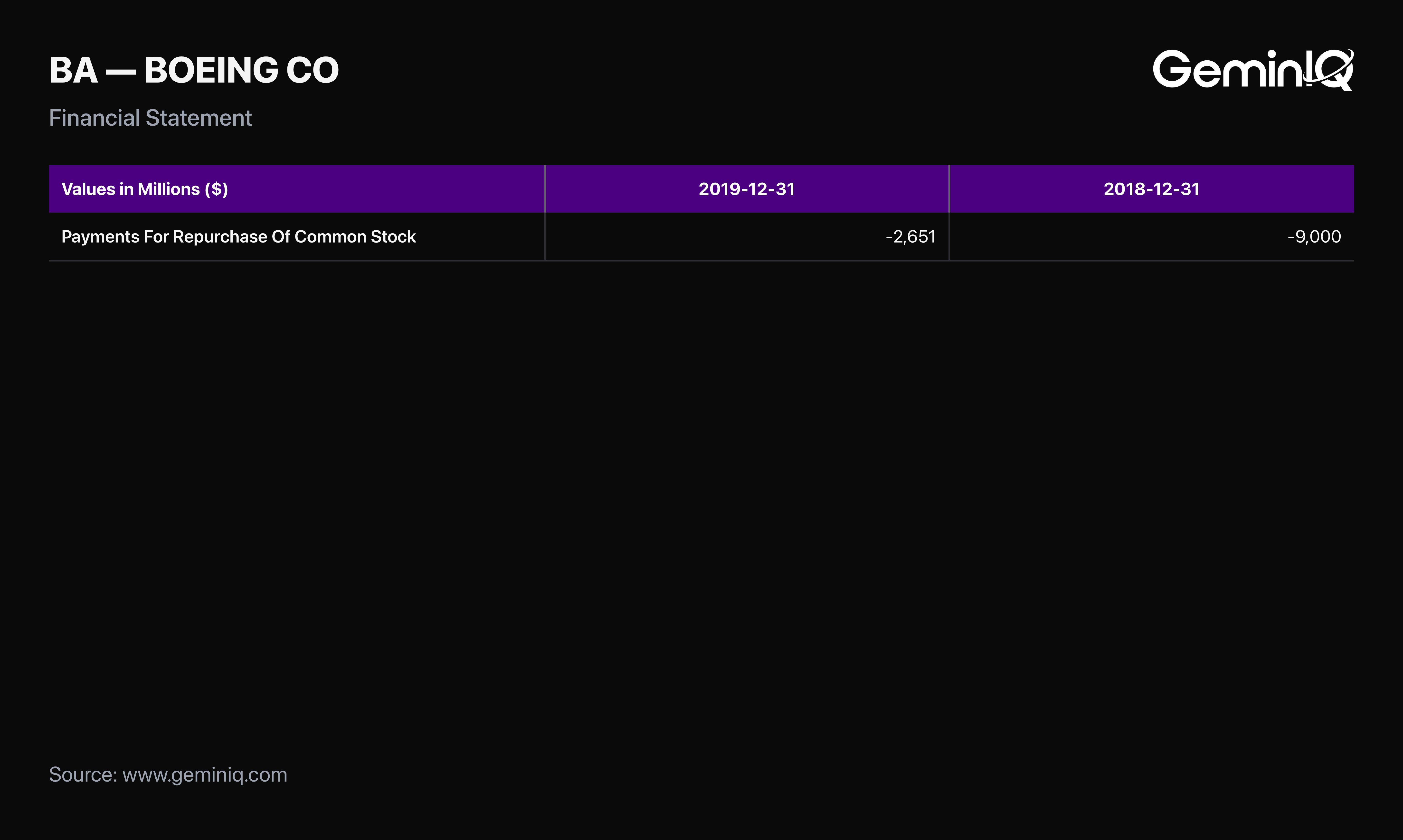
The Filing Data: Boeing's 10-K reports Payments For Repurchase Of Common Stock climbing from $2.801 Billion in FY2013 to $9.236 Billion in FY2017 and $9.0 Billion in FY2018 — a cumulative $43.441 Billion spent from FY2013 through FY2019. In December 2018, the board approved a fresh $20 Billion repurchase authorization, replacing the prior one. Four months later, in April 2019, the company paused the program entirely following the 737 MAX groundings. FY2019's filed spend came in at just $2.651 Billion — a fraction of the prior year's pace, cut short mid-year. On March 21, 2020, Boeing's board didn't just extend the pause: it formally terminated the authorization outright, per the company's own 8-K. Payments For Repurchase Of Common Stock is absent from Boeing's 10-K in every fiscal year from FY2020 through FY2025 — six consecutive years of zero.
The Signal: Diluted shares bottomed at 565.4 Million in FY2019, down 20.7% from 713.4 Million at the start of the buyback era in FY2009. The count crept up only modestly through FY2023, reaching 605.8 Million — mostly the ordinary drift of equity compensation with the buyback line at zero. Then, in October 2024, Boeing priced a public offering of 112.5 Million common shares to raise $21.1 Billion, shoring up its balance sheet amid a seven-week labor strike and a threatened credit downgrade — a fresh crisis, unconnected to the 737 MAX grounding that killed the buyback five years earlier. Diluted shares jumped to 762.3 Million by FY2025, 6.9% above where the count stood before the entire FY2013–FY2019 buyback era began. The $20 Billion authorization never ran dry. It was cancelled with room still on it, and the shares it retired came back through a doorway the original announcement never mentioned.
General Electric: $50 Billion Authorized, $20.9 Billion Never Spent
General Electric announced one of the largest buyback commitments of the decade in 2015. Three years later, its own CEO admitted most of it wouldn't be used.
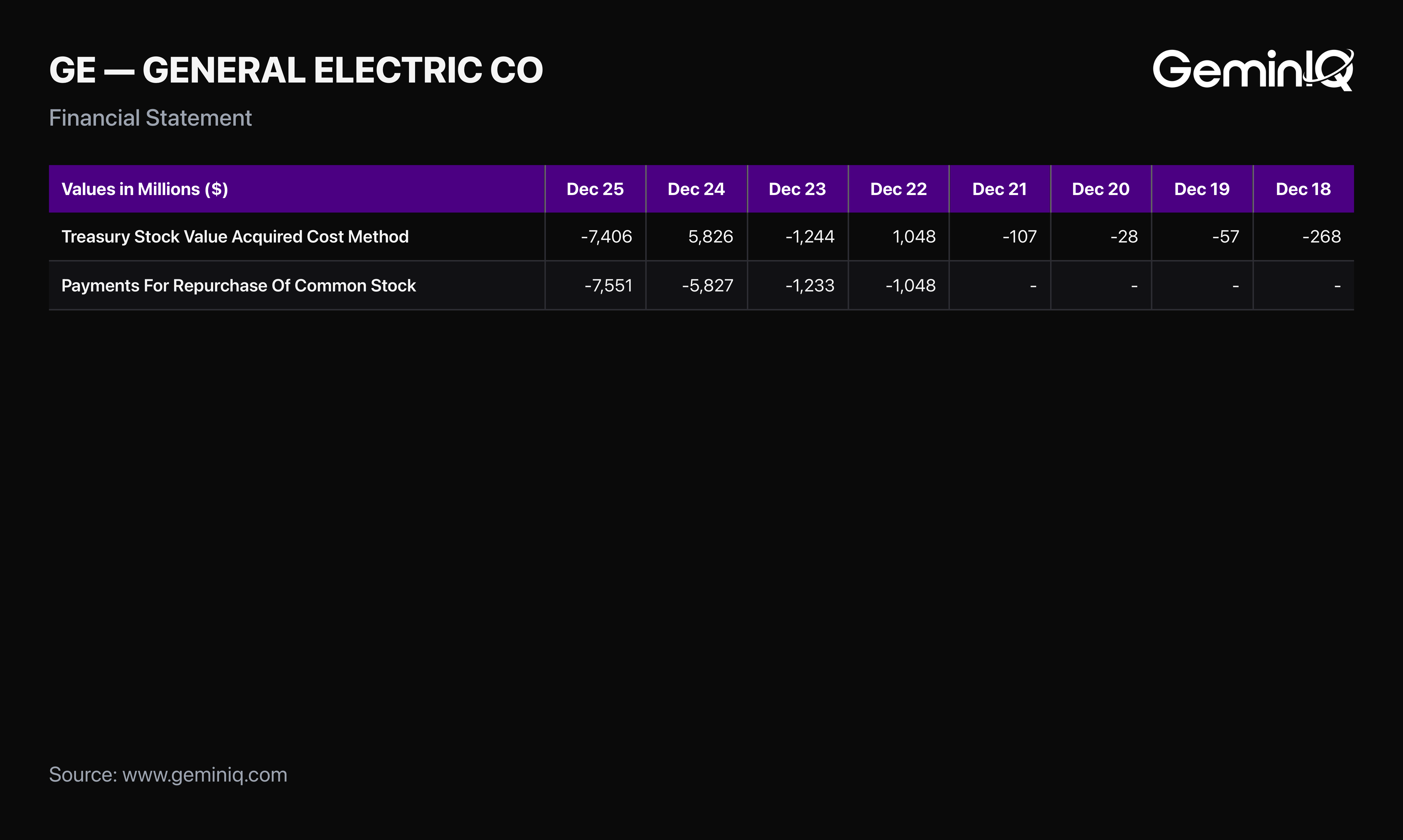
The Filing Data: GE's 10-K reports $21.429 Billion under Proceeds From Repurchase Of Equity in FY2016 alone. That spending followed an October 2015 board authorization of $50 Billion in buybacks, part of a $90 Billion total shareholder-return commitment tied to the sale of GE Capital's financing businesses. By 2018, roughly $20.9 Billion of that $50 Billion authorization remained unused, and CEO John Flannery told investors the company was "not anticipating much" further buyback activity. GeminIQ's filed data confirms the retreat: Treasury Stock Value Acquired Cost Method shows just $268 Million in FY2018, $57 Million in FY2019, $28 Million in FY2020, and $107 Million in FY2021 — four straight years where the authorized capacity barely moved. Payments For Repurchase Of Common Stock doesn't reappear as a meaningful figure until FY2024's $5.827 Billion and FY2025's $7.551 Billion, following the split of GE into GE Aerospace, GE Vernova, and GE HealthCare.
The Signal: Diluted shares fell from 1.3205 Billion in FY2012 to 1.086 Billion in FY2017 — a real 17.8% reduction during the years the $50 Billion program was actually being spent. Then the share count went essentially flat for six years, closing FY2023 at 1.099 Billion, marginally higher than FY2017 despite a still-open authorization with billions of dollars of room left. The number the board announced in 2015 wasn't fake. It just stopped being acted on the moment the company's larger business hit real trouble, and the filings — not the original press release — are the only place that shows up.
Intel: $7.24 Billion of Authorized Buybacks Still Unspent
Intel's case is the one still unfolding in real time. The gap between what's authorized and what's spent isn't a historical footnote — it's on the books right now.
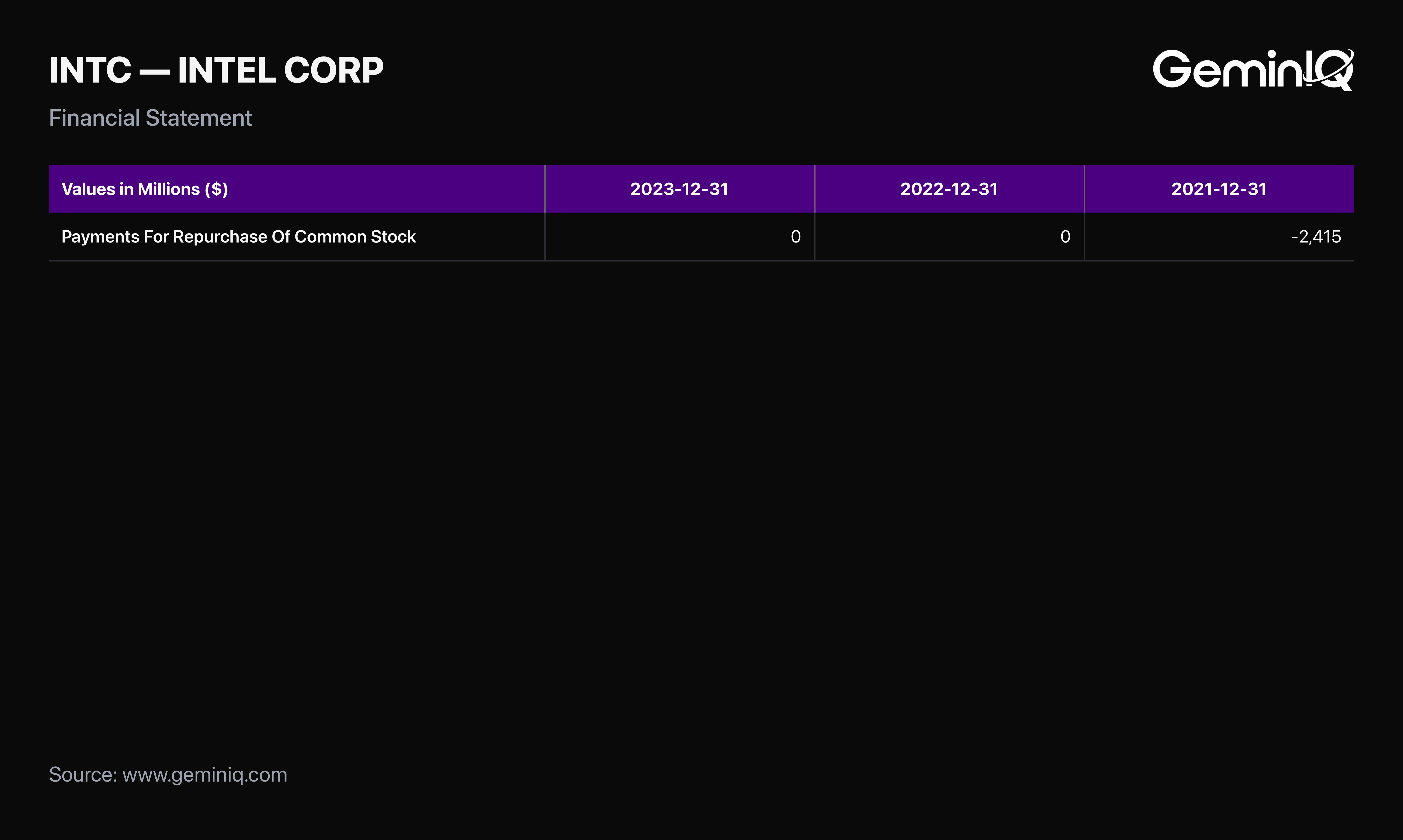
The Filing Data: Intel's 10-K reports Payments For Repurchase Of Common Stock at $13.576 Billion in FY2019 and $14.229 Billion in FY2020 — a five-year stretch, FY2019 through FY2023, totaling $30.220 Billion in filed repurchase spend. Then the figure collapses: $2.415 Billion in FY2021, an explicit $0 in both FY2022 and FY2023, and the line item absent entirely from the FY2024 and FY2025 10-Ks. Intel's own disclosures show the company is authorized to repurchase up to $110.0 Billion cumulatively since the program's 1990 start. Of that, $7.24 Billion remained available as of the most recent 10-Q — capacity the board has approved and the company simply isn't using, in the same stretch this GeminIQ series has already shown produced a negative trailing-twelve-month Free Cash Flow figure.
The Signal: Diluted shares fell from 5.645 Billion in FY2009 to 4.090 Billion in FY2021 — a 27.6% reduction across the aggressive-spending years. From that FY2021 trough, the count has since climbed back to 4.530 Billion by FY2025, a 10.8% increase with the buyback line at zero and equity compensation still issuing new shares underneath it. The turnaround narrative and the AI-era struggles both got covered separately by the standard financial press — but the footnote showing $7.24 Billion in board-approved buyback capacity sitting untouched, while the share count quietly climbs back toward where it started, didn't make either story.
Authorization vs. Execution: All Four Companies Compared
| Company | Ticker | Authorization | Filed Spend | Unspent / Status | Diluted Shares | Net Change |
|---|---|---|---|---|---|---|
| Apple | AAPL | $90 Billion (May 2023), replaced by $110 Billion (May 2024) | $94.949 Billion (FY2024); $90.711 Billion (FY2025) | $4.1 Billion left when the board replaced it | 26.087 Billion (FY2013) → 15.005 Billion (FY2025) | -42.5% |
| Boeing | BA | $20 Billion (December 2018) | $2.651 Billion (FY2019); $0 in FY2020–FY2025 | Terminated outright March 21, 2020 with room still on it | 713.4 Million (FY2009) → 762.3 Million (FY2025) | +6.9% |
| General Electric | GE | $50 Billion (October 2015) | $21.429 Billion (FY2016); $28 Million (FY2020) | ~$20.9 Billion still unused as of 2018 | 1.3205 Billion (FY2012) → 1.086 Billion (FY2017) → 1.099 Billion (FY2023) | -17.8% to FY2017, then flat |
| Intel | INTC | $110.0 Billion cumulative since 1990 | $30.220 Billion (FY2019–FY2023); $0 in FY2022 and FY2023 | $7.24 Billion unspent as of the most recent 10-Q | 5.645 Billion (FY2009) → 4.090 Billion (FY2021) → 4.530 Billion (FY2025) | -27.6% to FY2021, then +10.8% |
Line all four up and the pattern isn't that buybacks are fake. Apple proves they aren't — a board can authorize a number and burn through nearly all of it within about a year, then do it again. The pattern is that an authorization is a ceiling, not a commitment, and the distance between the two only shows up in a filing that arrives long after the press release stopped generating headlines.
Boeing's $20 Billion authorization died with room still on it the moment a crisis hit. GE's $50 Billion promise went mostly quiet for four years the moment the broader business did. Intel's $7.24 Billion is sitting unused right now, in filings anyone can read this quarter. In every one of these three cases, the diluted share count eventually moved in the opposite direction from what the original announcement implied — not because the buyback was a lie when it was announced, but because nobody was still checking the follow-through once the headline faded.
Check Your Holdings
This is a check you can run on anything you own in a few minutes, and it doesn't require trusting the last buyback press release you read. Pull up the company's most recent 10-K or 10-Q and find the stock repurchase footnote — it discloses the total authorized amount and how much remains available, by regulation. Then open the Cash Flow Statement and find Payments For Repurchase Of Common Stock (or the equivalent repurchase-related tag the filer actually uses) for the last several fiscal years. If the remaining authorization is large and growing while the cash flow statement shows little or nothing being spent against it, that's not a violation of anything — but it does mean the buyback story investors may still be pricing in isn't the one currently showing up in the filings. Compare that trend against the diluted share count on the Balance Sheet or Income Statement footnotes across the same years: a rising share count next to an unused authorization is the clearest sign the announcement and the reality have quietly parted ways. The authorization footnote lives in the filing itself rather than in a normalized data field, which is one of the differences covered in our comparison with BamSEC.
Frequently Asked Questions
Does a buyback always reduce shares outstanding?
No. A repurchase only reduces the diluted share count if the cash is actually spent and nothing reissues the shares afterward. Boeing spent $43.441 Billion from FY2013 through FY2019 and still ended FY2025 with 762.3 Million diluted shares — 6.9% more than it had in FY2009 — because the program was terminated and the company later sold 112.5 Million new shares.
How much of a buyback authorization actually gets spent?
It varies from nearly all of it to almost none. Apple ran a $90 Billion authorization down to $4.1 Billion in about a year. GE still had roughly $20.9 Billion of a $50 Billion authorization unused three years after announcing it, and Intel has $7.24 Billion available today with $0 of filed repurchase spend in FY2022 and FY2023. The authorized figure is a ceiling, not a forecast.
Can a company cancel a buyback program after announcing it?
Yes, and it doesn't require shareholder approval. Boeing's board paused its $20 Billion authorization in April 2019 after the 737 MAX groundings and formally terminated it on March 21, 2020, per the company's own 8-K. The cancellation shows up in a filing; the original authorization showed up in a press release.
Why did my share count go up despite a buyback?
Because repurchases are only one side of the ledger. Equity compensation issues new shares continuously, and a capital raise can issue them in a single event — Intel's count climbed 10.8% off its FY2021 trough with the buyback line at zero and comp still running underneath it. When issuance is the dominant force rather than the exception, that is the pattern we ranked in companies that dilute shareholders.
Which companies actually reduced their share count the most?
Not the ones with the biggest announcements. We ranked the decade's genuine share-count reducers from as-filed 10-K data in companies reducing share count — the leaderboard is dominated by runoff insurers and capital-return specialists rather than the megacaps that dominate buyback headlines.
How does a stock buyback work?
The board authorizes a maximum dollar amount, and the company then buys its own shares over time, usually on the open market, sometimes through a tender offer or an accelerated repurchase agreement with a bank. Repurchased shares are either retired or held as treasury stock, and either way they no longer count as outstanding.
Do I lose my shares in a buyback?
No. An open-market buyback only buys shares from investors who choose to sell. If you keep your shares, you own a slightly larger percentage of the company afterward. Only in a tender offer are shareholders asked directly, and even then participation is voluntary.
Is a stock buyback a good thing?
It depends on the price and the funding. A buyback adds value when the stock is bought below its intrinsic value with cash the business does not need. It destroys value when the company overpays, borrows to fund it, or simply offsets shares issued as stock-based compensation, which leaves the share count flat.
Is there a tax on stock buybacks?
Yes. Since 2023, US public companies pay a 1% excise tax on the net value of shares they repurchase in a year, reduced by the value of new shares they issue. The tax is paid by the company, not by shareholders who sell.
Wall Street's data. Main Street's price.
Institutional terminals charge thousands a year for as-filed accuracy. GeminIQ gives you the same thing for a fraction of the cost: financials built directly from raw SEC EDGAR filings, not third-party APIs, with full XBRL traceability back to the original 10-K or 10-Q. No normalized guesswork, just calculated metrics, charts, screeners, and watchlists built on numbers exactly as the company reported them. Start researching now at GeminIQ.com.
Data Appendix: Filed buyback spend and diluted share count figures for Apple, Boeing, General Electric, and Intel are drawn from each company's as-filed 10-K and 10-Q filings, fiscal years 2009 through the most recent filing period, publicly available on SEC EDGAR. Board-authorized repurchase amounts, program pause/cancellation dates, and Boeing's October 2024 common stock offering are sourced from each company's SEC 8-K filings and investor disclosures rather than GeminIQ's own extracted dataset, since these are not filed as discrete XBRL facts. Methodology: How GeminIQ Builds a Filing Data Study.
Disclaimer: The content in this blog is for educational and entertainment purposes only and does not constitute financial, legal, or tax advice. Investing involves risk, including the loss of principal. The views expressed are my own and not intended as financial advice or a guarantee of future performance.