
Companies Reducing Share Count: The Decade's Real Cannibals

By Chad Hartman
Published · Last updated
Every investor can name a "buyback stock." Far fewer can name a company that actually shrank itself. Those are different things, and the gap between them is the whole story. A company can spend tens of billions repurchasing shares and end the decade with more shares outstanding than it started with, because stock-based compensation quietly issued them back. The only way to know who genuinely retired stock is to read the as-filed diluted share count in the 10-K, year by year, and watch where it actually ends up. We did that for the entire filing universe. The result overturns the popular list of "great capital allocators" — and reveals a base rate almost nobody talks about.
This is a GeminIQ Filing Data Study. The universe is every company with a 10-K in each fiscal year from 2015 through 2024 — 2,076 firms with a complete, rankable diluted-share history, drawn from 3,054 filers with at least one 10-K in the window. Every figure is the as-filed Weighted Average Number Of Diluted Shares Outstanding pulled directly from SEC EDGAR XBRL, split-adjusted, taken at its latest restated vintage for each fiscal year. Buyback and comp figures are the as-filed Payments For Repurchase Of Common Stock and Share Based Compensation. Post-filing returns are the 12-month cumulative move from each 10-K's filed date. No aggregator sits in between. The cleaning rules and excluded names are documented in the Data Appendix.
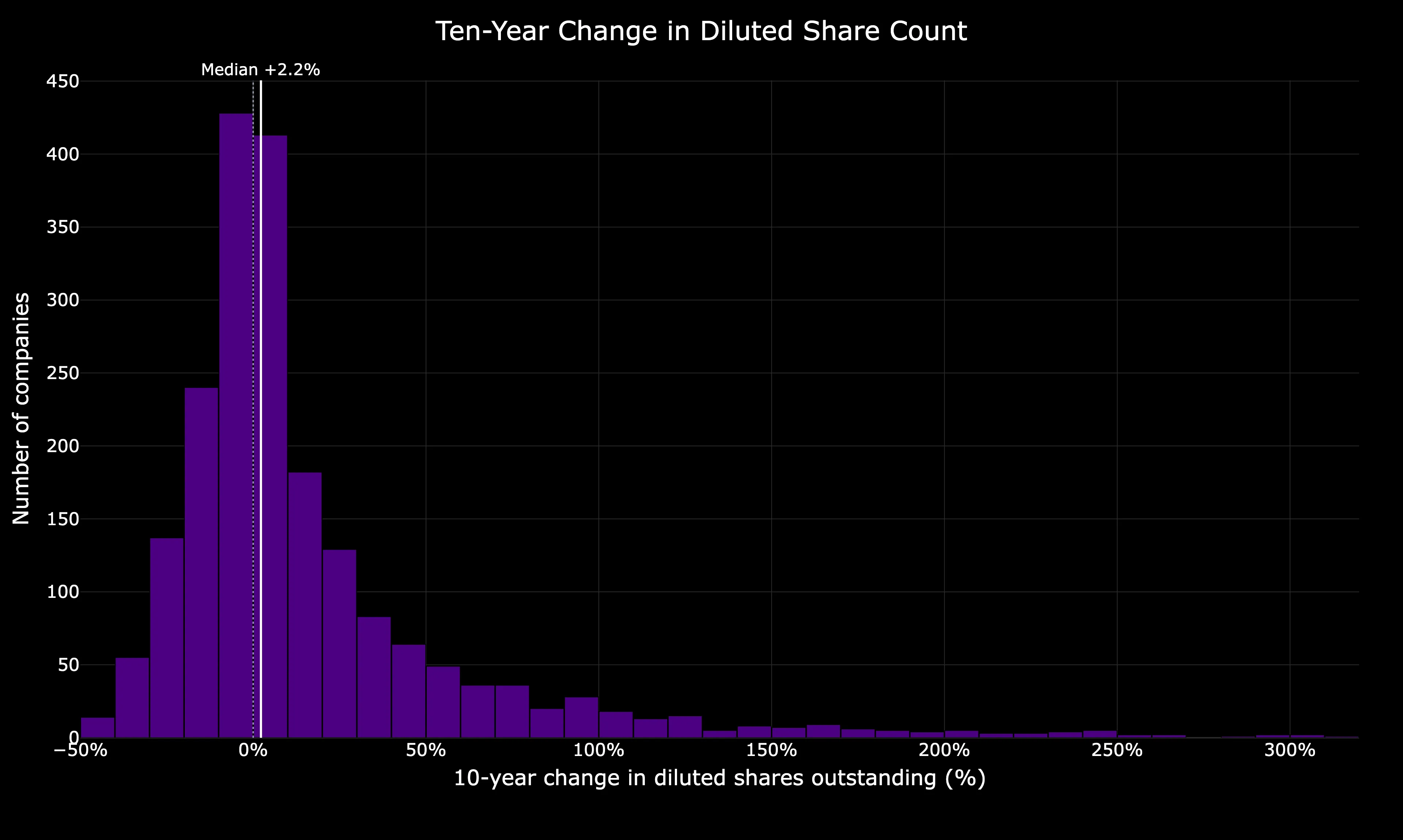
The Base Rate: The Median Company Grew Its Share Count +2.2%
Start with the base rate, because it reframes everything that follows. Across all 2,076 companies, the median ten-year change in diluted share count was +2.2%. The typical public company did not shrink over the decade. It grew its share count. Buybacks are constant news; net share-count reduction over ten years is the exception, not the norm. Against that baseline, here are the companies that actually did it — the decade's real cannibals.
The Leaderboard: 12 Companies That Cut Share Count 48.9% to 63.8%
| Rank | Company | Business Type | 10-Yr Diluted Share Change | 10-Yr Buyback | SBC as % of Buyback |
|---|---|---|---|---|---|
| 1 | MBIA | Bond insurer in runoff | -63.8% | $1.14B | 0% |
| 2 | Navient | Student-loan servicer winding down | -61.8% | $4.69B | 5% |
| 3 | AutoNation | Operating business | -56.7% | $7.04B | 4% |
| 4 | Avis Budget | Operating business | -55.6% | $7.21B | 3% |
| 5 | Assured Guaranty | Capital-return machine | -55.6% | $4.50B | 0% |
| 6 | Dillard's | Department stores | -55.0% | $2.90B | 0% |
| 7 | DaVita | Capital-return machine | -54.5% | $11.45B | 7% |
| 8 | eBay | — | -53.4% | $37.20B | 13% |
| 9 | Sleep Number | Operating business | -51.8% | $1.51B | 10% |
| 10 | Louisiana-Pacific | Operating business | -50.4% | $3.46B | 2% |
| 11 | Synchrony | Capital-return machine (2014 spinoff) | -49.1% | $16.76B | 0% |
| 12 | White Mountains | — | -48.9% | $3.22B | 1% |
Notice who is not here. The megacap "buyback champions" that dominate financial media never crack the list. Apple, the most-cited repurchaser on earth, retired -28% of its diluted shares over the same decade — real, but roughly half the pace of every name above. The companies that shrank the hardest are not the household compounders. They are capital-return specialists, insurers, and a handful of operators willing to buy back stock relentlessly and let almost nothing leak back out through comp.
The Deepest Cutters Aren't Compounders: MBIA (-63.8%) and Navient (-61.8%)
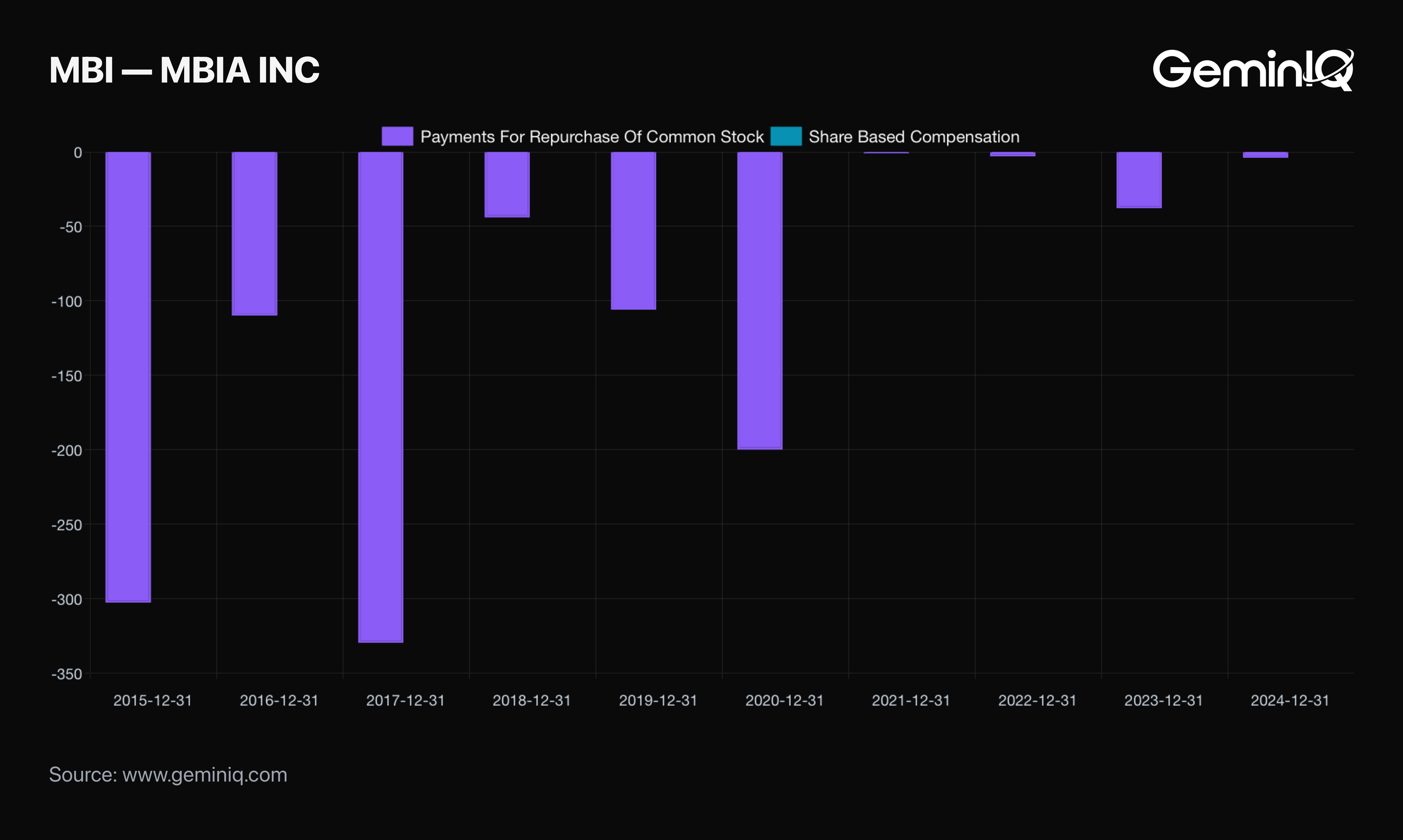
The two deepest reducers in the entire universe are MBIA at -63.8% and Navient at -61.8% — and neither is a growth compounder. MBIA is a bond insurer in runoff. Navient is a student-loan servicer winding down its legacy book. Both shrank their share counts by returning capital as the underlying business contracted, not by compounding it. The top of the board is an immediate lesson in reading filings literally.
That distinction matters, and standard financial media doesn't read the footnotes closely enough to make it. A screener sorting by share-count reduction flags MBIA as an elite capital allocator. But by pulling the raw filings via GeminIQ, the picture sharpens: MBIA spent just $1.14B on repurchases with zero stock-based compensation offsetting it, shrinking a runoff entity. The reduction is real, and entirely buyback-driven — the arithmetic of a company handing capital back as it shrinks, not the signature of a business getting bigger per share. The number is the truth; the label "compounder" would be the lie.
eBay: $37.20B, the Largest Buyback on This Leaderboard
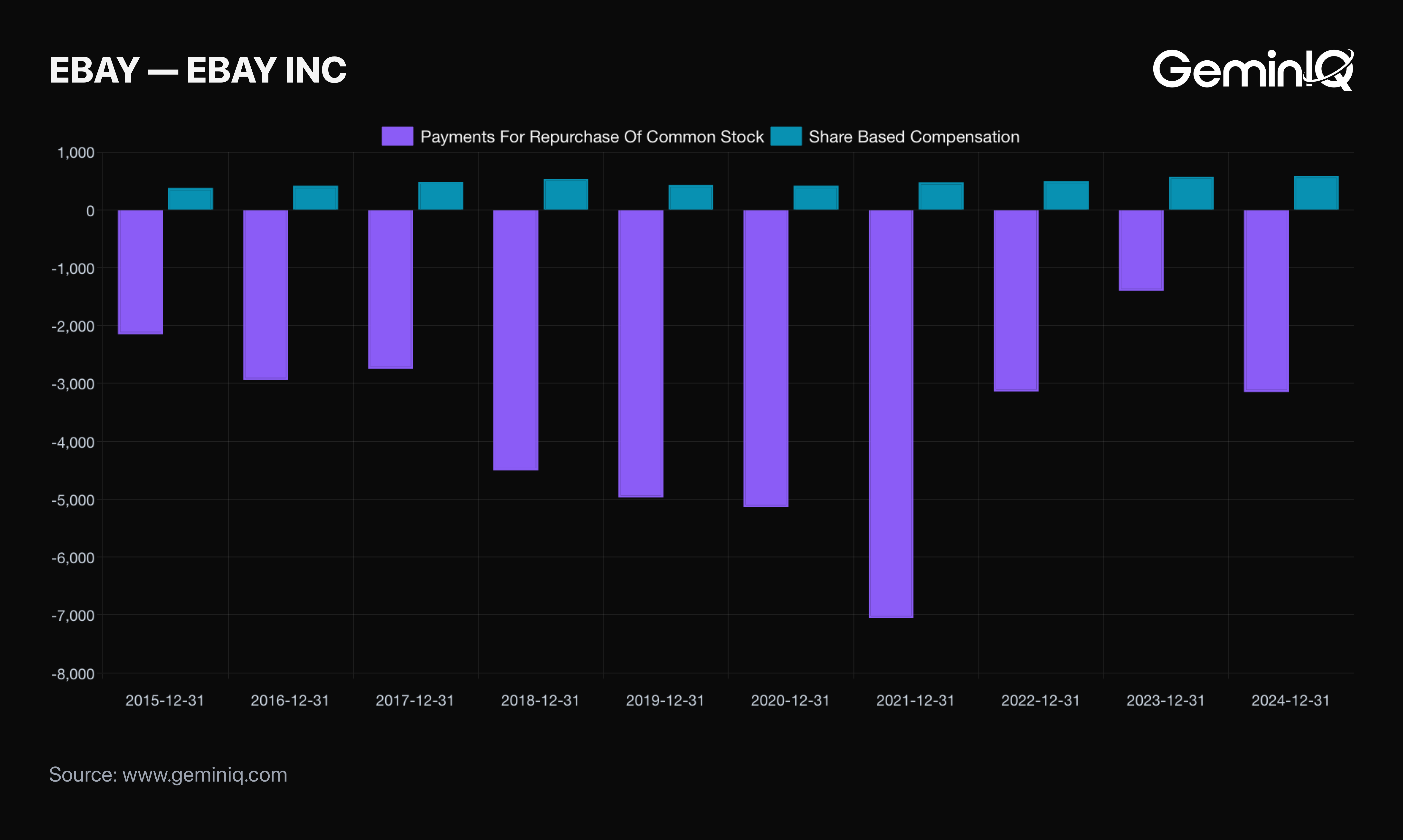
If MBIA shows that a small buyback can shrink a small company, eBay shows what genuine scale looks like. eBay spent $37.20B repurchasing stock over the decade — the largest cumulative buyback of any name on the board — and cut its diluted share count -53.4%, from over a billion shares to roughly half that.
Its Share Based Compensation ran at 13% of its buyback spend, the highest ratio on the leaderboard, and eBay still landed a top-tier reduction. The as-filed data shows how: the Payments For Repurchase Of Common Stock line stayed far ahead of the comp line, year after year. What it looks like when issuance wins that race instead is the subject of the companion study on companies that dilute shareholders.
The Capital-Return Machines: DaVita, Synchrony, and Assured Guaranty
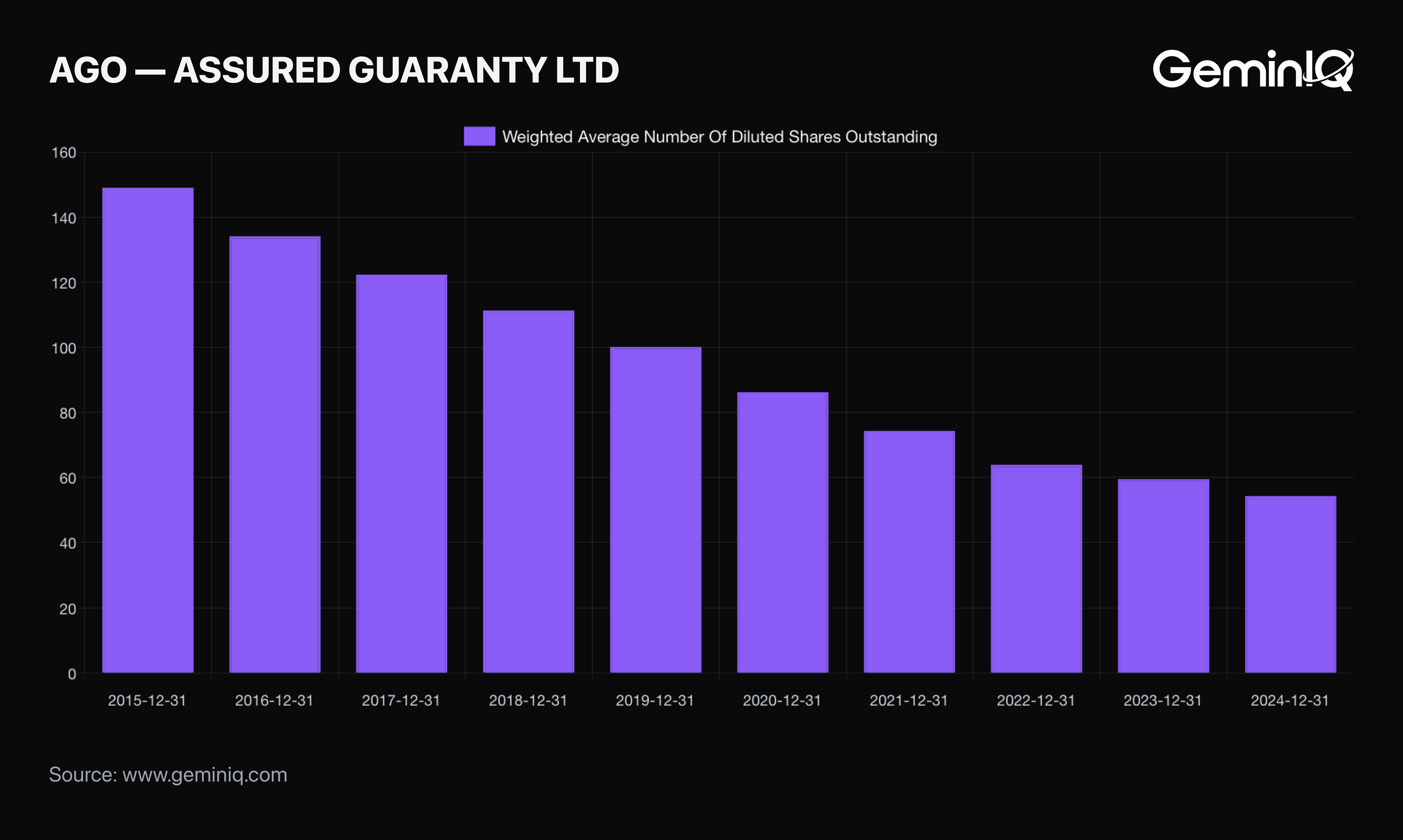
Three names on the board represent the purest form of the strategy: buy back relentlessly, issue almost nothing, let the share count fall in a straight line. DaVita spent $11.45B to cut its diluted shares -54.5%. Synchrony — a 2014 spinoff that could have spent its independence diluting shareholders — instead deployed $16.76B with zero net stock-based compensation drag, reducing its count -49.1%. And Assured Guaranty produced one of the cleanest charts in the entire study: a -55.6% reduction on $4.50B of repurchases with zero SBC, its diluted share count stepping down every single year without a single interruption.
Assured Guaranty is worth pausing on because its filing history is what a textbook cannibal looks like in raw XBRL — no acquisition spikes, no reverse-split artifacts, no comp leakage, just a monotonic decline. When a screener shows a smooth, uninterrupted fall in Weighted Average Number Of Diluted Shares Outstanding with no offsetting comp, that is the signature to trust. The tools that normalize and reclassify filing data often smooth these very lines into ambiguity; the as-filed numbers keep them sharp.
The Operating Cannibals: AutoNation, Avis Budget, Louisiana-Pacific, and Dillard's
The rest of the board is where operating businesses — companies that actually sell things — turn free cash flow into a shrinking share count. AutoNation cut -56.7% on $7.04B of buybacks; Avis Budget matched it at -55.6% on $7.21B, both concentrating enormous repurchases into the cash-rich pandemic-recovery years. Louisiana-Pacific turned an OSB-pricing windfall into a -50.4% reduction, and Sleep Number ground its count down -51.8%.
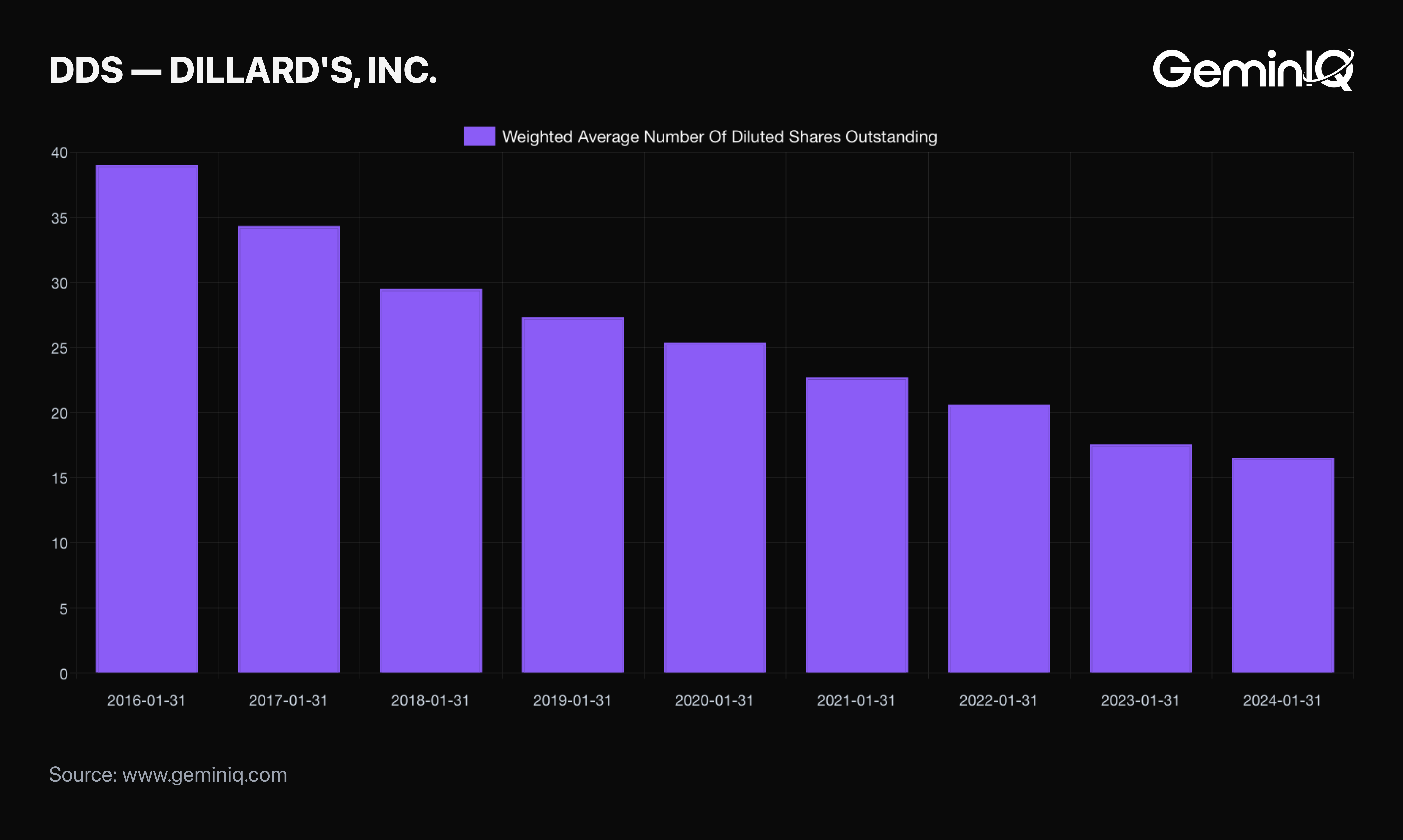
Then there is Dillard's — the department-store chain that has quietly become one of the most disciplined repurchasers in retail. Its diluted share count fell from 42.6 Million to 16.5 Million, a -55.0% reduction on $2.90B of buybacks with zero stock-based compensation. Dillard's is the operating-business version of Assured Guaranty: no comp, no games, just relentless retirement of stock, year after year. The share count tells the story the stock's quiet reputation never did.
Did the Cannibals Outperform? No — the Sample Is Too Small to Say
Across the universe, the average 10-K was followed by a +8.4% twelve-month return (median +3.0%) across 47,746 annual filings, and the twelve companies on this board scatter around that baseline rather than clustering above it — from MBIA at roughly the flat line to Dillard's well above it, with several names landing below the universe average. With only twelve companies the sample sits far below the threshold at which a post-filing return pattern becomes a finding rather than noise, so we draw no conclusion from it: deep share-count reduction is a fact about capital allocation, not a signal about next year's price.
The Method
Every figure here is the as-filed diluted share count read straight from the 10-K, split-adjusted, taken at its latest restated vintage per fiscal year, with implausible and internally inconsistent series excluded before ranking. Returns are cumulative from each filing's filed date and are never compounded. The full ruleset — base-rate adjustment, the sample-size minimum, outlier trimming — is documented in our filing data study methodology. The share-count-versus-comp dynamic behind the leaderboard is covered in more depth in stock buybacks vs. stock compensation.
Check Your Holdings
You can run this exact check on anything you own in about two minutes. Open the company in Financial Statements and pull the Weighted Average Number Of Diluted Shares Outstanding across the last decade. If it falls in a straight line, you own a genuine cannibal. If it is flat while the company reports billions in buybacks, pull the Share Based Compensation line — the comp is eating the repurchases, and you are on the treadmill, not ahead of it. Then check the number against the base rate: the median company grew its share count +2.2% over the decade, so anything meaningfully negative is already rare. The narrative around a stock will tell you it "returns capital to shareholders." The as-filed diluted share count tells you whether it actually did.
Frequently Asked Questions
Which companies reduced their share count the most from 2015 to 2024?
MBIA at -63.8% and Navient at -61.8% lead the ranking, followed by AutoNation (-56.7%), Avis Budget and Assured Guaranty (both -55.6%), and Dillard's (-55.0%). All twelve names cut their diluted share count between 48.9% and 63.8% over the decade, measured as-filed from each company's 10-K.
What is a cannibal stock?
A company that persistently buys back and retires its own shares, so that each remaining share represents a larger claim on the business. The label only earns itself in the filings: a genuine cannibal shows a falling Weighted Average Number Of Diluted Shares Outstanding year after year, not just a large repurchase line that stock-based compensation quietly offsets.
Which companies buy back the most stock?
Those are two different lists. eBay spent $37.20B — the largest cumulative buyback on this leaderboard — but Apple, the most-cited repurchaser on earth, retired only -28% of its diluted shares over the same decade, roughly half the pace of every name in the top twelve. Dollar volume and net reduction are not the same measurement.
How much does the average company's share count change?
It rises. Across all 2,076 companies with a complete FY2015–FY2024 10-K history, the median ten-year change in diluted share count was +2.2%. Net reduction over a full decade is the exception, which is why anything meaningfully negative is already rare.
Do buybacks always reduce share count?
No. A repurchase authorization is a ceiling rather than a commitment, and programs get paused, cancelled, or simply left unspent — we traced four companies' announced authorizations against what their filings actually show was spent in do buybacks reduce share count.
Wall Street's data. Main Street's price.
Institutional terminals charge thousands a year for as-filed accuracy. GeminIQ gives you the same thing for a fraction of the cost: financials built directly from raw SEC EDGAR filings, not third-party APIs, with full XBRL traceability back to the original 10-K or 10-Q. No normalized guesswork, just calculated metrics, charts, screeners, and watchlists built on numbers exactly as the company reported them. Start researching now at GeminIQ.com.
Data Appendix: Universe of 2,076 companies filing a 10-K in each fiscal year 2015-2024, drawn from 3,054 filers with at least one 10-K in the window. Diluted share counts are the as-filed Weighted Average Number Of Diluted Shares Outstanding from SEC EDGAR XBRL, split-adjusted, taken at latest restated vintage per fiscal year; ten-year change is measured on the median of the first three and last three available fiscal years to guard against a single stray vintage. Companies with an implausible (>50 billion) or internally inconsistent diluted-share series were excluded before ranking (62 companies flagged and removed). Buyback and comp figures are as-filed Payments For Repurchase Of Common Stock and Share Based Compensation. Post-filing returns are 12-month cumulative moves from each 10-K's filed date; universe base rate +8.4% mean / +3.0% median across 47,746 fiscal-year filings. Corporate-action artifacts (mergers, spinoffs, reverse splits) were vetted out of the named leaderboard by hand.
Disclaimer: The content in this blog is for educational and entertainment purposes only and does not constitute financial, legal, or tax advice. Investing involves risk, including the loss of principal. The views expressed are my own and not intended as financial advice or a guarantee of future performance.